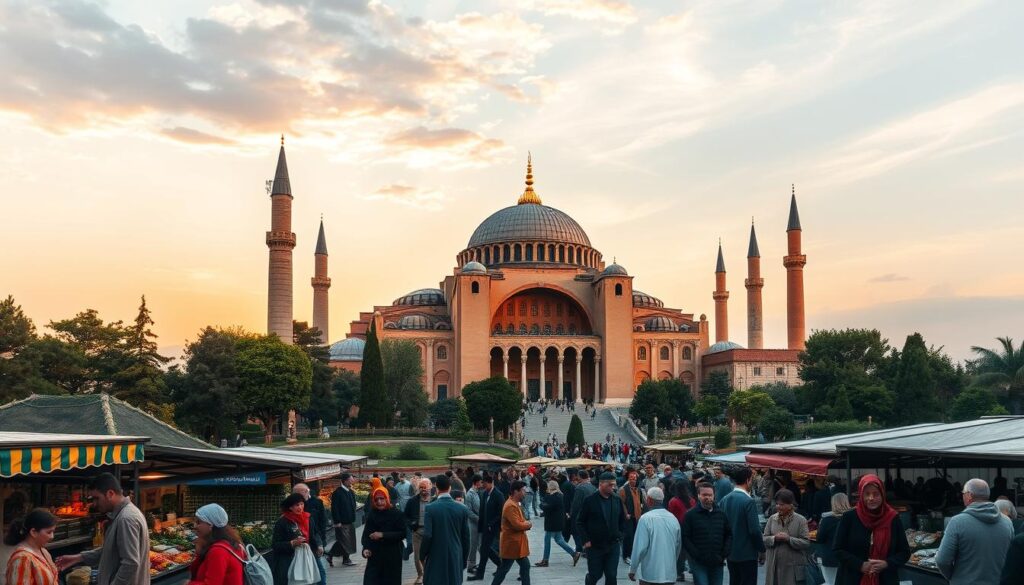
The Byzantine Empire, also known as the Eastern Roman Empire, lasted from 330 to 1453. Its history is rich and complex, spanning over a thousand years1. Constantinople, its capital, was founded by Constantine I in 330 AD2.
It played a key role in the empire’s survival and growth. The Byzantine Empire was a melting-pot society. It allowed individuals of various origins to rise in the military and civil service1.
The empire’s population reached a peak of 26,000,000 in 5653. Its currency included the Solidus, denarius, and hyperpyron3.
The history of the Byzantine Empire is fascinating. Understanding its origins and development is key to appreciating its role in world history. The Byzantine Empire was a major center of trade and culture.
Its legacy can be seen today. As you explore the Byzantine Empire’s history, you’ll discover a complex and intriguing world. It was shaped by Greek and Roman cultural influences.
Key Takeaways
- The Byzantine Empire existed from 330 to 1453.
- The empire’s capital, Constantinople, was founded by Constantine I in 330 AD.
- The Byzantine Empire was a melting-pot society with social mobility.
- The empire’s population fluctuated over the centuries, with a peak of 26,000,000 in 565.
- The Byzantine Empire’s legacy can be seen today, with its cultural and trade influences shaping the modern world.
- The empire’s currency included the Solidus, denarius, and hyperpyron.
- The Byzantine Empire survived for a thousand years after the Western Roman Empire fell1.
The Origins and Formation of the Byzantine Empire
The Byzantine Empire started from the eastern part of the Roman Empire. It lasted over a thousand years, becoming a center of culture and stability4. Its creation was shaped by strong administration and a strategic location.
Historical Context of the Eastern Roman Empire
The Eastern Roman Empire, later known as the Byzantine Empire, thrived through strong administration and wealth45. It lasted longer than many others because of good governance and adapting Roman systems to new needs.
The Role of Constantinople
Constantine I made Constantinople the new capital on May 11, 330, turning Byzantium into a bustling city5. Its location offered natural protection and control over important trade paths, leading to fast growth and cultural progress.
Key Figures in Early Byzantine History
Emperor Constantine I was key in starting the Byzantine government, ensuring stability in religion and politics4. His successors, like Theodosius I, built on this, making legal and cultural steps that shaped Byzantine society for ages5.
| Emperor | Reign | Key Achievements |
|---|---|---|
| Constantine I | 306-337 | Founded Constantinople, established Christianity |
| Theodosius I | 379-395 | Made Christianity the state religion, divided the Roman Empire |
| Justinian I | 527-565 | Expanded territories, codified laws (Corpus Juris Civilis) |
Cultural Achievements of the Byzantine Empire
The Byzantine Empire had a rich Byzantine culture that greatly influenced the world. It mixed Greco-Roman traditions with Christian beliefs. This blend created a unique society.
Byzantine Art and Architecture
Byzantine art is famous for its detailed mosaics and iconic religious images. These Byzantine art pieces showed Christian themes. They combined classic beauty with spiritual meaning.
The empire’s buildings, like the Hagia Sophia, show the beauty of Byzantine architecture. Built in Constantinople during Justinian’s time, the Hagia Sophia is a masterpiece6.
Literature and Education
The Byzantines played a key role in saving ancient Greek and Roman texts. Their work kept these texts alive during hard times. They also helped create new types of literature.
- Preservation of classical texts
- Development of illuminated manuscripts
- Advancements in educational institutions
Religious Influence on Culture
Orthodox Christianity deeply shaped Byzantine culture. It influenced art, literature, and everyday life. The mix of old pagan and new Christian ideas made a unique culture.
“The integration of faith and art in Byzantium created timeless masterpieces that continue to inspire.”6
| Category | Description |
|---|---|
| Byzantine Art | Intricate mosaics and religious icons blending classical and Christian themes |
| Byzantine Architecture | Architectural marvels like the Hagia Sophia with innovative dome structures |
| Literature | Preservation and creation of classical and new literary works |
| Religion | Orthodox Christianity’s impact on all facets of cultural life |
Political Structure and Governance
The Byzantine government was complex and helped the empire last over a thousand years. At its heart was the emperor’s absolute power. A detailed bureaucracy managed all aspects of the empire.
Byzantine Emperors and Their Roles
Byzantine emperors were seen as divine rulers, carrying God’s authority on earth. This divine right was shown in grand court ceremonies and the emperor’s central power7. They were not just rulers but also the spiritual leaders of the Orthodox Church, making them supreme.
The Administration of the Empire
The Byzantine Empire’s administration was well-organized. It was divided into four prefectures, each run by a Praetorian Prefect. They handled administrative, fiscal, and judicial tasks8.
The empire had 12 dioceses and over 100 provinces. Each was overseen by governors and city councils. Important ministers, like the quaestor sacripalatii and magister officiorum, were key to the empire’s smooth operation8.
Military Strategies and Defense
The Byzantine military was key to defending the empire’s vast lands. Emperor Heraclius reorganized the governance into themes. These were large provinces governed by military leaders who also handled civil duties8.
This system allowed for quick military action and effective defense. It helped keep the Byzantine state stable and long-lasting7.
The Decline and Fall of the Byzantine Empire
The Byzantine Empire faced many challenges that led to its downfall. These issues weakened the empire, making it easy to conquer. They also changed its economy and religion.
Internal Challenges and Conflicts
Political instability was a big problem, with 13 emperors ruling from 1025 to 10819. The economy was also under strain, leaving less money for defense and services. Religious conflicts, like the schism of 1054, made unity hard to keep.
The Impact of External Forces
External threats were a major factor in the empire’s decline. The rise of the Seljuk Turks and the Ottoman Empire was a big challenge9. The Battle of Manzikert in 1071 was a major loss for the empire9. The Crusades also took away resources, weakening the empire’s defenses.
The Legacy of the Byzantine Empire
Even though it fell on May 29, 1453, the Byzantine Empire’s legacy lives on9. Its religion shaped Christian practices and church structures. The Byzantine economy’s trade networks and money systems laid the groundwork for today’s economy. Byzantine art, law, and culture also continue to inspire us, showing the empire’s lasting impact.
FAQ
What was the Byzantine Empire and why is it significant in world history?
The Byzantine Empire was the Eastern Roman Empire’s continuation. It lasted over a thousand years. It kept classical knowledge alive, shaped Christian traditions, and influenced both East and West with its Greek and Roman mix.
How did the Byzantine Empire evolve from the Roman Empire?
The Byzantine Empire started from the Roman Empire’s eastern half as the west fell. Emperor Constantine I founded Constantinople. It kept Roman ways but also had its own culture and rules.
What was the role of Constantinople in the Byzantine Empire?
A: Constantinople was the Byzantine Empire’s capital. It was at the crossroads of Europe and Asia. Its strong walls and location made it a hub for trade, defense, and culture.
Who were some key figures in the early Byzantine history?
Key figures were Emperor Constantine I and Theodosius I. They helped shape the early Byzantine state. Their leadership was key in the empire’s early years.
What are some examples of Byzantine art and architecture?
Byzantine art is famous for its detailed mosaics, icons, and manuscripts. It mixed Greco-Roman styles with Christian symbols. The Hagia Sophia is a masterpiece of Byzantine architecture, known for its domes and decorations.
How did Orthodox Christianity influence Byzantine culture?
A: Orthodox Christianity deeply influenced Byzantine culture. It shaped art, literature, and daily life. Religious themes were common in art, and theology guided the empire’s culture and society.
How was the Byzantine government structured?
The Byzantine government was complex, based on Roman systems. It had many administrative roles and a strict hierarchy. The emperor had the most power, seen as having a divine right to rule.
What was the role of the Byzantine emperors?
A: Byzantine emperors were key in politics and religion. They ruled with absolute power, led ceremonies, and were seen as divine leaders. They mixed secular and sacred roles.
How did the Byzantine Empire defend its territories?
The Byzantine military was well-organized and used advanced tactics. It had strong defenses like Constantinople’s walls. This helped the empire face many threats and last long.
What factors contributed to the decline and fall of the Byzantine Empire?
The decline was due to internal issues like political instability and economic troubles. External threats from the Seljuk Turks and Ottoman Empire also played a part. The Crusades weakened the empire, leading to the fall of Constantinople in 1453.
What is the legacy of the Byzantine Empire today?
The Byzantine Empire’s legacy is seen in art, law, religion, and architecture. It preserved classical knowledge, influencing the Renaissance. The Justinian Code shaped modern law. Orthodox Christianity continues to influence culture and religion in many places.
Source Links
- Byzantine Empire | History, Geography, Maps, & Facts | Britannica – https://www.britannica.com/place/Byzantine-Empire
- History of the Byzantine Empire – https://en.wikipedia.org/wiki/History_of_the_Byzantine_Empire
- Byzantine Empire – https://en.wikipedia.org/wiki/Byzantine_Empire
- Byzantine Empire: Definition, Religion & Byzantium | HISTORY – https://www.history.com/topics/ancient-middle-east/byzantine-empire
- Byzantine Empire – https://www.worldhistory.org/Byzantine_Empire/
- Byzantine Contributions Byzantine Empire Achievements – https://byzantineempires.org/byzantine-contributions-byzantine-empire-achievements.html
- Byzantine bureaucracy and aristocracy – https://en.wikipedia.org/wiki/Byzantine_bureaucracy_and_aristocracy
- Byzantine Government – https://www.worldhistory.org/Byzantine_Government/
- Byzantine Empire – Byzantine decline and subjection to Western influences: 1025–1260 | Britannica – https://www.britannica.com/place/Byzantine-Empire/Byzantine-decline-and-subjection-to-Western-influences-1025-1260