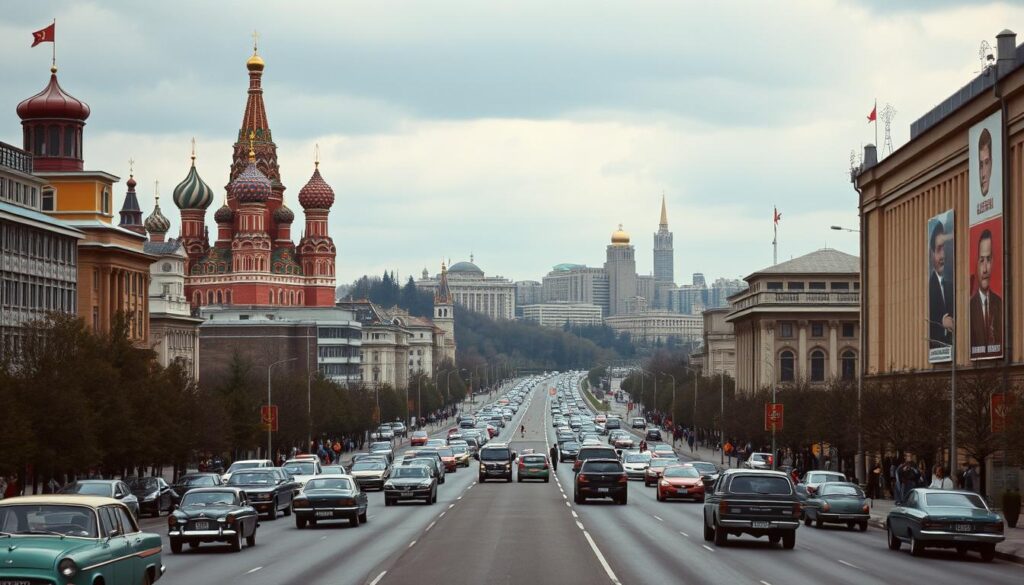
The Soviet Union, also known as the USSR, was a huge country that covered much of Eurasia from 1922 to 1991. It stretched across eleven time zones and bordered twelve countries1. It was the biggest country by area, home to over 100 different nationalities. During the Cold War, it was one of the world’s two superpowers, playing a big role in 20th-century politics, including World War II1.
The USSR started in 1922 with Russia, Belarus, Ukraine, and Transcaucasia. This included Georgia, Azerbaijan, and Armenia2.
The history of the Soviet Union is both complex and interesting. It was shaped by big events like the Bolshevik Revolution and the USSR’s formation1. Over time, it grew to include 15 republics and nearly 130 ethnic groups2. The Soviet Union ended in 1991, marking the end of a big era, said Russian President Vladimir Putin1.
Key Takeaways
- The Soviet Union was a transcontinental country that existed from 1922 to 1991.
- The USSR was the largest country by area, comprising over 100 distinct nationalities.
- The Soviet Union played a significant role in shaping 20th-century geopolitics, including its role in World War II1.
- The Soviet Union was founded in 1922 with a confederation of Russia, Belarus, Ukraine, and Transcaucasia2.
- The dissolution of the Soviet Union in 1991 marked the end of a significant geopolitical era1.
- The Soviet Union’s history is complex and fascinating, with significant events that shaped the country’s development1.
Origins of the Soviet Union
The Soviet Union’s start was filled with big changes and bold leadership. The Bolshevik Revolution in 1917 changed Russia’s politics forever.
The Bolshevik Revolution
Vladimir Lenin led the Bolsheviks in a coup against the Provisional Government. They created the first socialist state, the Russian SFSR. This event led to big changes under the Soviet government3.
Formation of the USSR
On December 30, 1922, the USSR was formed. It brought together four socialist republics into one federal state. This move added diverse areas to the Soviet economy3.
Early Communist Policies
The USSR’s early years saw the start of the New Economic Policy (NEP) and the first Five-Year Plans. These plans aimed to stabilize and grow the economy fast. They greatly affected the Soviet economy and the roles of Soviet Union leaders like Stalin3.
The Soviet government’s centralized system helped make quick decisions. This unity and strength were key in making the Soviet Union a powerful nation4.
Key Events during the Soviet Era
The Soviet era was filled with events that changed the nation and the world. It saw the devastation of World War II, the Cold War rivalry, and the Space Race achievements. Each event left a lasting impact on history.
World War II and its Aftermath
The Soviet Union was key in defeating the Axis powers in World War II. They lost about 27 million people5. Battles like the Siege of Leningrad showed the Soviet military’s strength.
After the war, the USSR became a superpower, changing global politics6.
The Cold War Dynamics
After World War II, tensions between the Soviet Union and the United States grew. This led to the Cold War5. The two sides had different beliefs and wanted to be the top power.
The Soviet Union flag symbolized communism against Western capitalism7.
The Space Race
The Space Race was a key part of the Cold War. It showed the tech and belief competition between the USSR and the USA. In 1957, the USSR launched Sputnik 1, the first artificial satellite5.
In 1961, Yuri Gagarin became the first person in space6. These wins showed Soviet strength and made the rivalry even more intense.
Decline and Dissolution of the Soviet Union
The Soviet Union faced many challenges in the 1980s. Economic stagnation was a big problem, caused by inefficiencies and too much spending on the military. Mikhail Gorbachev tried to fix this by introducing reforms to boost the economy and increase openness.
Economic Challenges and Reforms
Gorbachev’s policies, perestroika and glasnost, aimed to improve the economy and open society. But these reforms also showed the deep problems, leading to lower productivity and more economic decline.
Nationalism and Independence Movements
As the economy got worse, nationalism grew in the Soviet republics. People started to want their own freedom and to govern themselves. This made the Soviet state weaker and weaker.
The Fall of the Soviet Union in 1991
In August 1991, Boris Yeltsin gave a key speech in front of the Russian parliament8. A failed coup against Gorbachev by hard-line Communists made things worse9. By December 31, 1991, the Soviet Union broke up into 15 independent states10. This ended a long era and changed the world’s politics.
FAQ
What was the Soviet Union?
The Soviet Union, also known as the USSR, was a socialist state from 1922 to 1991. It was made up of many Soviet republics across Eurasia. Over 100 nationalities lived there. The USSR was a major world power during the Cold War.
How was the Soviet Union formed?
The Soviet Union started in 1922 after the Bolshevik Revolution in 1917. Vladimir Lenin led the Bolsheviks to power. They created the world’s first socialist state. The union brought together various Soviet republics under one government.
Who were the key leaders of the Soviet Union?
Important leaders included Vladimir Lenin and Joseph Stalin. Lenin started the Bolshevik Revolution. Stalin led the nation through big changes and World War II. Later, Mikhail Gorbachev introduced reforms like perestroika and glasnost, leading to the USSR’s end.
What role did the Soviet Union play in World War II?
The Soviet Union was key in World War II, starting with the Nazi attack in 1941. The Siege of Leningrad and the Battle of Stalingrad were turning points. The USSR’s huge resources helped defeat the Axis powers.
What were the main causes of the Cold War?
The Cold War was caused by big differences in ideology and goals between the USSR and the United States. The arms race, military alliances, and proxy wars were key factors.
What were the Soviet Union’s achievements in the Space Race?
The Soviet Union led in the Space Race, achieving many firsts. They launched Sputnik 1 and sent Yuri Gagarin on the first human spaceflight. These achievements showed the USSR’s tech skills and sparked competition with the US.
What led to the decline and eventual collapse of the Soviet Union?
The Soviet Union declined due to economic problems and high military spending. Mikhail Gorbachev’s reforms aimed to improve but sped up the union’s fall. Rising nationalism and independence movements also played a part, ending with the USSR’s collapse on December 26, 1991.
What were the early Communist policies in the Soviet Union?
Early policies included the New Economic Policy (NEP) and the Five-Year Plans. The NEP brought back some market mechanisms to boost the economy. The Five-Year Plans focused on fast industrialization and collectivizing agriculture, changing Soviet society and economy.
How diverse was the population of the Soviet Union?
The Soviet Union was very diverse, with over 100 nationalities and ethnic groups. Its vast area showed many cultures, languages, and traditions. The government tried to unite these groups but faced challenges from nationalism and ethnic tensions.
What symbols represented the Soviet Union?
The Soviet Union flag had the hammer and sickle, symbolizing workers and peasants. The red star represented communism. State emblems also showed the USSR’s ideals and goals.
What was the Soviet economy like during its existence?
The Soviet economy was planned and controlled by the state. It focused on heavy industry, military, and agriculture. Despite growth and tech advances, it faced issues like inefficiency and lack of consumer goods, leading to stagnation before its collapse.
Source Links
- The Birth of the Soviet Union and the Death of the Russian Revolution – JSTOR Daily – https://daily.jstor.org/the-birth-of-the-soviet-union-and-the-death-of-the-russian-revolution/
- What Countries Were Part of the Soviet Union? | HISTORY – https://www.history.com/news/what-countries-were-in-soviet-union
- Soviet Union | History, Leaders, Flag, Map, & Anthem | Britannica – https://www.britannica.com/place/Soviet-Union
- Soviet Union – https://en.wikipedia.org/wiki/Soviet_Union
- Soviet Union ‑ Countries, Cold War & Collapse | HISTORY – https://www.history.com/topics/european-history/history-of-the-soviet-union
- History of the Soviet Union – https://en.wikipedia.org/wiki/History_of_the_Soviet_Union
- Soviet Union timeline – https://www.bbc.com/news/world-europe-17858981
- Milestones in the History of U.S. Foreign Relations – https://history.state.gov/milestones/1989-1992/collapse-soviet-union
- Collapse of the Soviet Union | Causes, Facts, Events, & Effects | Britannica – https://www.britannica.com/event/the-collapse-of-the-Soviet-Union
- Dissolution of the Soviet Union – https://en.wikipedia.org/wiki/Dissolution_of_the_Soviet_Union