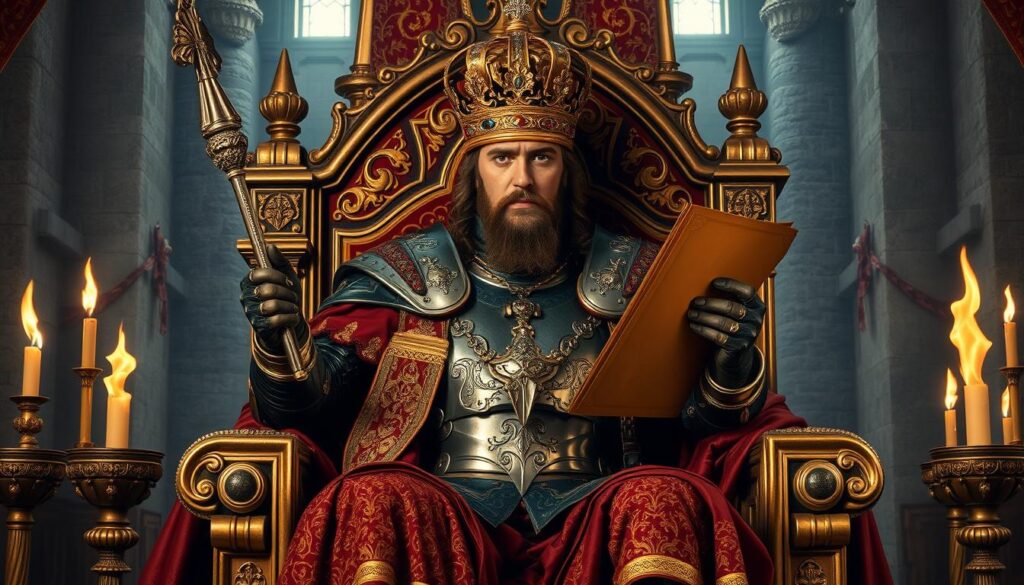
Charlemagne, also known as the Holy Roman Emperor, was a key figure in European history. His life and reign have been studied a lot1. As the King of the Franks, he shaped the Carolingian dynasty and left a big mark on European politics and culture.
Born in the late 740s near Liège in modern-day Belgium, Charlemagne became the sole ruler of the Frankish kingdom in 771 after his brother Carloman’s death2. He was a major player in the Carolingian Empire. This empire covered a lot of Western Europe, including France, Switzerland, parts of Germany, and the Low Countries1.
Charlemagne’s early life and rise to power are really interesting. His coronation as Emperor of the Romans on December 25, 800, was a big moment in his career1. He was part of the Carolingian dynasty, a powerful family with notable figures like Pepin the Short and Bertrada of Laon1. His native tongue was Old High German, likely Rhenish Franconian, based on Einhard’s accounts1.
Charlemagne’s life and reign show his strength and vision as a leader. His legacy continues to inspire curiosity and admiration3.
Key Takeaways
- Charlemagne was a prominent figure in European history and played a key role in shaping the Carolingian dynasty1.
- He became the sole ruler of the Frankish kingdom in 771 after his brother Carloman’s death2.
- Charlemagne was crowned Emperor of the Romans on December 25, 800, at Old St. Peter’s Basilica in Rome1.
- He had multiple spouses, including Desiderata, Hildegard, Fastrada, and Luitgard1.
- Charlemagne’s empire covered a lot of Western Europe at the time of his death3.
- He was canonized in 1165 under Emperor Frederick Barbarossa3.
Historical Context of Charlemagne’s Reign
The time of Charlemagne was a turning point in 8th-century Europe. To grasp his story, we must look at the Carolingian Empire and key events that led to his rise.
The Carolingian Empire: An Overview
Charlemagne took the throne from his father, Pippin III, with papal backing4. The Carolingian Empire, known for the Carolingian Renaissance, was a major milestone in history4. This era saw a cultural and intellectual rebirth, setting the stage for Charlemagne’s achievements.
Key Events Leading to Charlemagne’s Ascendancy
Charlemagne was born in 747 and showed great political and military skills early on5. His rise to power was fueled by expanding the empire and forming alliances. He was crowned emperor in 800, marking a significant moment in his reign5.
Influence of the Papacy in the 8th Century
The partnership between the Frankish rulers and the Papacy was vital for their power4. This alliance helped Charlemagne gain papal support for his rule. He promised to protect Rome and support the Church’s power4. The Papacy’s influence helped him standardize religious practices and fight paganism Charlemagne history.
Charlemagne’s Achievements and Contributions
Charlemagne’s rule was a turning point in European history. He was the Charlemagne ruler of Europe. His leadership brought about big changes in many areas.
Reforms in Education and Culture
Charlemagne started the Carolingian Renaissance, a time of renewed focus on learning and the arts4. He set up schools and worked to keep old texts alive. This helped keep knowledge going even when times were hard.
He also made writing easier to read with the Carolingian Minuscule. This made texts clearer and more accessible4.
Military Campaigns: Expansion of the Empire
Charlemagne grew his empire through smart military actions. He took over areas that are now France, Germany, Italy, and more6. His victories in Saxony and Lombardy spread Christianity and united a lot of land6.
His military skills helped bring back the unity of the old Roman Empire6.
Administration: Legal and Governmental Innovations
Charlemagne made big changes in how things were run. He made sure everyone used the same weights and measures, which helped trade and the economy4. He also created a single money system, making business easier across his vast empire4.
His laws made things more organized and fair. This helped his government work better2.
| Achievement | Description | Source |
|---|---|---|
| Carolingian Renaissance | Revival of art, culture, and education | 4 |
| Military Expansion | Conquests of Saxony and Lombardy, uniting Europe | 6 |
| Administrative Reforms | Standardized weights, measures, and currency | 4 |
| Legal Codes | Promoted accountability and centralized governance | 2 |
Legacy of Charlemagne
Charlemagne’s influence went far beyond his lifetime. He shaped European history and culture. His vision and actions helped create a unified Europe, leaving a lasting mark.
The Impact on European History
Charlemagne greatly impacted medieval Europe. He expanded the Frankish kingdom through military campaigns and conquests7. He also established a centralized administration and promoted the Carolingian Renaissance, creating a unified European culture7.
His coronation as Emperor by Pope Leo III in 800 started the Holy Roman Empire8. This had a big impact on European politics for over a thousand years.
Charlemagne in Modern Culture and Literature
The Charlemagne legacy is celebrated with the Charlemagne Prize in Aachen, Germany, started in 1950. Leaders like Winston Churchill and Pope Francis have been honored7. His story is also told in the Song of Roland, where he is seen as a heroic warrior king7.
Charlemagne is a symbol of pan-European unity and cultural heritage. He inspires both scholarly and popular media7.
The Concept of the Holy Roman Empire
Charlemagne’s title as emperor started the Holy Roman Empire. This empire was key in European governance8. It shaped the structure of modern European states and fostered a shared identity8.
The legacy of the Holy Roman Empire shows Charlemagne’s lasting impact on Europe. He is known as the “Father of Europe”7.
FAQ
Who was Charlemagne?
Charlemagne, also known as Charles the Great, was a king and later an emperor. He united much of Western Europe in the early Middle Ages. His work helped start modern European civilization.
How did Charlemagne rise to power in the Frankish kingdom?
Charlemagne used his smarts and strength to win power in 8th-century Francia. He made alliances, fought battles, and ruled well. This made him the top ruler of the Frankish kingdom, growing its lands a lot.
What were the major achievements of Charlemagne’s reign?
Charlemagne’s rule was filled with big wins. He grew his empire, made laws, and boosted education and culture. His work sparked the Carolingian Renaissance, a time of art, literature, and learning in medieval Europe.
How did Charlemagne influence education and culture in Europe?
Charlemagne focused on education, starting schools and attracting scholars. This led to the Carolingian Renaissance, a time of learning and culture. His support for the arts and education changed European culture forever.
What was the relationship between Charlemagne and the Papacy?
Charlemagne and the Papacy worked together closely. This support gave him religious backing and helped him rule. It also helped spread Christianity and manage his big empire.
Why is Charlemagne often referred to as the “Father of Europe”?
Charlemagne is called the “Father of Europe” for many reasons. He united different areas, promoted learning, and set up systems that shaped medieval Europe. His work helped create modern European nations.
How did Charlemagne’s administration innovate governance in his empire?
Charlemagne brought new ideas to governance, like laws, taxes, and local leaders. These changes made his empire run smoothly. It helped him manage his vast lands well.
What lasting impacts did Charlemagne have on European history?
Charlemagne’s impact is seen in many parts of European history. He helped form the Holy Roman Empire and boosted culture and education. His dream of a united Europe inspired many rulers for centuries, making him key to Western civilization.
Source Links
- https://en.wikipedia.org/wiki/Charlemagne – Charlemagne
- https://www.britannica.com/biography/Charlemagne – Charlemagne | Biography, Accomplishments, Children, & Facts | Britannica
- https://www.history.com/topics/middle-ages/charlemagne – Charlemagne: Facts, Empire & Holy Roman Emperor ‑ HISTORY
- https://courses.lumenlearning.com/suny-hccc-worldhistory/chapter/charlemagnes-reforms/ – Charlemagne’s Reforms | Western Civilization
- https://www.britannica.com/biography/Charlemagne/Religious-reform – Charlemagne – Religious Reform, Holy Roman Empire, Papacy | Britannica
- https://courses.lumenlearning.com/atd-herkimer-westerncivilization/chapter/the-rise-of-charlemagne/ – The Rise of Charlemagne | Western Civilization
- https://www.historyextra.com/period/medieval/charlemagne-unifier-father-europe-correct-european-symbol-who-was-he/ – The legacy of Charlemagne: how the king of the Franks continues to cast a shadow over Europe
- https://essaygenius.ai/essay/essay-on-the-legacy-of-charlemagne – EssayGenius AI Essay Writer