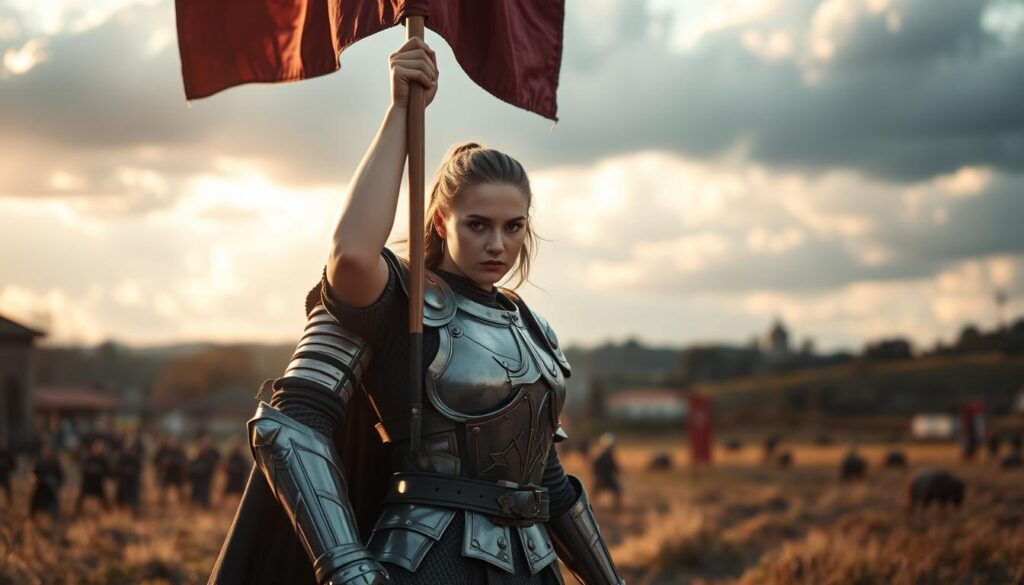
Joan of Arc, also known as Saint Joan, was born around 1412 in Domrémy, France. She lived during the Hundred Years’ War between England and France1. As a peasant girl, she became a national heroine and a Roman Catholic saint, playing a key role in the war1.
Her life and achievements have been widely recognized. Her legacy inspires people worldwide.
Joan of Arc’s real name was Jehanne d’Arc, also known as Jehanne la Pucelle (“Joan the Maid”)2. She started hearing voices and having visions at 12 or 132. These visions guided her to help Charles VII save France from English domination.
As a result, Joan of Arc became a key figure in French history. Her story has been told and retold in various forms of art and literature. This has solidified her position as a cultural icon and a symbol of French resistance.
Key Takeaways
- Joan of Arc was born around 1412 in Domrémy, France1.
- She was a peasant girl who became a national heroine and a Roman Catholic saint1.
- Joan of Arc played a significant role in the Hundred Years’ War between England and France1.
- She was guided by visions from St. Michael, St. Margaret, and St. Catherine1.
- Joan of Arc was canonized by Pope Benedict XV in 1920 and declared one of the patron saints of France two years later1.
- Her real name was Jehanne d’Arc, also known as Jehanne la Pucelle (“Joan the Maid”)2.
Early Life and Background
Joan of Arc, known as the Maid of Orleans, was born in a small village in France. This was during a time of great turmoil in the Hundred Years’ War. Her early years were deeply affected by this ongoing conflict.
Birth and Family
Joan was born around 1412 to Jacques d’Arc and Isabelle Romée in Domrémy, Bar, France34. Her family was very religious. This upbringing would shape her future mission.
Influences and Childhood Experiences
The Hundred Years’ War had a big impact on Joan’s life. She saw her village struggle and stay strong. These experiences made her want to help her country.
Religious Visions
At 13, Joan started having visions. She believed these were messages from saints like St. Michael and St. Catherine35. These visions guided her to support Charles VII and free France from the English.
Military Campaigns and Achievements
Joan of Arc became a French military leader during the Hundred Years’ War. Her leadership inspired both soldiers and civilians.
Rise to Prominence
At 17, Joan convinced Charles VII to let her lead an army to break the Siege of Orléans. Her bravery and determination quickly made her a respected leader in France.
Key Battles and Strategies
Joan fought in thirteen battles, winning nine6. She used cannons in sieges, showing her smart tactics.
- Battle of Jargeau
- Battle of Meung-sur-Loire
- Battle of Beaugency
Role in the Siege of Orléans
The Siege of Orléans was a key moment in the war. More gunpowder was used than ever before6. Joan’s leadership led to the fall of thirty cities without a fight6, weakening English defenses.
Her white banner with sacred figures boosted French morale and scared the English6.
Coronation of Charles VII
After her victories, Joan took Charles VII to Reims for his coronation6. This event legitimized his rule and showed a united France ready to fight back.
| Battle | Outcome | Year |
|---|---|---|
| Siege of Orléans | French Victory | 1429 |
| Battle of Jargeau | French Victory | 1429 |
| Battle of Meung-sur-Loire | French Victory | 1429 |
| Battle of Beaugency | French Victory | 1429 |
Legacy and Cultural Impact
Joan of Arc’s story didn’t end with her death. In 1456, her trial was declared null, making her a Catholic saint and French heroine7. Her canonization in 1920 celebrated her faith and courage, marking her as the Patron saint of France7.
Joan has inspired many artists and writers over the years. Films like “Bill and Ted’s Excellent Adventure” and Arcade Fire’s “Reflektor” album feature her8. TV shows like “The Simpsons” have also shown her, showing her lasting appeal8.
Today, Joan’s story is seen in many ways. Fashion brands like Versace have been inspired by her look. In the 1920s, hairstyles like the “Coupe à la Jeanne d’Arc” became popular8. These examples show her lasting impact on culture.
Joan of Arc stands for strength and national pride. Her legacy sparks talks on faith, patriotism, and gender roles7. As a French heroine, her life story continues to inspire people all over the world.
FAQ
Who was Joan of Arc and why is she considered a significant figure in French history?
Joan of Arc, also known as Saint Joan, was a peasant girl from Domrémy. She became a key French military leader during the Hundred Years’ War. Her faith and visions led French troops to victories, like the Siege of Orléans.
Her actions helped Charles VII claim the French throne. She was later canonized as a saint. This makes her a national heroine and a symbol of French faith.
What were the early life and family background of Joan of Arc?
Joan of Arc was born around 1412 in Domrémy. She was the daughter of Jacques d’Arc and Isabelle Romée. Her family was devoutly religious.
Her upbringing in a war-torn France shaped her. It prepared her for her future role as the Maid of Orléans.
How did the Hundred Years’ War influence Joan of Arc’s destiny?
The Hundred Years’ War was a long conflict between England and France. It made Joan’s village, Domrémy, unstable. This war fueled her mission to support Charles VII.
Her involvement in battles was shaped by the war’s goals. She became a key figure in France’s fight for freedom.
What were Joan of Arc’s religious visions and how did they shape her mission?
Joan of Arc had visions and heard voices of saints from a young age. These experiences guided her to defend France and support Charles VII. Her faith gave her the courage to lead troops.
In medieval times, her visions were seen as divine support. They inspired her followers and the French people.
How did Joan of Arc rise to prominence as a military leader?
Joan’s rise was due to her faith, charisma, and tactical skills. She claimed divine guidance and won Charles VII’s trust. Her presence boosted troop morale and inspired strategic victories.
Her leadership made her a significant figure in the Hundred Years’ War.
What were the key battles and strategies employed by Joan of Arc during the Hundred Years’ War?
Joan was involved in several key battles, like the Siege of Orléans. She rallied troops, used unconventional tactics, and inspired leadership. Her adaptability and swift actions led to victories.
These strategies revitalized French spirit during a critical war phase.
What was Joan of Arc’s role in the Siege of Orléans?
Joan played a key role in the Siege of Orléans (1428-1429). She arrived when French forces were near defeat. Her leadership and presence boosted morale and led to the siege’s lifting.
This victory lifted French spirits and paved the way for Charles VII’s coronation.
How did Joan of Arc contribute to the coronation of Charles VII?
After the Siege of Orléans, Joan helped legitimize Charles VII’s claim. She led victories that cleared the path for his coronation in Reims. Her support united the nobility and reinforced Charles VII’s authority.
This ensured a stronger France against English forces in the Hundred Years’ War.
What is the legacy of Joan of Arc as both a national heroine and a Catholic saint?
Joan of Arc is remembered for her courageous leadership and role in French victories. She was canonized in 1920, honoring her faith and mission. Her life symbolizes integrity, patriotism, and belief.
Her story is a blend of national identity and spiritual devotion. It inspires people worldwide.
How has Joan of Arc been represented in arts and literature throughout history?
Joan of Arc has been depicted in various arts and literature for centuries. Her image represents bravery and divine inspiration. Literary works explore her life and triumphs.
In modern times, filmmakers and artists reinterpret her story. They highlight different aspects of her character and legacy. Her portrayal keeps her memory alive and inspires ongoing discussions.
What are the modern interpretations and significance of Joan of Arc’s life?
Today, Joan of Arc is celebrated as a symbol of empowerment and resilience. Modern interpretations explore faith, nationalism, and gender roles. Her story inspires movements for justice, equality, and courage.
Her legacy continues to influence discussions on women’s leadership and the intersection of spirituality and politics. She remains relevant today.
Source Links
- https://en.wikipedia.org/wiki/Joan_of_Arc – Joan of Arc
- https://www.history.com/news/7-surprising-facts-about-joan-of-arc – 7 Surprising Facts About Joan of Arc | HISTORY
- https://www.britannica.com/biography/Saint-Joan-of-Arc – Joan of Arc | Biography, Death, Accomplishments, & Facts | Britannica
- https://www.biography.com/military-figures/joan-of-arc – Joan of Arc – Death, Facts & Accomplishments
- https://www.history.com/topics/middle-ages/saint-joan-of-arc – Joan of Arc: Facts, Passion, Death & Sainthood ‑ HISTORY
- https://scottmanning.com/content/joan-of-arc-military-successes-and-failures/ – Joan of Arc’s Military Successes and Failures
- https://www.catholic365.com/article/12632/the-feisty-joan-of-arc-and-her-legacy.html – The Feisty Joan of Arc and Her Legacy
- https://artsemerson.org/2018/02/22/saint-joan-in-popular-culture/ – Saint Joan in Popular Culture – ArtsEmerson