
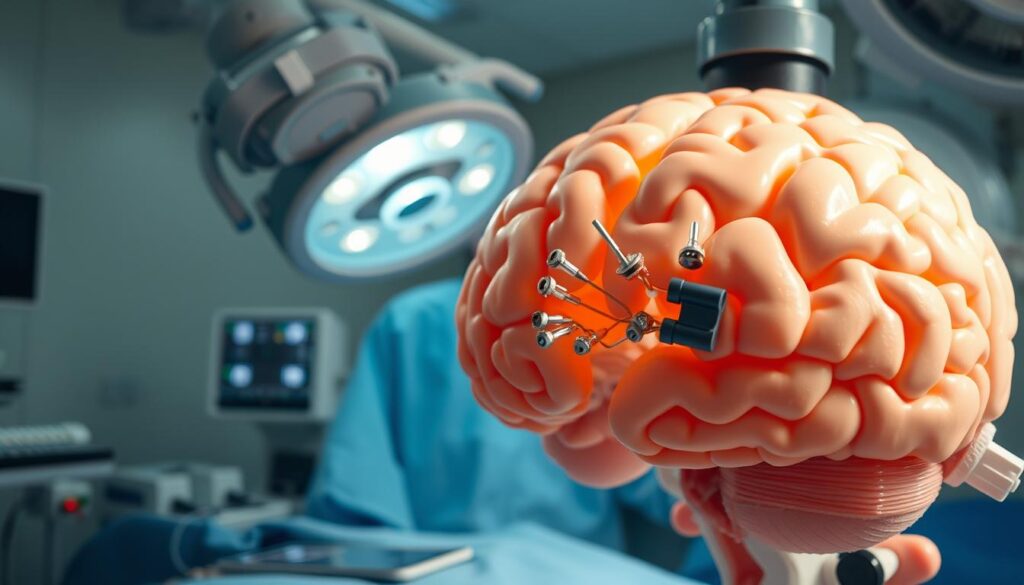
Neurosurgery can be complex, especially for movement disorders like Parkinson’s disease. Deep Brain Stimulation (DBS) offers hope for patients with persistent neurological symptoms1. This innovative procedure helps those battling tremors and movement disorders that medications can’t fully control2.
DBS involves implanting electrodes in specific brain regions to regulate abnormal neural activity. It’s the most common surgical treatment for Parkinson’s disease1. The FDA approved this technique for essential tremor in 1997 and Parkinson’s disease in 20022.
For those living with movement disorders, DBS could be life-changing. It’s typically recommended after four years of Parkinson’s disease with motor complications1. DBS works best for stiffness, slowness, and tremors.
However, it may not help as much with balance issues or non-motor symptoms1.
Key Takeaways
- DBS is an advanced neurosurgical treatment for movement disorders
- FDA-approved for multiple neurological conditions since 1997
- Most effective in treating motor symptoms of Parkinson’s disease
- Requires comprehensive medical assessment before surgery
- Can help reduce medication dependence
Understanding Deep Brain Stimulation
Deep Brain Stimulation (DBS) is a groundbreaking treatment for movement disorders. It uses brain implants and neuromodulation to manage tough neurological conditions. This innovative tech offers hope to many patients3.
What Makes DBS Unique
DBS surgery stands out with its reversible and adjustable approach. Unlike invasive procedures, it uses electrode implantation. This allows doctors to fine-tune treatment for each patient.
- Continuously modulate specific brain circuits
- Customize treatment for individual patient needs
- Reduce reliance on systemic medications
How the DBS System Functions
The DBS system has three key parts: leads, extension wires, and a neurostimulator. Surgeons place electrodes in specific brain areas using advanced imaging3.
The process typically involves two surgical stages:
- Electrode placement in targeted brain areas
- Neurostimulator implantation near the collarbone
Benefits and Potential Limitations
DBS can greatly help patients with movement disorders. The FDA has approved it for conditions like essential tremor and Parkinson’s disease3.
Key advantages include improved motor symptom management and potential reduction in medication requirements.
“DBS offers a precise, personalized approach to neural stimulation that traditional treatments cannot match.”
| Treatment Aspect | DBS Characteristics |
|---|---|
| Procedure Duration | Two-stage surgery, approximately 1-2 weeks apart |
| Battery Lifespan | 3-5 years for standard, up to 15 years for rechargeable |
| Potential Risks | Infection, brain bleeding, hardware complications |
DBS offers great potential, but it’s not for everyone. Talk to a specialized neurologist about your options. They can help find the best treatment for your specific condition4.
Deep Brain Stimulation: Medical Applications and Treatment Options
Deep brain stimulation (DBS) offers hope for patients with challenging neurological conditions. This innovative treatment provides relief for various movement disorders. DBS can address different medical conditions through precise neural stimulation5.
DBS has proven effective in managing several key neurological disorders:
- Parkinson’s Disease: Targeting specific brain regions to reduce tremors and motor symptoms6
- Essential Tremor: Helping patients regain control of movement5
- Dystonia: Addressing abnormal muscle movements and postures6
- Epilepsy: Potentially reducing seizure frequency5
For Parkinson’s patients, DBS can be transformative. Candidates often have uncontrollable tremors or severe motor fluctuations. Some patients are limited by medication side effects6.
The Cleveland Clinic highlights the potential of this groundbreaking treatment. DBS can significantly improve patients’ quality of life.
“DBS isn’t just a treatment, it’s a pathway to reclaiming independence for many neurological patients.”
DBS shows remarkable promise, but individual results can vary. Potential candidates undergo thorough evaluations to determine suitability. Factors like medication history, symptom severity, and overall health are considered6.
Researchers are exploring DBS applications in psychiatric conditions. They’re also looking into other neurological challenges5. Your doctor can help you decide if DBS might be right for you.
Conclusion
Deep brain stimulation (DBS) surgery has revolutionized neurological disorder treatment. Over 160,000 patients have seen improved lives through this innovative neuromodulation technique7. Companies like Medtronic, Abbott, and Boston Scientific develop advanced brain implants targeting specific neural circuits8.
DBS now addresses various conditions, including Parkinson’s disease, epilepsy, and obsessive-compulsive disorder8. The FDA-approved Medtronic Percept PC offers real-time stimulation adjustment, advancing personalized neural treatment7.
Future brain implants promise more precise neuromodulation. Some Parkinson’s patients have experienced positive results for over a decade after surgery7. Despite challenges, DBS technology offers hope to many seeking innovative neurological treatments8.
FAQ
What is Deep Brain Stimulation (DBS)?
Deep Brain Stimulation is a neurosurgical procedure using implanted electrodes. It delivers electrical stimulation to specific brain areas. DBS treats movement disorders by regulating abnormal brain activity.
The system includes a brain-implanted lead, an extension wire, and a neurostimulator. The neurostimulator is placed under the skin near your collarbone.
Who is a good candidate for Deep Brain Stimulation?
DBS may help if your movement disorder doesn’t respond well to medication. It’s also an option if your medications cause significant side effects.
Patients with Parkinson’s disease, essential tremor, or dystonia often benefit. A comprehensive medical evaluation determines if DBS is right for you.
How effective is Deep Brain Stimulation?
DBS can significantly improve motor symptoms for many patients. It can reduce tremors and decrease medication requirements. Many patients experience improved quality of life.
However, DBS may not eliminate all symptoms. Results can vary between individuals.
What are the risks associated with DBS surgery?
DBS carries risks like infection, bleeding, and hardware complications. There’s a small risk of stroke or other neurological issues. Your neurosurgeon will discuss these risks in detail.
How long does a Deep Brain Stimulation device last?
The neurostimulator typically lasts 3-5 years, depending on settings and device type. You’ll need an outpatient procedure to replace it when the battery runs low.
Your doctor will monitor the battery life during follow-ups. They’ll help you plan for replacement when needed.
Can I control the Deep Brain Stimulation device?
Yes, you’ll get a handheld programmer to adjust stimulation settings. This gives you some control over your treatment. Your neurologist will help optimize the settings for maximum benefit.
Are there alternative treatments to Deep Brain Stimulation?
Alternatives might include medication, physical therapy, or other surgical interventions. Medication is often the first treatment for movement disorders. DBS can be effective when medications don’t work well.
Your healthcare provider can help explore the best options for you.
Does insurance cover Deep Brain Stimulation?
Most Medicare and private insurance plans cover DBS for FDA-approved conditions. Coverage can vary, so check with your specific insurance provider. Your healthcare team can help with insurance requirements.
Source Links
- Deep Brain Stimulation – https://www.michaeljfox.org/deep-brain-stimulation
- Deep brain stimulation (DBS) at the interface of neurology and psychiatry – https://pmc.ncbi.nlm.nih.gov/articles/PMC3809784/
- Understanding Deep Brain Stimulation (DBS) | Brain Institute – https://www.ohsu.edu/brain-institute/understanding-deep-brain-stimulation-dbs
- Understanding Deep Brain Stimulation (DBS) | Boston Scientific – https://www.dbsandme.com/en/understanding-dbs.html
- Deep brain stimulation – Mayo Clinic – https://www.mayoclinic.org/tests-procedures/deep-brain-stimulation/about/pac-20384562
- Deep Brain Stimulation – https://www.hopkinsmedicine.org/health/treatment-tests-and-therapies/deep-brain-stimulation
- Mya Care – https://myacare.com/blog/deep-brain-stimulation-understanding-the-procedure-benefits-and-risks
- Frontiers | Past, Present, and Future of Deep Brain Stimulation: Hardware, Software, Imaging, Physiology and Novel Approaches – https://www.frontiersin.org/journals/neurology/articles/10.3389/fneur.2022.825178/full

