
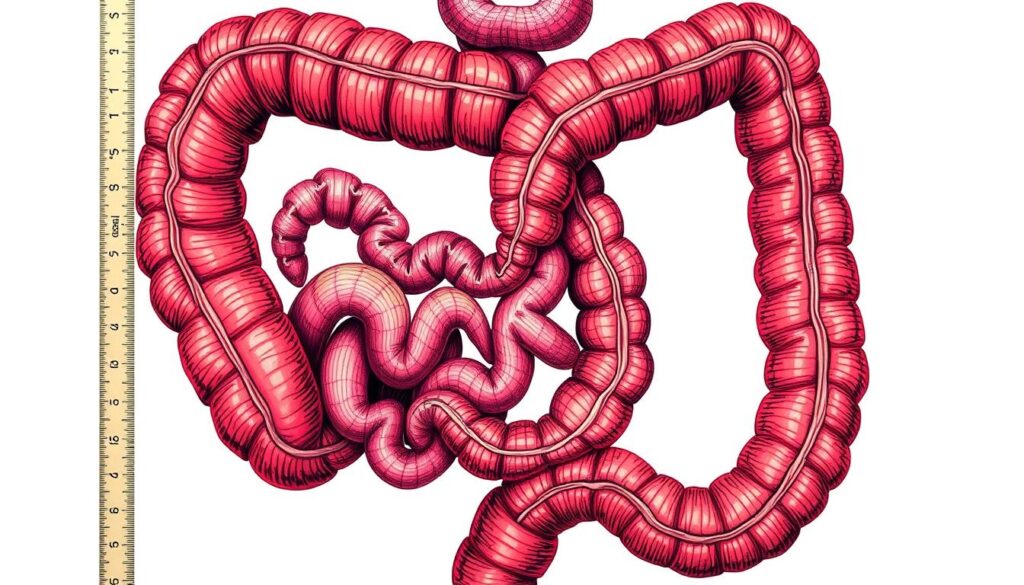
Your digestive system is a marvel of biological engineering. It stretches much longer than you might think. The intestines form a complex network that processes nutrients and supports your health1.
Your digestive system works non-stop every day. The small intestine’s impressive span and large intestine’s vital functions make up this amazing network2.
Your entire intestinal tract could stretch to nearly 26 feet if fully extended. The small intestine alone ranges from 9 to 16 feet long. This creates a vast pathway for absorbing nutrients1.
Interestingly, intestinal length can vary between individuals. Factors like body weight can influence how long your intestines are1.
Key Takeaways
- The human intestinal system is incredibly long and complex
- Small intestines can stretch up to 16 feet in length
- Individual intestinal length varies based on body weight
- Digestive tract performs crucial nutrient absorption functions
- Your intestines work continuously to support overall health
Understanding Your Digestive System’s Amazing Architecture
Your digestive system is a complex network of organs. It transforms food into essential nutrients. This biological machine processes everything you eat, extracting vital energy for your health.
Key Components of the Digestive Tract
The gastrointestinal tract involves several critical organs working together:
- Mouth: Initial food processing point
- Esophagus: Approximately 25.4 cm long, transporting food to stomach3
- Stomach: Four primary regions for digestion3
- Small and Large Intestines: Primary nutrient absorption zones
The Digestive System’s Hidden Nervous System
Your digestive tract contains an enteric nervous system, often called the “second brain”. This network controls muscle contractions and hormone production. It also communicates directly with your central nervous system.
“The gut is not just a digestive organ, but a complex communication center.”
Role of Digestive Enzymes and Bile
Digestive enzymes and bile are key in breaking down food. About 1 to 1.5 liters of saliva are secreted daily. This starts the process of nutrient extraction3.
Bile, made by the liver, contains powerful acids. These acids help digest food and support optimal intestinal anatomy.
Length of Intestines: A Journey Through Your Digestive Tract
Your digestive tract is an amazing feat of biological engineering. It’s much longer than you might think. An adult’s digestive system stretches about 30 feet, transforming food into essential nutrients45.
The small intestine is truly extraordinary. It’s incredibly long and filled with tiny villi that increase its surface area. These finger-like projections create an absorptive surface as big as a tennis court54!
| Intestinal Section | Length | Key Function |
|---|---|---|
| Small Intestine | 22 feet | Nutrient Absorption |
| Large Intestine | 5 feet | Water Removal |
| Rectum | 1-1.6 inches | Waste Storage |
Your digestive system is a remarkable journey of transformation, turning food into fuel with incredible precision.
Your small intestine processes up to three gallons of liquid daily. It shows amazing efficiency in digestion4.
The large intestine’s main job is to remove water from undigested matter. It also prepares waste for excretion5.
Surprising Facts About Small and Large Intestine Dimensions
Your digestive system is a marvel of biological engineering. The intestines are complex and expansive, revealing a remarkable system of nutrient absorption. The Small Intestine Size and Large Intestine Length work together in a compact internal space.
Small Intestine: A Remarkable Digestive Powerhouse
Your small intestine stretches an impressive 22 feet (7 meters) long. It’s the longest section of your digestive tube4.
This organ packs a surface area of about 250 square meters. That’s roughly the size of a tennis court4.
- Average small intestine length: 22 feet
- Surface area: 250 square meters
- Daily liquid processing: 1-3 gallons
Large Intestine: Compact Yet Crucial
The large intestine is shorter but vital to digestion. It measures around 5 feet long and is broader than the small intestine.
This part is essential for water reabsorption1.
| Intestinal Segment | Length | Key Function |
|---|---|---|
| Small Intestine | 9-16 feet | Nutrient Absorption |
| Large Intestine | 5 feet | Water Reabsorption |
Surface Area and Absorption Capabilities
Your intestinal tract’s design allows for maximum nutrient extraction. The small intestine has 20-40 villi per square millimeter, increasing its absorption surface6.
This microscopic architecture helps your body efficiently process nutrients from food.
“Your intestines are like a sophisticated processing plant, compact yet incredibly efficient.”
Conclusion
Your gastrointestinal tract is a biological marvel that supports overall health. It’s an amazing network of engineering designed for more than just digestion. The small intestine’s surface area spans about 200 square meters, with complex absorption mechanisms.
The digestive system’s length offers insights into nutrient processing and wellness. Living individuals have small intestines ranging from 3 to 5 meters. This flexible design ensures efficient nutrient absorption and supports unique metabolic needs.
Good intestinal health requires understanding these intricate biological systems. Regular check-ups and balanced nutrition can support its complex functions. By appreciating your digestive system’s design, you can make choices for long-term wellness.
Your digestive system works tirelessly to keep you nourished and healthy. Treat it with care and listen to its signals. Give it the support it needs to function at its best67.
FAQ
How long are the human intestines?
Your intestines stretch an impressive 22 to 30 feet long. The small intestine measures 9 to 16 feet. The large intestine is about 5 feet long.
This length allows for efficient nutrient absorption and waste processing.
Why is the small intestine longer than the large intestine?
The small intestine’s length maximizes nutrient absorption. It has complex folds and tiny projections called villi. These features increase its surface area for efficient nutrient extraction.
How long does food take to travel through the digestive system?
Your digestive journey typically lasts two to three days. It starts when food enters your mouth. The process ends when waste exits your body.
Multiple organs and complex biological mechanisms work together during digestion. They break down food and absorb nutrients.
What factors influence intestinal length?
Your intestinal length can vary based on weight, age, and gender. Heavier, younger, and male individuals often have slightly longer intestines.
What is the “second brain” in the digestive system?
The enteric nervous system is often called the digestive tract’s “second brain”. It controls muscle contractions and hormone production.
This complex network sends crucial signals to your central nervous system. It plays a vital role in digestive function.
How large is the surface area of the intestines?
Your small intestine has a surface area of about 2,700 square feet. That’s comparable to half a badminton court.
This vast area is crucial for efficient nutrient absorption. It ensures optimal digestive performance.
Can stress affect my digestive system?
Stress can significantly impact your digestive health. It may cause upset stomach and excessive acid production. It can also disrupt normal digestive processes.
Your brain and gut are closely connected. This means emotional states can directly influence how your digestive system works.
What role does bile play in digestion?
Bile, made by your liver, contains acids that help break down food. It’s crucial for digestion, helping to emulsify fats.
This substance supports overall digestive efficiency. It plays a key role in nutrient absorption.
Source Links
- How long are your intestines? Length of small and large intestine – https://www.medicalnewstoday.com/articles/how-long-are-your-intestines
- The human digestive system – National Geographic Kids – https://www.natgeokids.com/uk/discover/science/general-science/your-digestive-system/
- Gastrointestinal (Digestive) System – https://ecampusontario.pressbooks.pub/medicalterminology/chapter/digestive-systems/
- Differences in Small & Large Intestines | Children’s Pittsburgh – https://www.chp.edu/our-services/transplant/intestine/education/about-small-large-intestines
- Digestive System (for Parents) – https://kidshealth.org/en/parents/digestive.html
- The Small and Large Intestines – https://courses.lumenlearning.com/suny-ap2/chapter/the-small-and-large-intestines/
- Small intestine – https://en.wikipedia.org/wiki/Small_intestine

