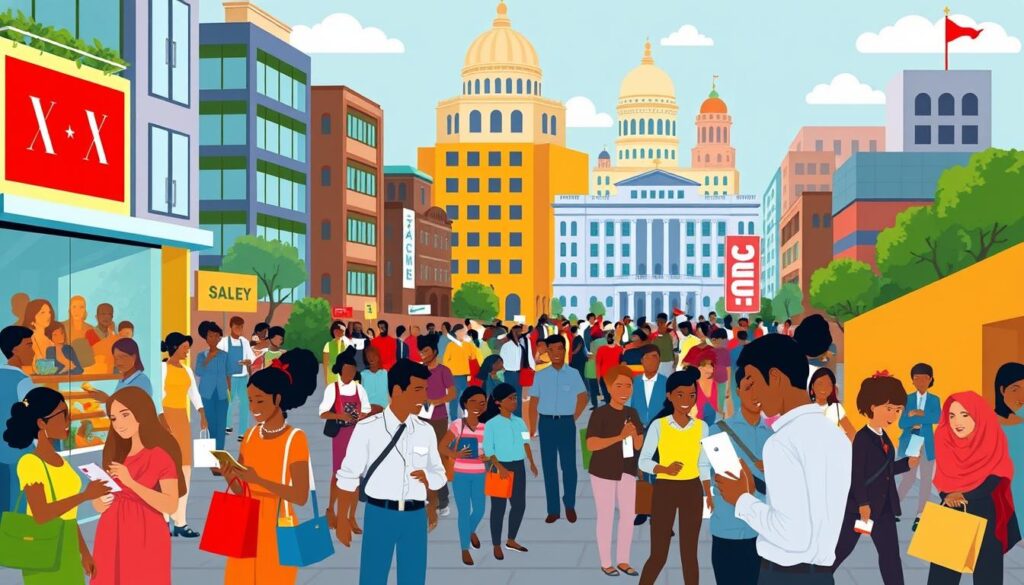
Economic policies, like government rules and spending plans, deeply affect our daily lives. They influence jobs, how much we can buy, and even our health. Think about how these policies shape your choices and chances.
In most countries, people feel the economy is struggling1. Governments respond to these issues, like cutting interest rates to 0%2 or sending money to citizens2. These policies change what we pay for things and the jobs we find.
Government rules and policies shape job chances, a big worry for young people1. The Federal Reserve manages money and guides the economy2. Knowing how these policies work helps you plan your financial future.
Key Takeaways
- Economic policies, including government regulations and fiscal measures, have a significant impact on our daily lives.
- Employment opportunities and purchasing power are influenced by economic policies1.
- The government’s response to economic challenges, such as the COVID-19 pandemic, can include reducing the federal funds rate to 0%2.
- Economic policies can affect the overall quality of life, from education to healthcare.
- Understanding how economic policies work can help you make informed decisions about your financial future.
- Economic reforms are among the top 10 most cited issues in nearly every country surveyed, including high-income countries1.
Understanding Economic Policies and Their Importance
Economic policies shape how economies work. They affect jobs and prices. Knowing these policies helps us see how governments impact our lives.
Definition of Economic Policies
Economic policies are actions by governments to manage the economy. They include monetary policy and trade agreements. These policies control money and international trade3.
Types of Economic Policies
There are many types of economic policies:
- Fiscal Policy: Uses government spending and taxes to shape the economy.
- Monetary Policy: Central banks manage money supply and interest rates.
- Trade Policy: Deals with international trade rules and tariffs.
Key Goals of Economic Policies
The main goals are to boost the economy, control inflation, and lower unemployment. Good policies help the economy grow and stay stable4. They also try to reduce income gaps, but progress is slow3.
The Impact of Economic Policies on Employment
Economic policies shape the job market. They decide how many jobs are created or lost. They also affect how much people earn in different jobs.
Job Creation and Loss
Investment and spending on infrastructure can create a lot of jobs. For example, between June 2009 and December 2017, the U.S. added 16.6 million jobs5. But, not enough economic help can lead to job losses. It’s important to have strong policies to help all sectors grow.
Wage Levels and Income Distribution
Rules like minimum wage and taxes affect how much people earn. To fight inequality, policies need to help low- and middle-wage workers. They should also work to close pay gaps between genders and races6. It’s also key to make sure everyone gets paid the same for the same work7.
| Year | Jobs Created (US) | Unemployment Rate (%) |
|---|---|---|
| 2009 | 1.5 million | 9.3 |
| 2017 | 16.6 million | 4.1 |
| 2022 | 192 million (Global) | 5.4 |
Economic Policies and Consumer Behavior
Economic policies shape how we spend, save, and invest. Knowing these policies helps us make better financial choices. These choices impact our daily lives.
Inflation and its Effects on Purchasing Power
Inflation makes money worth less over time. This means we can buy less with the same money. The U.S. Federal Reserve aims for an annual inflation rate of 2%8.
When interest rates go up, borrowing costs more. This can make people spend less and help control inflation8.
Tax Policies and Spending Habits
Taxes affect how much money we have to spend or save. Lower taxes mean more money to spend or invest. Higher taxes might make us spend less8.
Different tax policies impact different income groups. This shapes how we spend our money.
Regulation and Market Choices
A good regulatory framework keeps markets fair and safe. Laws like consumer protection and environmental standards build trust and choice9. Good regulations prevent market failures and help the economy grow.
| Policy Type | Impact on Consumers | Example |
|---|---|---|
| Inflation Control | Maintains purchasing power | Federal Reserve interest rate adjustments |
| Tax Policies | Influences spending and saving | Tax cuts or increases |
| Regulatory Framework | Ensures fair market practices | Consumer protection laws |
Evaluating the Effectiveness of Economic Policies
Looking at economic policies means we need to understand many factors. These factors help us see if policies are working as they should. We also find out where changes might be needed.
Measuring Economic Growth and Stability
Important numbers like GDP, job rates, and inflation tell us about a country’s economy. For instance, a growing GDP shows the economy is expanding. Stable job rates mean people are finding work, which is good.
These numbers help leaders see if their plans are working. They show if the economy is strong and growing well.
Public Perception and Political Implications
What people think about economic policies matters a lot. Media, education, and politics shape these views. If people think positively, they trust the government more. But, if opinions are negative, there might be calls for changes.
Future Trends in Economic Policy Development
Economic policies are changing to tackle big issues like fairness, green living, and new tech. New ideas aim to make life better and healthier. Leaders are working on policies that help everyone and make the economy strong and fair.
Good policy analysis uses many kinds of data and methods. This way, we get a clear picture of how policies affect people. By looking at different groups and using reliable studies, we can really understand policy results10. This helps make sure policies are good for everyone11.
FAQ
What are economic policies and why are they important?
A: Economic policies are strategies used by governments to shape a country’s economy. They are key because they affect jobs, how much people can buy, and more. By managing spending, money supply, and trade, these policies aim to grow the economy, control prices, and lower unemployment.
How do fiscal and monetary policies differ?
A: Fiscal policy deals with government spending and taxes to influence the economy. For example, spending more can boost the economy, while taxes can control inflation. On the other hand, monetary policy is about managing money supply and interest rates by central banks. This can change borrowing costs and spending, affecting the economy’s stability.
What are the key goals of economic policies?
Economic policies aim to grow the economy, control inflation, and reduce unemployment. They also aim to reduce income gaps and support economic development. This includes making trade agreements and improving the regulatory environment.
How do economic policies impact job creation and loss?
Economic policies greatly affect jobs by creating or destroying them. For instance, spending on projects can create jobs, while tight money policies might lead to layoffs. Government rules and analysis also shape industry stability and growth.
In what ways do economic policies affect wage levels and income distribution?
Economic policies shape wages and can either help or hurt income equality. Laws like minimum wage and progressive taxes directly affect salaries. By adjusting these, governments can make income more fair, improving community well-being.
How do economic policies influence consumer purchasing power?
Policies like monetary policy and taxes directly impact how much people can buy. For example, keeping prices stable helps maintain consumer power. Tax policies also affect disposable income, influencing spending, saving, or investing.
What role do trade agreements play in economic policy?
A: Trade agreements are vital in economic policy, setting terms for international trade. They open markets, reduce barriers, and promote economic growth. Good agreements can boost a country’s global standing.
How are the effectiveness of economic policies evaluated?
Policy success is measured by GDP, unemployment, and inflation. Analysts also look at public views and impacts on different groups. This helps governments adjust policies to improve stability and growth.
What challenges exist in assessing economic policies?
Evaluating policies is hard due to complex indicators, global factors, and diverse opinions. Media and politics can also sway public views. This requires thorough analysis and flexible strategies to accurately measure policy success.
What are the emerging trends in economic policy development?
New trends focus on income equality, sustainability, and tech disruption. Governments are using economic stimulus for innovation and green projects. There’s also a push for adaptable regulations to handle tech and global changes.
Source Links
- 3. Economic and policy changes – https://www.pewresearch.org/global/2024/03/13/economic-and-policy-changes/
- What Impact Does Economics Have on Government Policy? – https://www.investopedia.com/ask/answers/031615/what-impact-does-economics-have-government-policy.asp
- Economic policy – https://en.wikipedia.org/wiki/Economic_policy
- Economic policy – EUR-Lex – https://eur-lex.europa.eu/EN/legal-content/glossary/economic-policy.html
- Recommendations for creating jobs and economic security in the U.S.: Making sense of debates about full employment, public investment, and public job creation – https://www.epi.org/publication/creating-jobs-and-economic-security/
- The influence of economic policies on social environments and mental health – https://pmc.ncbi.nlm.nih.gov/articles/PMC11046160/
- Economic Growth – United Nations Sustainable Development – https://www.un.org/sustainabledevelopment/economic-growth/
- Which Economic Factors Most Affect the Demand for Consumer Goods? – https://www.investopedia.com/ask/answers/042815/which-economic-factors-most-affect-demand-consumer-goods.asp
- APPLYING INSIGHTS FROM BEHAVIORAL ECONOMICS TO POLICY DESIGN – https://pmc.ncbi.nlm.nih.gov/articles/PMC4265800/
- What are the best practices for conducting economic policy evaluations? – https://www.linkedin.com/advice/3/what-best-practices-conducting-economic-policy-evaluations
- Evaluating the Impacts of Local Economic Development Policies On Local Economic Outcomes: What Has Been Done and What is Doable? – https://research.upjohn.org/cgi/viewcontent.cgi?article=1106&context=up_workingpapers