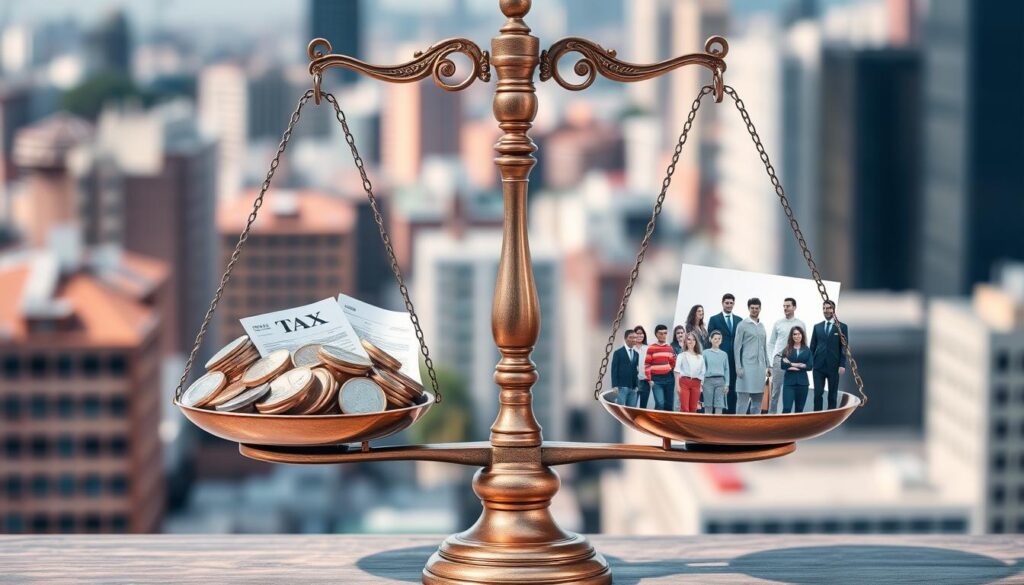
Tax policies are key in shaping a country’s economy and fighting inequality. The top fifth of earners saw their share jump from 46% to 55% from 1979 to 20191. This rise in income gap has led to a national debate on tax policies’ role in fairness. It’s time to think about how to make our system more equal and how taxes can help.
It’s vital to understand how taxes affect income inequality for a fair society. Looking at tax history and goals helps us grasp the issue better. Knowing that the rich pay more in taxes than the poor1 shows we need a smarter tax system. One that considers everyone’s income and wealth.
Key Takeaways
- Tax policies, government taxation, and fiscal policies have a significant impact on reducing inequality.
- The top fifth of the population with the highest income saw their share rise from 46% to 55% between 1979 and 20191.
- Income inequality has been consistently lower for after-tax income than for before-tax income, as measured by the Gini index1.
- Government taxation and fiscal policies can be leveraged to reduce inequality by creating a more progressive tax system.
- Understanding the historical context of tax policies and their key objectives is essential for creating a more just and equitable society.
- Tax policies should be designed to take into account the varying levels of income and wealth in a given population.
Understanding Tax Policies and Their Impact
Tax policies are key to the economy. They decide how money is made and spent. These rules affect everyone’s money and the economy’s health.
Definition of Tax Policies
Tax policies are laws about taxes. They tell us how taxes are collected and used. They also show what we must do as taxpayers and how governments make money2.
Historical Context of Tax Policies
Taxes have changed over the years. In the 1950s, the highest tax rate was over 90%. Now, it’s 37%. This shows how economic and political views have changed.
Key Objectives of Taxation
Taxes have two main goals: making money and sharing wealth fairly. Laws aim to fund public services and make sure everyone pays their fair share. The idea of progressive taxation helps those who can pay more to support everyone2.
| Aspect | Details |
|---|---|
| Total U.S. Tax Revenue (2020) | Approximately 25% of GDP2 |
| Top Income Earners’ Tax Contribution | 39% of federal individual income taxes from those earning over $200,0002 |
| Tax Rate Evolution | Top marginal rate decreased from >90% (1950s) to 37% today2 |
Mechanisms for Reducing Inequality Through Taxation
Tax systems are key in making the economic field level. By using income tax policies, governments can tackle differences effectively.
Progressive Taxation: How It Works
Progressive taxation makes sure the rich pay more. It sets tax brackets so that as income grows, so does the tax rate. This promotes fairness in the system3.
Wealth Redistribution Through Tax Credits
Tax credits help lower-income people and families. They lower the tax burden, helping to spread wealth and narrow income gaps43.
Closing Tax Loopholes and Evasion
Getting rid of tax loopholes makes sure everyone pays their share. Fighting tax evasion makes tax reforms work better, leading to a fairer system53.
Case Studies: Successful Tax Policies in Action
Looking at real-life examples shows how tax changes can help reduce inequality. These stories show different ways to tackle this issue and their results.
Scandinavian Countries’ Tax Models
Scandinavian countries use high taxes to fund social services. This helps spread wealth and lower income gaps. Yet, some argue that the high taxes are a big drawback6.
The Impact of Tax Reform in the U.S.
In the U.S., tax reforms have tried to tackle income inequality. Before these changes, the top 1% made 32 times more than the middle class. Now, it’s 25 times6. Also, the U.S. corporate tax rate is 25.8%, helping to raise more money by cutting down on bad business tax breaks6.
Lessons from Emerging Economies
Emerging economies have their own ways to fight inequality with taxes. For example, in South Africa, tobacco prices went up a lot after tax hikes. This shows that markets can handle higher taxes7. In Senegal, companies changed prices to deal with tax changes, keeping their competitiveness and helping the government’s income7. These stories show the value of flexible and well-timed tax policies in various economies.
FAQ
What are tax policies and why are they important in reducing inequality?
A: Tax policies are the rules for collecting and managing taxes. They help reduce inequality by moving wealth from the rich to the poor. This makes the economy more balanced.
How have tax policies evolved over time in the United States?
Tax policies in the U.S. have changed with the economy and society. From the early 20th century’s progressive income tax to recent reforms, they’ve adapted to address wealth and revenue issues.
What are the primary objectives of taxation?
Taxes aim to generate revenue for the government, redistribute wealth to balance income, and control behavior. These goals keep the economy stable and fair.
How does progressive taxation work and contribute to reducing inequality?
A: Progressive taxation charges higher rates on the rich. This way, the wealthy pay more, reducing income gaps and funding social programs for everyone.
In what ways do tax credits aid in wealth redistribution?
A: Tax credits help the poor by lowering their taxes. This increases their income, fighting poverty and reducing wealth differences.
What are tax loopholes and how does closing them affect economic fairness?
A: Tax loopholes let people or companies pay less tax legally. Closing them makes taxes fairer, ensuring everyone contributes equally and promoting economic equality.
What lessons can be learned from the Scandinavian countries’ tax models?
Scandinavian taxes are high but fund great social services. Their models show how strong taxes can support welfare, reduce inequality, and stabilize the economy. But, they also have high tax burdens.
How have recent tax reforms in the U.S. impacted income distribution?
U.S. tax reforms have mixed effects on income. Some have narrowed the gap by taxing the rich more, while others have kept inequality high with tax breaks for the wealthy. Despite progress, inequality remains.
What role do income tax policies play in fiscal policies?
A: Income tax policies are key to fiscal policies. They decide how much money the government gets and how it’s spent, affecting growth, spending, and fairness.
How do tax regulations and tax laws differ, and why is this distinction important?
A: Tax laws are made by legislatures, while tax regulations are rules for applying these laws. Knowing the difference is vital for following the law and effective policy.
What can emerging economies learn from established tax policies to address inequality?
Emerging economies can adopt progressive taxes, close loopholes, and redistribute wealth. These steps help fight inequality, support welfare, and encourage growth.
Source Links
- How do taxes affect income inequality? – https://taxpolicycenter.org/briefing-book/how-do-taxes-affect-income-inequality
- How Do Tax Policies Affect Individuals and Businesses? – https://siepr.stanford.edu/publications/policy-brief/how-do-tax-policies-affect-individuals-and-businesses
- Exploring the Fiscal policy—income inequality relationship with Bayesian model averaging analysis – Economic Change and Restructuring – https://link.springer.com/article/10.1007/s10644-024-09577-1
- Improving Tax Rules by Means-Testing: Bridging Wealth Inequality and “Ability To Pay” – https://digitalcommons.law.ou.edu/cgi/viewcontent.cgi?article=1320&context=olr
- Corporate taxes and economic inequality: A credit channel – https://cepr.org/voxeu/columns/corporate-taxes-and-economic-inequality-credit-channel
- 10 Tax Reforms for Growth and Opportunity – https://taxfoundation.org/research/all/federal/economic-growth-opportunity-tax-reforms/
- Undermining government tax policies: Common legal strategies employed by the tobacco industry in response to tobacco tax increases – https://pmc.ncbi.nlm.nih.gov/articles/PMC5747349/