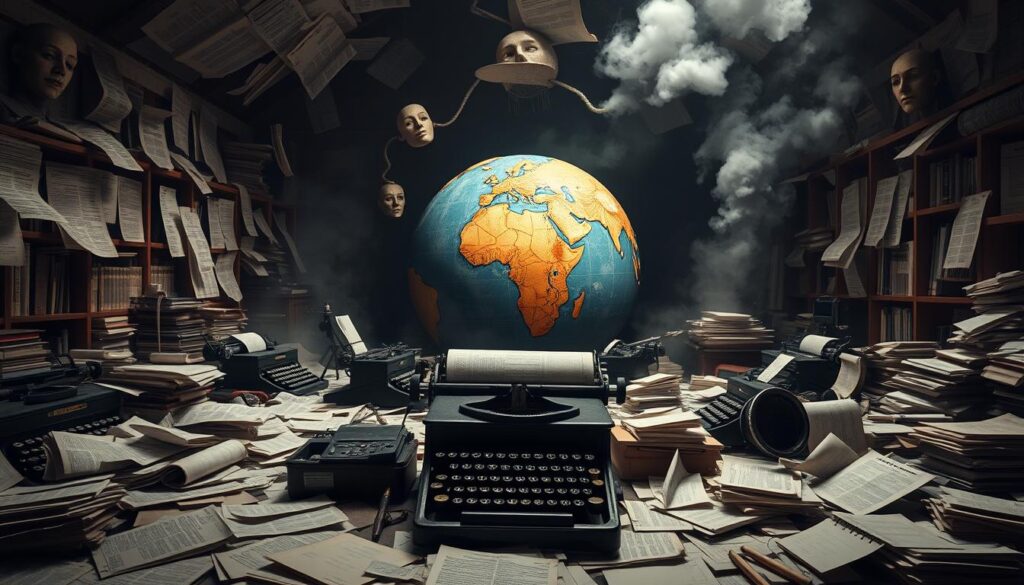
In today’s world, fake news and misinformation spread fast. They affect society and make it key for us to learn how to spot fake news1. Social media plays a big role in sharing false information1. Sites that spread fake news often look unprofessional and have too many ads2.
It’s important to learn how to tell real news from fake. This means understanding what fake news is, how common it is, and why we need to be media savvy3. By knowing how to spot fake news, like altered images, we can be smarter about what we read1. The News Literacy Project has created an app to help us get better at this, showing we need tools to fight fake news online1.
When we deal with news and information, it’s key to remember that fake news can confuse us. It can make us doubt real news sources2. By knowing about the chance of misinformation, we can protect ourselves and become more informed citizens.
Key Takeaways
- Learning to spot fake news and misinformation is vital.
- Social media plays a big part in sharing false information1.
- Fake news sites often look amateurish and have lots of annoying ads2.
- Knowing how to spot fake news helps us be smarter readers3.
- Media literacy skills help fight misinformation and make us a more informed society1.
Understanding Fake News and Its Impact
Fake news is a big problem in our digital world. It changes how we see and trust information.
Definition of Fake News
Fake news is false or misleading info passed off as real news. It tries to trick people and sway public opinion. This hurts the credibility of true news sources.
Common Types of Misinformation
Misinformation takes many forms, each playing a part in spreading false info:
- Clickbait: Headlines that grab attention and get clicks, often by exaggerating the story.
- Propaganda: Biased info meant to push a certain agenda or view4.
- Satirical Content: Funny pieces mistaken for real news, causing confusion.
Consequences of Spreading Fake News
Spreading fake news has serious effects:
- It can damage people’s reputations and lower trust in real sources5.
- At a bigger level, fake news can sway election results and spread wrong health info6.
- Constantly seeing false info can make people doubt media and science56.
| Type of Misinformation | Impact |
|---|---|
| Clickbait | Increases website traffic with misleading content |
| Propaganda | Promotes specific ideologies, reducing unbiased information |
| Satirical Content | Confuses readers about what is factual |
Tips for Identifying Fake News
In today’s fast-paced world, it’s key to tell real news from fake. Using trustworthy sources helps you find accurate info.
Verifying Sources and Credibility
First, check the website’s background. Look for clear mission statements and contact info. Good sites have detailed “About Us” sections and a strong media reputation.
- Investigate the site’s history and ownership.
- Check for a physical address and valid contact details.
- Assess the overall design and professionalism of the website.
Checking the Author’s Background
Make sure the author is credible by looking up their credentials and past work. A quick online search can show their expertise and reliable reporting history7.
Authors from well-known news outlets tend to offer trustworthy content8.
Analyzing the Content for Bias
Look at the article’s language. Biased content often uses emotional appeals and fallacies. Seek balanced reporting and diverse viewpoints to gauge credibility.
Be wary of stories with sensational headlines or no evidence98.
Tools and Resources for Fact-Checking
Having the right tools is key for fact-checking. They help you check information and make sure you use reliable sources.
Popular Fact-Checking Websites
Websites like FactCheck.org, Snopes.com, and PolitiFact.com are top choices for checking news10. They offer in-depth analysis and updates on claims. This makes it simpler to tell true news from false.
Social Media Verification Tools
Tools like Google Factcheck Explorer and Reuters News Tracer help spot and verify news on Twitter10. Our.news also helps by using the Newstrition process. This helps you identify fake news better.
Educational Resources for Media Literacy
Learning to understand media is vital today. There are online courses and workshops to improve your critical thinking11. The Verification Handbook gives detailed guides for checking content in emergencies10. Browser extensions like FakerFact.org use AI for fact-checking online10.
By learning and using these tools, you can confidently deal with the complex world of information.
FAQ
What is fake news?
A: Fake news is false or misleading info passed off as real news. It aims to trick readers, sway opinions, or grab attention with sensational headlines and made-up stories.
How does fake news differ from misinformation and disinformation?
Fake news, misinformation, and disinformation all involve false info. But, they differ in their purpose. Misinformation is wrong info shared without bad intent. Disinformation is false info spread on purpose. Fake news is made-up news meant to deceive.
What are the common types of misinformation?
There are several types of misinformation. Clickbait headlines exaggerate to get clicks. Propaganda pushes agendas. Satirical content is often mistaken for real news. Each type can distort truth and shape public views differently.
What are the consequences of spreading fake news?
Spreading fake news can cause big problems. It can harm personal reputations, sway elections, and worsen health crises. It also erodes trust in real news sources and institutions.
How can I verify the credibility of a news source?
Check a source’s credibility by looking at its “About Us” section. See if it’s owned by reputable people. Look for a track record of accurate reporting. Trusted sources have clear editorial standards and are recognized by others.
What steps can I take to check an author’s background?
Research an author’s background by looking at their professional history and previous work. A quick online search can show their affiliations and any biases. This ensures they’re an expert on the topic.
How can I analyze content for bias and emotional manipulation?
Watch for emotional language or one-sided info. Look for logical fallacies and if different views are presented. Critical reading helps spot biases and ensures a balanced view.
What are some reliable fact-checking websites?
Reliable fact-checking sites include FactCheck.org, Snopes.com, and PolitiFact.com. They focus on checking news stories and debunking false claims.
What tools can I use to verify information on social media?
Use tools like Google Images or TinEye for reverse image search. Tools like Botometer detect fake accounts. These tools help spot manipulated content and ensure social media credibility.
How can I improve my media literacy skills?
Improve your media literacy by taking online courses or workshops. Use browser extensions that encourage critical thinking. Sites like Coursera and edX offer courses on media literacy, making you a more informed info consumer.
Source Links
- Fake news: How to spot misinformation – https://www.npr.org/2019/10/29/774541010/fake-news-is-scary-heres-how-to-spot-misinformation
- How to Identify Fake News – https://usa.kaspersky.com/resource-center/preemptive-safety/how-to-identify-fake-news?srsltid=AfmBOoo0-O76kG_LElCqKMDnmVB9j9C82K8OK44OTlVL2urZfamLh9Df
- How to spot fake news: Identifying propaganda, satire, and false information | SFU Library – https://www.lib.sfu.ca/help/research-assistance/fake-news
- Research Guides: Fake News and Information Literacy: What is Fake News? – https://researchguides.uoregon.edu/fakenews/issues/defining
- LibGuides: Fake News: Consequences of Fake News – https://libguides.uvic.ca/fakenews/consequences
- Misinformation in action: Fake news exposure is linked to lower trust in media, higher trust in government when your side is in power | HKS Misinformation Review – https://misinforeview.hks.harvard.edu/article/misinformation-in-action-fake-news-exposure-is-linked-to-lower-trust-in-media-higher-trust-in-government-when-your-side-is-in-power/
- Academic Guides: Fact Check: How to decipher online news and information: Identifying Fake News – https://academicguides.waldenu.edu/library/fakenews/idfakenews
- Six tips for how to spot (and stop) fake news – ICIJ – https://www.icij.org/inside-icij/2017/10/six-tips-spot-stop-fake-news/
- Research Guides: Knowledge Is Power: Fighting Misinformation, Disinformation, and Junk News: Spotting Fake News – https://libguides.wustl.edu/evaluate_news/spot
- Tools and Resources for better fact-checking in cross-border collaboration – https://playbook.n-ost.org/research/fact-checking/tools-and-resources/
- Library: Misinformation & Disinformation: Tools to Evaluate Information – https://library.western.edu/disinfo/evaluate