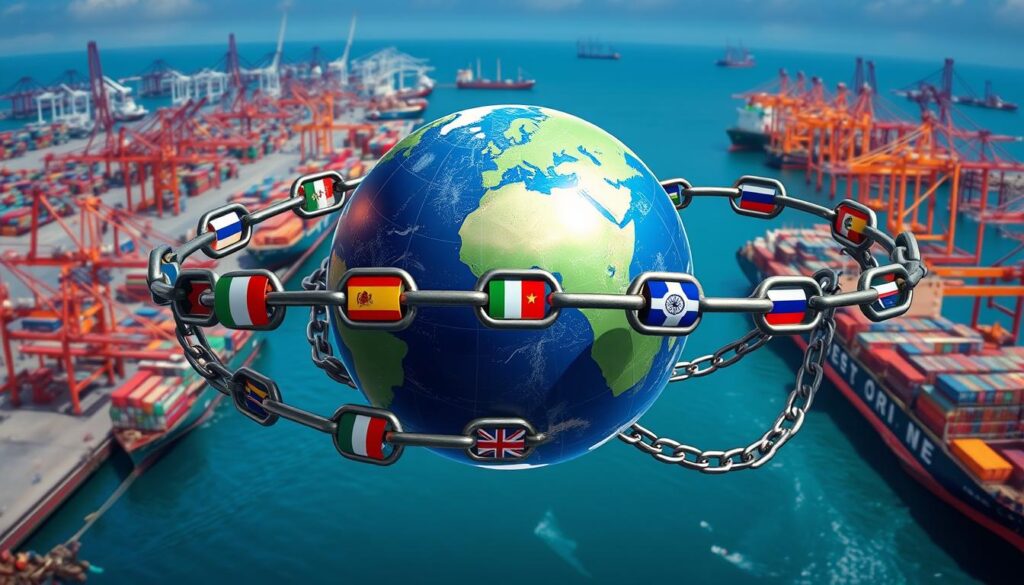
Trade agreements are key in shaping the world’s economies. They open doors for growth and development1. The General Agreement on Tariffs and Trade (GATT) was created in 1947 after World War II. It was a big step in international trade1.
Today, these agreements keep shaping global commerce. The European Union (EU) is a great example. It lets goods, services, money, and people move freely among its members2.
As the world gets more connected, trade agreements are vital. They help economies grow, improve international cooperation, and make the global market more integrated. With 355 Regional Trade Agreements (RTAs) in force, as the WTO reports2, it’s clear they’re key to global commerce. They’ve also boosted the value of exports by 0.48% through global value chains3.
Key Takeaways
- Trade agreements create opportunities for economic growth and development.
- International trade deals, such as the EU, facilitate the free movement of goods, services, money, and people.
- Global commerce pacts, like the USMCA, enhance trade flows within regions.
- Trade agreements have increased the domestic value-added content of exports by 0.48%.
- Deep trade agreements have facilitated the integration of countries into high-value added industries3.
Understanding Trade Agreements and Their Purpose
Trade agreements are key to global trade. They help countries work together by exchanging goods and services.
Definition of Trade Agreements
Trade agreements are formal deals between countries. They set rules for trade, like cutting tariffs and removing barriers. They also help countries work together economically.
Historical Context of Trade Agreements
Trade agreements have changed a lot over time. After World War II, leaders created the General Agreement on Tariffs and Trade (GATT) in 1947. This was a big step towards free trade4.
In 1995, the World Trade Organization (WTO) was formed. It helped lower tariffs and boost global trade4.
Types of Trade Agreements
There are many types of trade agreements. Each has its own purpose and involves different numbers of countries:
- Bilateral Trade Agreements: Deals between two countries to improve trade and investment.
- Multilateral Pacts: Agreements with many countries to set common trade rules.
- Regional Trade Blocs: Groups of countries in a region working together to reduce trade barriers.
| Type of Agreement | Description | Examples |
|---|---|---|
| Bilateral Trade Agreements | Trade agreements between two nations. | U.S.-Israel Free Trade Agreement |
| Multilateral Pacts | Trade agreements involving multiple countries. | World Trade Organization (WTO) |
| Regional Trade Blocs | Groups of countries within a specific region cooperating on trade. | European Union (EU), North American Free Trade Agreement (NAFTA) |
Economic Impact of Trade Agreements
Multilateral trade agreements are key in shaping the economies of countries involved. They help create economic partnerships. This leads to specialization and efficiency, boosting overall economic growth.
Trade Agreements and Economic Growth
Global commerce pacts help grow GDP by promoting technology sharing and boosting productivity. For example, free trade agreements (FTAs) in 2015 saw a 59.2% increase in US trade surpluses or a reduction in trade deficits with partner countries by $87.5 billion5.
Effects on Employment and Labor Markets
Economic partnerships can create jobs in competitive sectors but may lead to job losses in others. The Peterson Institute for International Economics found that the Trans-Pacific Partnership (TPP) would cause 53,700 jobs to change annually. These new jobs would pay more5.
Trade Agreements and Consumer Prices
Multilateral trade agreements often lower consumer prices by cutting tariffs and making goods more affordable. In 2014, FTAs saved up to $13.4 billion in tariffs. This benefit mainly went to low- and middle-income consumers5.
The Role of Trade Agreements in Global Relations
Trade agreements are key in shaping global relations. They do more than just help with trade. They help build economic partnerships and improve cooperation between countries.
Strengthening Diplomatic Ties
International trade deals help make diplomatic ties stronger. By working on trade agreements, countries build trust and respect. This is the start of bigger alliances6.
For example, NAFTA did more than just cut tariffs. It also made the political ties between the U.S., Canada, and Mexico stronger6.
Addressing Global Issues Through Trade
Trade agreements help solve global problems together. Countries can agree on standards for the environment and labor rights. This helps with sustainable growth.
Agreements like those from the World Trade Organization (WTO) help with things like intellectual property and investment rules6.
Trade Agreements and Developing Nations
For developing countries, trade agreements can really help. They get access to bigger markets and new skills and technology7. This can help grow their economy and reduce poverty.
But, it’s important to make sure these agreements are fair. This prevents economic inequality and exploitation7.
Key Trade Agreements Influencing Today’s Economy
Trade agreements are key in shaping global trade. They help countries work together economically, leading to growth and cooperation.
North American Free Trade Agreement (NAFTA)
NAFTA has changed trade among the U.S., Mexico, and Canada. Now, it’s the United States-Mexico-Canada Agreement (USMCA). The U.S. has 14 Free Trade Agreements (FTAs) with 20 countries. This helps U.S. exporters by making markets more accessible and lowering tariffs on goods8.
This change aims to update trade relations. It supports U.S. exporters in competitive markets.
Trans-Pacific Partnership (TPP)
The TPP aimed to strengthen economic ties among Pacific Rim countries. Even though the U.S. left, other countries keep working on it. They focus on cutting tariffs and protecting intellectual property.
These deals aim to make rules clearer and support sustainable growth.
European Union Trade Agreements
The European Union has many trade agreements. They help trade flow smoothly and lower tariffs. This makes the EU stronger in global markets.
Also, sectors like the chemical industry gain. They get support for innovation and lower trading costs9.
FAQ
What are trade agreements?
Trade agreements are formal contracts between nations. They outline the rules for international trade. These agreements aim to reduce barriers like tariffs and quotas, making trade smoother and more efficient.
How have trade agreements evolved over time?
Trade agreements have grown from simple economic partnerships to complex agreements involving many countries. They now cover tariffs, intellectual property, and more. This shows how the global economy has become more complex and interconnected.
What are the different types of trade agreements?
There are several types of trade agreements. These include bilateral agreements between two countries, multilateral agreements with many countries, and regional trade blocs. Tariff agreements focus on reducing or eliminating tariffs on traded goods.
How do trade agreements promote economic growth?
Trade agreements help countries grow by encouraging specialization. By reducing tariffs, countries can focus on what they do best. This leads to more productivity, innovation, and GDP growth.
What impact do trade agreements have on employment and labor markets?
Trade agreements can create jobs in competitive sectors by expanding market access. But, they can also lead to job losses in industries facing more competition. It’s important to balance these effects for fair trade benefits.
In what ways do trade agreements affect consumer prices?
Trade agreements often lower consumer prices by reducing tariffs and increasing competition. This makes goods more affordable and available, improving living standards and stimulating the economy.
How do trade agreements strengthen diplomatic ties between nations?
Trade agreements help build trust and cooperation between nations. They create a foundation for stronger diplomatic ties. This cooperation can extend beyond trade to address broader geopolitical issues.
How do trade agreements address global issues such as environmental protection and labor standards?
Modern trade agreements include provisions for environmental protection, labor standards, and intellectual property rights. These elements ensure economic growth doesn’t harm social and environmental responsibilities, promoting sustainable development.
What role do trade agreements play in the development of emerging economies?
Trade agreements are key for emerging economies, providing access to larger markets and attracting investment. They can accelerate growth and development. But, it’s important to manage challenges like economic inequality and market competition for fair benefits.
What is the North American Free Trade Agreement (NAFTA) and its significance?
NAFTA was a trade agreement between the U.S., Canada, and Mexico to eliminate trade barriers. Its renegotiation into the USMCA continues to shape trade and economic partnerships in North America.
What is the Trans-Pacific Partnership (TPP) and why is it important?
The TPP is a multilateral trade agreement in the Asia-Pacific region. The U.S. withdrew, but it remains significant for its trade liberalization and high-standard regulations. It influences geopolitical relations among member nations.
How do European Union trade agreements impact international trade?
EU trade agreements are vital for shaping international trade. They establish rules and tariff reductions with member states and partners. These agreements enhance the EU’s global market position, promote partnerships, and create a more integrated market.
What are bilateral and multilateral trade agreements, and how do they differ?
Bilateral agreements are between two countries, while multilateral agreements involve many nations. Bilateral agreements focus on specific needs and foster closer ties. Multilateral agreements offer broader market access and standardized rules across more countries.
What are tariff agreements and why are they important in trade deals?
Tariff agreements set the rates of tariffs on imported and exported goods. They are key because they affect the cost of trading goods, influence pricing, and determine industry competitiveness within participating nations.
Source Links
- Chapter 3: Trade Agreements and Economic Theory – https://www.wilsoncenter.org/chapter-3-trade-agreements-and-economic-theory
- Everything you need to know about Trade Agreements – ResearchFDI – https://researchfdi.com/everything-you-need-to-know-about-trade-agreements/
- Trade agreements and global production – https://cepr.org/voxeu/columns/trade-agreements-and-global-production
- Britannica Money – https://www.britannica.com/money/trade-agreement
- The Real Impact of Trade Agreements – https://www.bayareaeconomy.org/report/the-real-impact-of-trade-agreements/
- International Trade Agreements – Econlib – https://www.econlib.org/library/Enc/InternationalTradeAgreements.html
- Role of trade agreements in the global cereal market and implications for virtual water flows – Scientific Reports – https://www.nature.com/articles/s41598-022-10815-7
- Free Trade Agreement Overview – https://www.trade.gov/free-trade-agreement-overview
- Free Trade Agreements are Key to Economic Prosperity in Today’s World – WITA – https://www.wita.org/blogs/free-trade-agreements-prosperity/