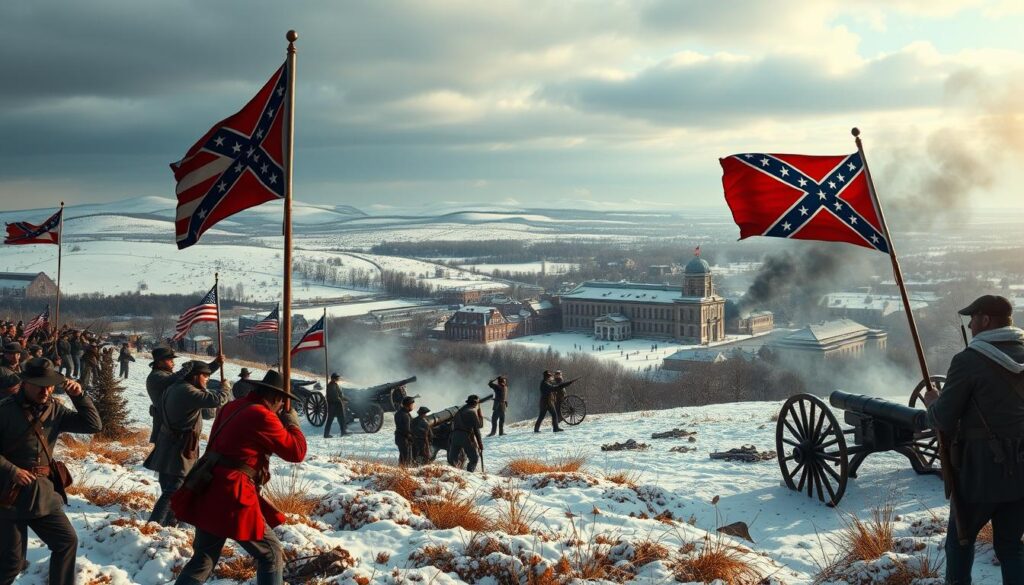
The Battle of Fredericksburg was a key event in the American Civil War1. It happened from December 11 to 15, 1862, in and around Fredericksburg, Virginia. The Union Army of the Potomac, led by Maj. Gen. Ambrose Burnside, faced off against the Confederate Army of Northern Virginia, led by Gen. Robert E. Lee. The Union had about 122,009 soldiers1, while the Confederates had around 78,5131.
Fredericksburg, Virginia, was a key location in the Eastern Theater of the American Civil War. Its strategic position made it important for both sides.
Fredericksburg, Virginia, is a historic town deeply shaped by the Battle of Fredericksburg. This battle is more than just a part of the war. It shows the importance of understanding Civil War history in American history. By studying the Battle of Fredericksburg, we can learn more about the American Civil War and its lasting impact.
Introduction to the Battle
The Battle of Fredericksburg was a major fight in the American Civil War. The Union Army lost 12,653 soldiers1, while the Confederate Army lost 5,3771. The Union Army of the Potomac had about 120,000 men2. The Confederate Army of Northern Virginia had 78,000 men2. The battle’s outcome was shaped by the strategic decisions of both commanders, including Burnside’s plan to march 40 miles to Fredericksburg, Virginia2.
Key Takeaways
- The Battle of Fredericksburg took place from December 11 to 15, 18621.
- The Union Army of the Potomac consisted of approximately 122,009 soldiers1.
- The Confederate Army of Northern Virginia had around 78,513 soldiers1.
- General Robert E. Lee commanded 78,000 men in the Army of Northern Virginia2.
- The battle resulted in significant casualties for both the Union and Confederate armies12.
- Fredericksburg, Virginia, played a critical role in the American Civil War due to its strategic location2.
Overview of the Battle of Fredericksburg
In late 1862, President Abraham Lincoln decided to replace Gen. George McClellan with Maj. Gen. Ambrose Burnside. This move was to boost the Union’s fight against Gen. Robert E. Lee’s Army of Northern Virginia.
The Battle of Fredericksburg took place in a historic town. The vibrant community of Fredericksburg was picked for its strategic spot. It was a key path to the Confederate capital of Richmond. The Union hoped to use this spot to their advantage3.
Background and Context
Before the battle, the Union Army had about 120,000 men3. The Confederate forces had around 72,500 soldiers4. This made it one of the biggest battles of the Civil War3.
Key Players Involved
Maj. Gen. Ambrose Burnside led the Union’s plan, while Gen. Robert E. Lee commanded the Confederates. Union Generals C. Feger Jackson and George Bayard, and Confederate Generals Thomas R.R. Cobb and Maxey Gregg, were key figures. They were among those who lost their lives in the intense fighting3.
Strategic Importance of Fredericksburg
Fredericksburg was key because it was on the way to Richmond. It was a vital spot for both armies. Taking control of this historic town was important for breaking Confederate supply lines and showing Union strength in the area4. Today, Fredericksburg is a top spot for tourism, attracting visitors with its history and battlefields.
Major Events During the Battle
The Battle of Fredericksburg lasted three intense days. It was filled with key military moves and fierce battles. This battle changed the Civil War’s course and left a mark on Fredericksburg. Now, it’s known for its downtown shopping, local restaurants, and wineries.
Day One: The Union’s Advance
On December 11, 1862, Union forces under Maj. Gen. Ambrose Burnside started their river crossing5. They faced strong resistance from Confederate sharpshooters. The troops moved into Fredericksburg, facing fierce street fighting that tested their will6.
Day Two: Assaults on Marye’s Heights
The second day was the bloodiest at Marye’s Heights. Union soldiers made several attacks against the Confederate lines led by Lieut. Gen. James Longstreet’s corps5. They suffered heavy losses. The stone walls were too strong, stopping the Union from breaking through6.
Day Three: The Final Push
December 13 was the battle’s last day. Union troops tried one more time to take key positions. But the Confederates held strong5. This led to a Confederate win, boosting their morale6.
| Aspect | Union | Confederate |
|---|---|---|
| Troop Strength | 120,000 | 80,000 |
| Casualties | Nearly 13,000 | Approximately 5,000 |
| Outcome | Crushing Defeat | Decisive Victory |
Today, the battle areas are peaceful. They now have lively downtown shopping, cozy local restaurants, and famous wineries. Fredericksburg has changed from a battleground to a thriving community.
Aftermath and Legacy of the Battle
The Battle of Fredericksburg had a big impact on soldiers and the Civil War. The Union’s heavy losses changed military leadership and plans. The town of Fredericksburg also became known for its Civil War history.
Casualties and Impact on Troops
Over 12,000 Union soldiers were killed, wounded, or missing after the battle. This was more than twice the Confederate losses of 5,3777. The Union’s defeat hit their morale hard, leading to General Ambrose Burnside’s resignation7.
The loss was emotionally tough for the troops. Many struggled with the defeat’s impact7.
Changes in Military Strategy
The Union’s defeat at Fredericksburg led to big changes in military strategy. General George Meade took over the Army of the Potomac. He brought new tactics that worked well at the Battle of Gettysburg7.
The Confederate army, boosted by their win, stuck to defensive strategies. This approach influenced future battles7. These changes showed the importance of flexible and strong military planning.
Commemoration and Historical Significance
Today, Fredericksburg celebrates its Civil War history with monuments, museums, and battlefields. It draws history fans and tourists7. The town has grown into a lively community that honors its past while moving forward.
Visitors can dive into the town’s history while enjoying modern comforts. Fredericksburg is a top spot for those interested in American history and culture7.
FAQ
What was the significance of the Battle of Fredericksburg in the American Civil War?
The Battle of Fredericksburg was a key fight in December 1862. It showed how important Fredericksburg, Virginia, was on the way to Richmond. The South won big, boosting their spirits and changing how the North fought.
Why was Fredericksburg, Virginia chosen as the battlefield?
Fredericksburg was key because it was on the South’s supply lines. It was also close to the Rappahannock River, making it a great spot for a battle. Its layout helped both sides move and supply their troops.
Who were the key leaders involved in the Battle of Fredericksburg?
Major General Ambrose Burnside led the Union, and General Robert E. Lee led the South. Burnside took over after Lincoln replaced McClellan. Lee used the land to his advantage, winning the battle. Their choices greatly affected the battle’s outcome.
How did the Union’s leadership change affect the battle?
Lincoln’s choice to replace McClellan with Burnside changed the Union’s plan. Burnside’s new tactics, like attacking Marye’s Heights, led to heavy losses. This change showed Lincoln wanted a more aggressive approach, but Burnside’s plan failed, hurting Union morale.
What were the major events during the Battle of Fredericksburg?
The battle lasted three days. The first day, crossing the Rappahannock River was tough for the Union. The second day, attacks on Marye’s Heights were brutal, with many Union casualties. The third day, the Union tried to break through but failed, leading to a retreat.
What were the casualties and impact of the Battle of Fredericksburg?
The battle was very bloody, with over 17,900 soldiers lost. The Union’s heavy losses hurt their morale and led to criticism of Burnside. The battle’s brutality made both sides rethink their strategies.
How did the Battle of Fredericksburg influence future Civil War strategies?
The battle showed the power of defensive positions. Lee’s success at Marye’s Heights made the South focus on defense. The Union, after their defeat, became more cautious and strategic in their planning.
How is the Battle of Fredericksburg commemorated today?
Fredericksburg remembers its Civil War past with monuments, museums, and battlefields. Visitors can see sites like Marye’s Heights and the Fredericksburg and Spotsylvania National Military Park. Reenactments and educational programs keep the battle’s memory alive.
How has Fredericksburg’s history influenced its modern-day tourism and community?
Fredericksburg’s Civil War history has made it a lively community and tourist spot. Historic sites attract visitors, while downtown offers shopping, food, and wine. This mix of history and modern life makes the town vibrant and growing.
What can visitors see today at the Battle of Fredericksburg sites?
Today, visitors can see battlefields, monuments, and museums. The Fredericksburg and Spotsylvania National Military Park offers tours and exhibits. Downtown has restaurants and wineries on historic sites, showing the town’s evolution from battle to modern community.
Source Links
- Battle of Fredericksburg – https://en.wikipedia.org/wiki/Battle_of_Fredericksburg
- Battle of Fredericksburg History – Fredericksburg & Spotsylvania National Military Park (U.S. National Park Service) – https://www.nps.gov/frsp/learn/historyculture/fburghist.htm
- Fredericksburg – https://www.battlefields.org/learn/articles/fredericksburg
- Battle Of Fredericksburg – https://www.historynet.com/battle-of-fredericksburg/
- Battle of Fredericksburg | Facts, Casualties, & Aftermath | Britannica – https://www.britannica.com/event/Battle-of-Fredericksburg
- Battle of Fredericksburg ‑ Who Won, Timeline & Location | HISTORY – https://www.history.com/topics/american-civil-war/battle-of-fredericksburg
- The Aftermath of the Battle of Fredericksburg: General Burnside’s Perspective | SchoolTube – https://www.schooltube.com/the-aftermath-of-the-battle-of-fredericksburg-general-burnsides-perspective/