The French and Indian War was a key event in North American history. It was a part of the Seven Years’ War, where the British colonies fought against the French. Both sides had support from Native American tribes1. This conflict changed the colonial landscape, affecting the British Empire and New France.
The war lasted from 1754 to 1763. It ended with the Treaty of Paris, giving Great Britain a lot of land in North America1. The British had about 2 million settlers, while the French had 60,0002. This war was a big deal for the British Empire and New France, shaping the future of the colonies.
Introduction to the French and Indian War
The French and Indian War was a complex fight involving European powers and Native American tribes. It was a big struggle between the British Empire and New France. The British won many battles, taking over French islands, Spanish Cuba, and the Philippines1.
Key Takeaways
- The French and Indian War was a key event in North American history, involving the British Empire and New France.
- The war was part of a larger struggle between European powers, including the British Empire and New France.
- The British colonies had a population of roughly 2 million settlers, compared to 60,000 in the French colonies2.
- The war lasted from 1754 to 1763, culminating in the Treaty of Paris, which resulted in significant territorial gains for Great Britain in North America1.
- The British naval strength and Spanish ineffectiveness led to British victories, with British forces seizing French Caribbean islands, Spanish Cuba, and the Philippines1.
- The war was a significant event in the history of the Seven Years’ War, and its outcome had a lasting impact on the colonial landscape.
Overview of the French and Indian War
The French and Indian War lasted from 1754 to 1763. It was a key battle in North America. The Ohio River valley was a main area of conflict, with both sides wanting control3. The French built Fort Duquesne to claim the valley4.
Causes of the Conflict
France and Britain had disagreements over land and money. The Ohio River valley was a key area of tension3. The French built forts like Duquesne to stop British growth4.
Key Players in the War
George Washington and Edward Braddock were important figures. Washington learned a lot early on, and Braddock’s failed expedition showed the war’s difficulties3. Their actions greatly influenced the war’s path4.
Timeline of Major Events
- 1754: Battle of Fort Necessity3
- 1755: Battle of the Monongahela where Braddock’s forces suffered heavy casualties4
- 1756-1763: Series of battles leading to the Treaty of Paris
| Year | Event | Outcome |
|---|---|---|
| 1754 | Battle of Fort Necessity | Washington capitulates to over 300 attackers4 |
| 1755 | Battle of Monongahela | British forces led by Braddock suffer over 900 casualties4 |
| 1758 | Siege of Fort Duquesne | French retreat, British take control |
| 1763 | Treaty of Paris | Territorial changes favor Britain |
Combat Strategies and Tactics
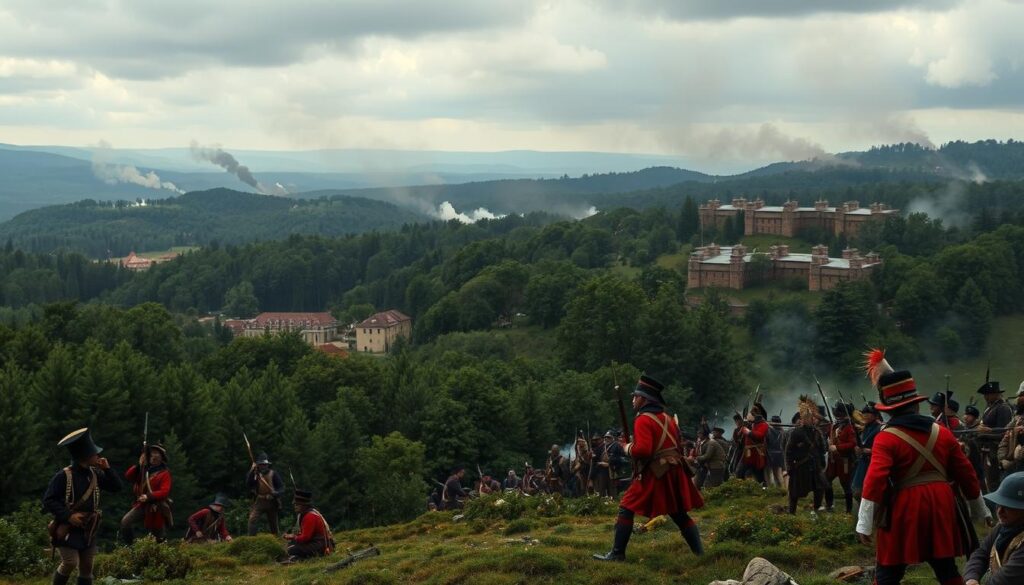
The rugged terrain of North America shaped the guerrilla warfare tactics used during the French and Indian War. Both the French and British forces had to change their European military ways to fit the frontier fighting challenges.
French Military Approaches
The French focused on being quick and sneaky, often doing fast raids and ambushes. Their strong ties with the Huron tribes helped them move through dense forests and waterways well. This made them strong in unconventional battles.
British Military Strategies
At first, British forces found it hard to use traditional European tactics in the wilderness. But, they soon got better, using local knowledge and frontier fighting methods. Mixing regular troops with colonial militias made them more effective5.
Role of Native American Allies
Native American tribes were key in the war. The Iroquois Confederacy and the Huron tribes helped a lot with their guerrilla skills and knowledge of the land. Their help was very important in many battles6.
| Alliance | Contributions |
|---|---|
| Iroquois Confederacy | Intelligence gathering, reconnaissance, and coordinated attacks |
| Huron tribes | Navigating waterways, guerrilla warfare, and logistical support |
Consequences of the War
The French and Indian War changed North America a lot. The Treaty of Paris in 1763 was a big deal. It changed who controlled the land, making a big difference in the continent’s politics.
Treaty of Paris and Territorial Changes
The Treaty of Paris gave Britain control over Canada and all French lands east of the Mississippi River. But, it didn’t include New Orleans or some West Indies areas7. Britain also got Florida from Spain and more in the Caribbean7. This made Britain’s presence in North America much bigger8.
Impact on Native American Tribes
The British victory upset the balance for many Native American tribes. British rules stopped them from moving west, causing a lot of tension8. The Proclamation Line of 1763 made things worse for both settlers and Native Americans7.
Long-term Effects on British Colonial Policy
Britain had to pay a lot of money after the war. So, it started taxing its American colonies, which made them very upset7. The Proclamation of 1763 was meant to calm things down but actually made things worse. It helped grow the desire for independence that led to the American Revolution8.
FAQ
What was the French and Indian War?
The French and Indian War was a major conflict from 1754 to 1763. It was part of the global Seven Years’ War. The war was fought between the British Empire and New France in North America. It also involved many Native American tribes, who fought on either side.
What were the main causes of the French and Indian War?
The war started over land and money in the Ohio River Valley. The British and French wanted to control this area. Their rivalry led to fights and the start of the war.
Who were the key players in the French and Indian War?
Important figures included George Washington and General Edward Braddock from the British. The French had their own leaders. Many Native American tribes, like the Iroquois and Huron, also played big roles.
What were the major events and timeline of the French and Indian War?
The war began with fights in the Ohio River Valley. The Battle of Fort Duquesne was a key moment. General Braddock’s expedition and Washington’s battles were also important. The British won, leading to the Treaty of Paris in 1763.
How did the French and Indian War influence military strategies?
The war made both sides change their fighting ways. The French used surprise attacks and worked with Native Americans. The British learned from their mistakes and got better at fighting in the wilderness.
What were the consequences of the French and Indian War?
The Treaty of Paris in 1763 changed North America. It made the British the main power and ended French rule. The war also hurt Native American tribes and their ways of life. The British then put new rules and taxes on the colonies, leading to the American Revolution.
How did the French and Indian War lead to the American Revolution?
After the war, the British put new rules and taxes on the colonies. These actions made the colonists angry. This anger helped start the American Revolution.
Source Links
- Milestones in the History of U.S. Foreign Relations – https://history.state.gov/milestones/1750-1775/french-indian-war
- French and Indian War – https://en.wikipedia.org/wiki/French_and_Indian_War
- French and Indian War | Definition, History, Dates, Summary, Causes, Combatants, & Facts | Britannica – https://www.britannica.com/event/French-and-Indian-War
- The French and Indian War (1754-1763): Causes and Outbreak – https://www.battlefields.org/learn/articles/french-and-indian-war-1754-1763-causes-and-outbreak
- French and Indian Wars – https://en.wikipedia.org/wiki/French_and_Indian_Wars
- French and Indian War – https://www.mountvernon.org/library/digitalhistory/digital-encyclopedia/article/french-and-indian-war
- The French and Indian War (1754-1763): Its Consequences – https://www.battlefields.org/learn/articles/french-and-indian-war-1754-1763-its-consequences
- Confronting the National Debt: The Aftermath of the French and Indian War – https://pressbooks-dev.oer.hawaii.edu/ushistory/chapter/confronting-the-national-debt-the-aftermath-of-the-french-and-indian-war/