The Yom Kippur War started on October 6, 1973, during Yom Kippur, the holiest day in Judaism. It was a clash between Israel and Arab states, led by Egypt and Syria. This war changed the Middle East’s politics for many years, marking a key moment in the Arab-Israeli conflict1.
The fighting lasted about 20 days, ending on October 26, 19732. Egypt, Israel, and Syria were the main players in this conflict2.
The Yom Kippur War began on October 6, 19731. It was also called the 1973 Arab–Israeli War or the Fourth Arab–Israeli War. We will look into its causes, major events, and how it affected the region. This includes the peace deal between Israel and Egypt on March 26, 19792.
Key Takeaways
- The Yom Kippur War was a key moment in Middle Eastern history, starting on October 6, 1973.
- The conflict involved Israel and Arab states, led by Egypt and Syria, lasting about 20 days2.
- The war was a major event in the Arab-Israeli conflict, with a peace deal between Israel and Egypt on March 26, 19792.
- The war deeply affected the region, with a UN peacekeeping force creating a buffer zone between Israel and Egypt2.
- The Yom Kippur War was also known as the 1973 Arab–Israeli War or the Fourth Arab–Israeli War. It happened during Yom Kippur, the holiest day in Judaism1.
- An Egyptian-Israeli cease-fire was agreed upon by the United Nations on October 25, 19731.
- In 1974, the first of two Egyptian-Israeli disengagement agreements were signed, returning parts of the Sinai to Egypt1.
Background of the Yom Kippur War
The Yom Kippur War was a key event in the Arab-Israeli conflict. It was caused by Israel’s gains in the Six-Day War. Neighboring Arab nations wanted to take back their lost lands.
Historical Context of the Conflict
After the Six-Day War, Israel controlled Egypt’s Sinai, half of Syria’s Golan Heights, and the West Bank3. This change upset the balance of power in the region. It made Arab states want to get back their lost territories.
Key Players Involved
Important leaders played big roles in the war. Egypt’s President Anwar Sadat wanted to end the diplomatic stalemate. Israel’s Prime Minister Golda Meir aimed to keep Israel’s strategic advantage3.
Prelude to the War
Before 1973, peace talks failed and tensions rose. Both sides got ready for war, even during important religious times like Yom Kippur.
| Forces | Israel | Egypt | Syria | Allied Arab Forces |
|---|---|---|---|---|
| Troops | 375,000-415,0003 | 650,000-800,0003 | 150,0003 | 120,0003 |
| Tanks | 1,7003 | 1,7003 | 1,2003 | 500-6703 |
| Artillery Units | 9453 | 1,1203 | 6003 | — |
| Combat Aircraft | 4403 | 4003 | — | — |
Major Events During the War
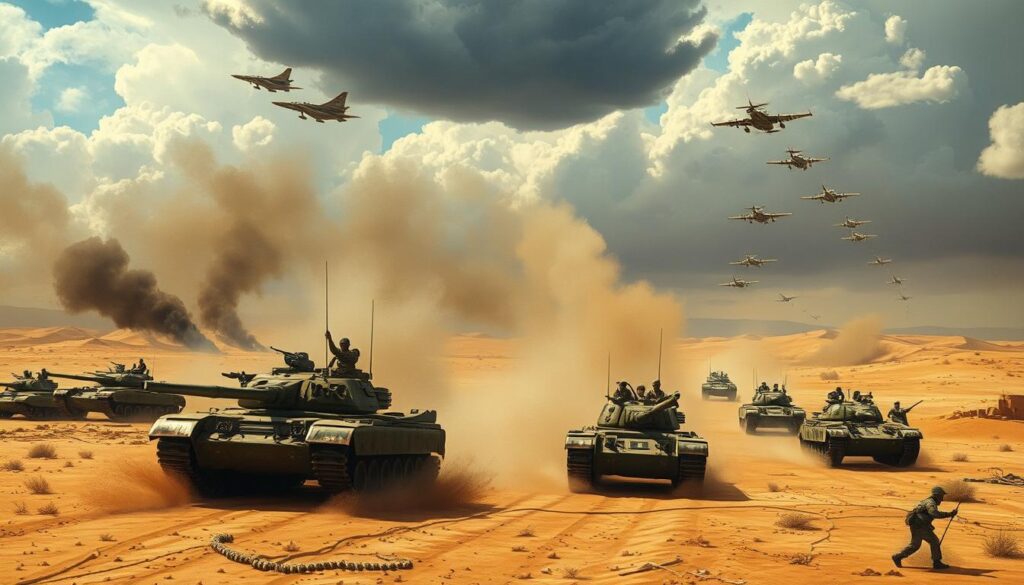
The Yom Kippur War saw intense military actions that changed the war’s path. Both sides used tactics that shaped the war’s course from the start.
Initial Attacks and Strategies
On October 6, 1973, Egypt and Syria launched a surprise attack. Many Israelis were in Yom Kippur prayers. Egyptian forces quickly crossed the Suez Canal, with fewer casualties than expected4. At the same time, Syrian troops moved into the Golan Heights, putting pressure on Israeli defenses.
Key Battles and Turning Points
The war saw huge tank battles, like those in the Sinai and Golan Heights. Israel lost about 2,500 soldiers5. Only 100 out of 265 tanks in the first line survived6. These battles were key, helping Israel launch a counterattack that changed the war’s direction.
Role of International Forces
International help was key to the war’s outcome. The United States started Operation Nickel Grass, airlifting vital supplies to Israel4. The Soviet Union helped Egypt and Syria, raising global tensions4. This support affected both the military strategies and the Cold War’s broader tensions.
Aftermath and Consequences
The Yom Kippur War changed Middle Eastern politics a lot. It didn’t solve the Arab-Israeli conflict right away. But it started a path towards peace.
Political Changes in the Region
After the war, big changes happened. Israel lost its image of being unbeatable. This led to big changes in its politics and new leaders7. Arab countries, like Egypt, felt more confident and strong in talks.
Impact on Israel and Arab Nations
The war changed Israel and Arab countries a lot. Israel had to rethink its military and government. Arab countries felt proud and more respected, helping the peace talks8.
Long-term Effects on Middle Eastern Relations
The Yom Kippur War helped start lasting peace talks. The UN Resolution 338 led to ceasefire talks and the Camp David Accords9. The oil embargo also showed how connected the world is through energy.
| Consequence | Impact |
|---|---|
| Political Landscape | Shifted power dynamics, emergence of new leaders |
| Peace Process | Led to Camp David Accords and Egypt-Israel Peace Treaty |
| Global Economy | Oil embargo caused energy crisis and economic instability |
| International Relations | Enhanced diplomatic efforts, influenced Middle Eastern alliances |
| Long-term Stability | Established foundations for ongoing peace negotiations |
Significance of Yom Kippur War
The Yom Kippur War was a key event in Middle Eastern history. It changed military and diplomatic strategies for many years.
Lessons Learned from the Conflict
The war showed major flaws in military planning and intelligence. Israel learned a hard lesson after losing a lot of its tanks in the first days10. This made them rethink their military approach, focusing on being ready and flexible.
It also taught the value of diplomacy. Peace talks were seen as a better way to solve problems than constant fighting11.
Memorialization and Commemoration
In Israel, the war is remembered with fasting and reflection. It honors those who lost their lives and shows respect for the challenges faced11. On the other hand, Egypt sees the war as a victory, celebrating the Suez Canal crossing and the return of Sinai11.
These different ways of remembering the war show its lasting impact on national identity and memory.
Influence on Future Conflicts
The Yom Kippur War greatly affected future military and diplomatic actions. It showed that peace talks could lead to lasting agreements, like the Camp David Agreement in 197912. It also led to peace treaties with Jordan12.
The war taught the importance of regional stability. It encouraged countries to choose diplomacy over long wars. These lessons help shape today’s military and peace strategies, aiming for lasting peace1112.
FAQ
What was the Yom Kippur War?
The Yom Kippur War, also known as the 1973 Arab-Israeli War, started on October 6, 1973. It happened on Yom Kippur, the holiest day in Judaism. Israel fought against a coalition of Arab states led by Egypt and Syria. This war changed the Middle East’s politics a lot.
Why did the Yom Kippur War begin on Yom Kippur?
Egypt and Syria chose Yom Kippur to attack Israel. They wanted to surprise Israel. Many Israeli soldiers and civilians were fasting and praying, making them less ready for the attack.
Who were the key leaders involved in the Yom Kippur War?
Egypt’s President Anwar Sadat wanted to take back lost territories. Israel’s Prime Minister Golda Meir had to defend Israel and respond to the attack.
What were the major turning points during the Yom Kippur War?
Key moments were when Egyptian forces crossed the Suez Canal and Syrian troops entered the Golan Heights. Israel then launched a strong counterattack. The U.S. airlift and Soviet support also played big roles.
How did international powers influence the Yom Kippur War?
The U.S. supported Israel with Operation Nickel Grass. The Soviet Union helped the Arab side. This made the war a global issue, showing the Cold War’s impact.
What were the long-term consequences of the Yom Kippur War?
The war led to big political changes. The Camp David Accords and Egypt-Israel Peace Treaty were signed. It also caused an oil embargo, leading to an economic crisis in the West. It changed alliances and diplomacy in the Middle East.
How is the Yom Kippur War remembered and commemorated today?
In Israel, the war is seen as a time of weakness and sacrifice. In Egypt, it’s celebrated as a victory. Memorials and ceremonies remember the war’s impact on national memories and relations.
Source Links
- Yom Kippur War ‑ 1973, Summary & Map | HISTORY – https://www.history.com/topics/middle-east/yom-kippur-war
- Yom Kippur War | Summary, Causes, Combatants, & Facts | Britannica – https://www.britannica.com/event/Yom-Kippur-War
- Yom Kippur War – https://en.wikipedia.org/wiki/Yom_Kippur_War
- 50 Years On: Explaining the Yom Kippur War – https://www.american.edu/sis/news/20231006-50-years-on-explaining-the-yom-kippur-war.cfm
- Timeline of Yom Kippur War – Jewish Telegraphic Agency – https://www.jta.org/1998/09/20/lifestyle/timeline-of-yom-kippur-war
- The Yom Kippur War (October 1973) – https://embassies.gov.il/MFA/AboutIsrael/history/Pages/The Yom Kippur War – October 1973.aspx
- Yom Kippur War – (AP European History) – Vocab, Definition, Explanations | Fiveable – https://library.fiveable.me/key-terms/ap-euro/yom-kippur-war
- Milestones in the History of U.S. Foreign Relations – https://history.state.gov/milestones/1969-1976/arab-israeli-war-1973
- How the Yom Kippur war led to a new order within Israel and beyond – https://www.theguardian.com/world/2023/oct/01/how-the-yom-kippur-war-led-to-a-new-order-within-israel-and-beyond
- Crossing under Fire – https://www.usmcu.edu/Outreach/Marine-Corps-University-Press/Expeditions-with-MCUP-digital-journal/Crossing-under-Fire/
- 4 Lessons From The Yom Kippur War – https://www.ajc.org/news/4-lessons-from-the-yom-kippur-war
- Yom Kippur War Implications | My Jewish Learning – https://www.myjewishlearning.com/article/yom-kippur-war-implications/