
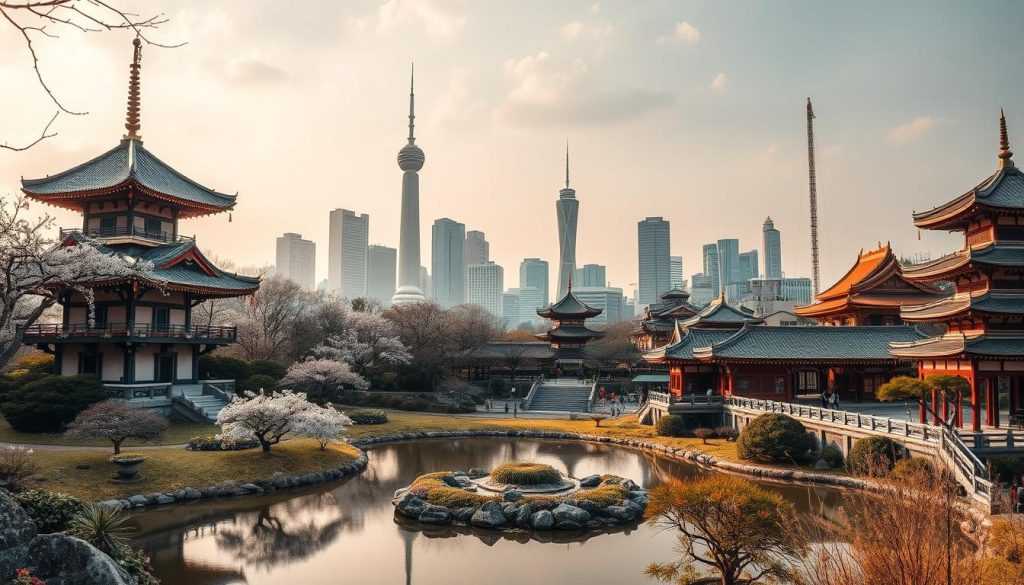
China and Japan showcase fascinating cultural diversity, despite being close neighbors. Their unique Eastern philosophies and social practices reveal deep insights. While sharing some cultural elements, their approaches to daily life differ greatly12.
Chinese and Japanese cultures show stark contrasts in social dynamics. Japanese society values formal social hierarchies, even with slightly older acquaintances. Chinese interactions, however, tend to be more flexible and direct13.
Public behavior highlights their cultural differences. Japanese people are known for their self-discipline and quiet demeanor in public. Chinese individuals typically display more vocal and expressive communication styles13.
These behavioral nuances reflect deeper cultural values. They showcase the unique societal frameworks of both nations.
Key Takeaways
- Cultural differences extend beyond geographical proximity
- Social hierarchy plays a critical role in both societies
- Communication styles vary dramatically between China and Japan
- Public behavior reflects underlying cultural philosophies
- Eastern philosophies showcase unique interpersonal dynamics
Historical Origins and Cultural Evolution
Chinese and Japanese cultures have a complex relationship spanning thousands of years. Their interaction has shaped unique identities for both civilizations. Asian traditions have played a key role in this process4.
Ancient Chinese Influence on Japan
Japan’s first major connections with other cultures began around 400 BCE. These connections came mainly through migrants from continental Asia4.
Early interactions included fascinating diplomatic exchanges. These exchanges reveal the growing relationship between the two cultures.
- First tribute missions to China recorded in 57 CE and 107 CE4
- Queen Himiko sent diplomatic embassies to China between 238-248 CE4
- Between 607-839 CE, Japan conducted 19 state-sponsored missions to China4
Development of Distinct National Identities
Confucianism and Buddhism greatly influenced both cultures. These philosophies created subtle differences in social structures. Collectivism vs individualism became key factors in their cultural growth5.
Impact of Isolation vs. External Contact
China experienced diverse cultural interactions over time. Japan, however, maintained relative isolation, shaping its unique national character. The Heian Period marked a big change in Japanese culture6.
Cultural exchange is not about imitation, but mutual understanding and transformation.
Trade between China and Japan included many luxury items. These ranged from medicines and silk to pearls and musical instruments4.
These interactions created complex, interconnected cultural landscapes. Yet, both nations maintained their distinct identities throughout history.
Chinese vs Japanese Culture: Core Values and Social Norms
Eastern philosophies shape China and Japan’s social landscapes, revealing fascinating nuances in honor and respect. These cultures show unique approaches to collectivism and individualism. Their social interactions create rich tapestries of cultural diversity7.
Harmony is a key principle in Japanese culture. It shows up in complex social behaviors. The Japanese focus on societal balance and avoid direct confrontation7.
Chinese culture, however, favors more direct communication. They value straightforward exchanges in their interactions.
- Japanese culture emphasizes subtle non-verbal communication
- Chinese culture values more explicit verbal expression
- Both societies deeply respect hierarchical structures
Confucian values greatly influence both cultures. These shared foundations shape their social interactions8. The patriarchal system remains strong, with the eldest male usually leading family units78.
“Respect is not commanded, but earned through understanding and patience.”
Religious practices set these cultures apart. Both embrace Buddhist traditions. Japanese society uniquely mixes Buddhism with Shinto beliefs7.
Chinese and Japanese cultures share deep respect for tradition. They value collective well-being and complex social protocols. Their approach to honor puts community harmony first8.
Traditional Arts and Daily Life Distinctions
Chinese and Japanese cultures differ in language, writing, and art. These differences show their unique histories and identities9. East Asian artistic intersections reveal how language shapes art and literature in these societies.
Japanese writing mixes Chinese characters with its own scripts10. The Heian period saw unique Japanese writing styles emerge10. Japan’s creative sector, at 37%, now influences global art trends11.
Japanese architecture follows natural landscapes, unlike symmetrical Chinese temples10. Modern Japanese homes now use concrete and stucco with Western influences9. Japanese design values simplicity and understated beauty.
Chinese food is bold and spicy, while Japanese cuisine is subtle and precise. The Japanese tea ceremony, from the 16th century, turns eating into art10. These food practices show cultural values of harmony and respect.
FAQ
What are the main philosophical influences on Chinese and Japanese cultures?
Confucianism and Buddhism shape both Chinese and Japanese cultures. In China, Confucianism stresses social hierarchy and group harmony. Japan interprets it more subtly in social interactions and respect structures.
Buddhism also differs between the two. Japanese Zen Buddhism focuses on meditation and spiritual minimalism. Chinese Buddhist practices are more ritualistic in nature.
How do communication styles differ between Chinese and Japanese cultures?
Japanese culture values indirect communication to maintain social harmony. They use subtle body language and context to convey meaning. Chinese communication is more direct and straightforward.
Chinese people tend to be more explicit in their verbal expression. This contrasts with the Japanese approach of avoiding direct confrontation.
What are the key differences in social structures between China and Japan?
Both cultures are collectivist, but with unique approaches. Japanese collectivism focuses on group consensus and conformity. Chinese collectivism is family-centered and hierarchical, respecting elders and social positions.
Japanese society is more uniform overall. Chinese society allows for more individual variation within collective frameworks.
How do writing systems differ between Chinese and Japanese cultures?
Chinese uses simplified or traditional characters called Hanzi. Japan adopted these characters and created a more complex system. Japanese writing combines Kanji (Chinese characters), Hiragana, and Katakana.
This mix reflects Japan’s ability to integrate and transform external influences. It creates a more nuanced written language compared to Chinese.
What are the main culinary differences between Chinese and Japanese cuisines?
Chinese cuisine features diverse regional styles and bold flavors. It often involves family-style shared dishes and varied cooking techniques. Japanese cuisine focuses on minimalism, presentation, and individual portions.
Japanese cooking highlights fresh ingredients and subtle flavors. It uses methods like steaming and raw preparation to preserve natural tastes.
How do traditional arts reflect the cultural differences between China and Japan?
Chinese traditional arts often use grand, symmetrical designs and bold colors. This reflects a more expansive cultural perspective. Japanese arts emphasize minimalism, negative space, and harmony with nature.
Examples of Japanese art include ikebana (flower arrangement) and zen gardens. Chinese art tends to be more ornate and symbolic.
What role does historical isolation play in these cultural differences?
Japan’s isolation period (Sakoku) from 1639 to 1853 shaped its unique cultural identity. This time allowed Japan to preserve and refine existing traditions.
China experienced more external interactions and invasions. This led to a more adaptive and synthesized cultural development. Japan’s isolation helped create its distinctive approach to traditional practices.
Source Links
- The Chinese and Japanese Difference in Language and Culture – https://www.pandanese.com/blog/difference-between-japanese-and-chinese
- Identifying Contrasting Chinese and Japanese Cultural Values Implications for Intercultural Youth Education – https://www.scirp.org/journal/paperinformation?paperid=59695
- The Cultural Differences and Similarities Between China and Japan – https://historyplex.com/cultural-differences-similarities-between-china-japan
- Ancient Japanese & Chinese Relations – https://www.worldhistory.org/article/1085/ancient-japanese–chinese-relations/
- History of China–Japan relations – https://en.wikipedia.org/wiki/History_of_China–Japan_relations
- Celebrating our Asian Heritage: The History of Japanese & Chinese Traditions in Each Design – https://kimandono.com/blogs/journal/celebrating-our-asian-heritage-the-history-of-japanese-chinese-traditions-in-each-design?srsltid=AfmBOoq_oPTXpaOXrIH1ktATzR299AM-NnHWi2YYdagmtQZPjpxpOJYz
- Contrasts in Japanese & Chinese cultures – CMM Languages – https://www.cmmlanguages.com/2021/04/01/contrasts-in-japanese-and-chinese-cultures/
- Major Culture Differences Between China and Japan – https://www.ccjk.com/major-culture-differences-between-china-and-japan/
- Japan – Culture, Traditions, Religion | Britannica – https://www.britannica.com/place/Japan/Cultural-life
- Japanese art | History, Characteristics, & Facts | Britannica – https://www.britannica.com/art/Japanese-art
- Understanding the social cultural differences between China, Japan and South Korea for better communication – https://glocalities.com/news/understanding-the-social-cultural-differences-between-china-japan-and-south-korea-for-better-communication

