
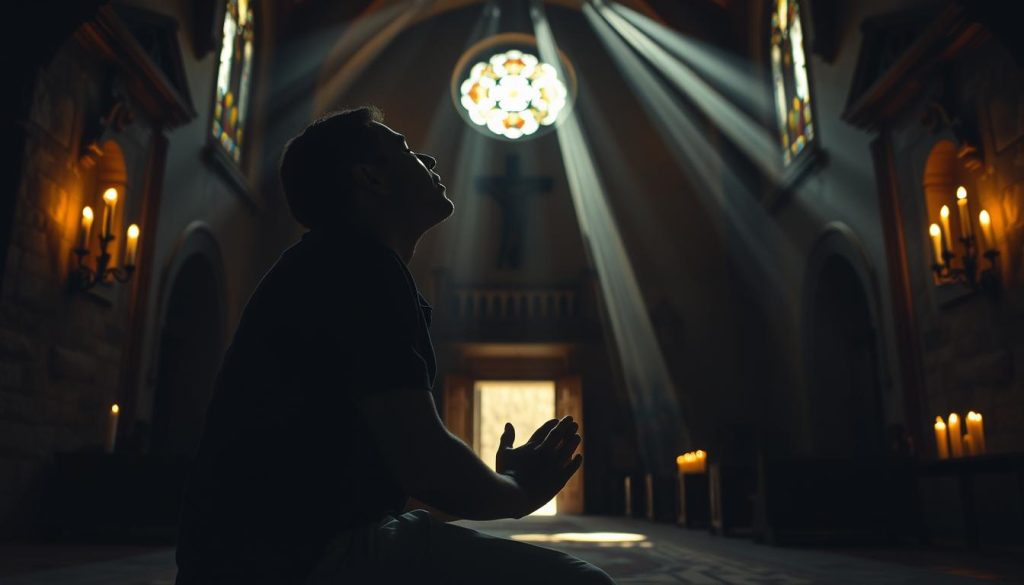
Praying in Spanish connects believers across diverse cultures. It’s a deep spiritual practice with rich traditions. Spanish prayers offer many ways to express faith and talk to God1.
Spanish-speaking communities blend Catholic practices with personal spiritual experiences. “Rezar” is used in formal church settings. “Orar” is more common in everyday conversations about prayer1.
Key prayers like Ave Maria and Padre Nuestro are central to Spanish-speaking regions. These prayers show deep religious roots that go beyond borders1.
Key Takeaways
- Spanish prayers offer diverse spiritual expressions
- Different verbs like “rezar” and “orar” have unique prayer contexts
- Catholic and Protestant traditions influence prayer language
- Personal and formal prayer styles exist in Spanish
- Prayer connects believers across cultural landscapes
Understanding Orar vs Rezar: Key Differences in Spanish Prayer
Spanish prayer offers two main ways to connect with the divine: orar and rezar. Each method carries unique spiritual significance2. These approaches reflect the depth of devotion in Spanish-speaking cultures.
Knowing the differences between these prayer forms can deepen your spiritual practice. Some people pray up to five times daily. They choose specific times like sunrise, midday, and sunset3.
Personal Prayer with Orar
Orar en español is an intimate, heartfelt talk with God. It involves spontaneous, personal communication straight from the heart2. This type of prayer is unscripted and emotionally direct.
- Spontaneous dialogue with the divine
- Personal and unscripted expressions
- Direct emotional connection
Formal Prayer with Rezar
Rezar en español focuses on reciting traditional, memorized prayers. It uses structured invocations passed down through generations2. This approach follows set formats and repeats sacred communal prayers.
- Reciting established prayer texts
- Following traditional liturgical formats
- Repeating sacred communal prayers
When to Use Each Prayer Form
Choosing between orar and rezar depends on context and personal preference. Believers worldwide maintain deep connections through various prayer approaches3.
Prayer is not about rigid practices but about meaningful encounters with the divine2.
Both personal reflection and communal traditions enrich one’s spiritual journey. Understanding these prayer forms deepens spiritual experiences in Spanish-speaking cultures.
Essential Spanish Prayers and Their Meanings
Spanish spiritual meditation unveils a rich tapestry of prayers connecting believers with divine guidance. Catholic tradition offers profound Spanish supplications as powerful spiritual tools. These prayers serve for personal reflection and worship.
- Padre Nuestro (Our Father): A foundational prayer that children learn early, representing the core of Christian communication with God4.
- Ave María (Hail Mary): A cornerstone of daily devotion, particularly in the Rosary, practiced by approximately 90% of Catholics in Spanish-speaking countries4.
- La Señal de la Cruz (Sign of the Cross): Learned by 85% of children in Catholic households as their first prayer4.
Each prayer holds deep spiritual meaning. The Gloria prayer has a rhythmic structure that helps with memorization. This makes it especially effective for children to learn4.
Spanish spiritual meditation goes beyond simple recitation. It invites believers into a profound dialogue with the divine. This practice deepens one’s connection to faith.
| Prayer Name | Significance | Usage Frequency |
|---|---|---|
| Padre Nuestro | Foundational Christian Prayer | Daily |
| Ave María | Marian Devotion | Rosary Prayers |
| El Credo | Statement of Beliefs | Liturgical Celebrations |
Grasping these prayers requires more than translation. It demands spiritual engagement and understanding. Spanish spiritual meditation connects heart, mind, and soul through carefully crafted supplications.
These prayers have been passed down through generations. They continue to inspire and guide believers in their spiritual journeys today.
Conclusion
Praying in Spanish opens a gateway to understanding religious traditions and cultural connections. The journey through oraciones en español reveals a rich tapestry of spiritual expression. These prayers offer a meaningful approach to worship for both native speakers and language learners5.
The differences between “orar” and “rezar” show how Spanish-speaking communities engage with prayer. Praying in Spanish connects people with a vibrant spiritual heritage. Each prayer carries emotional depth and cultural significance beyond mere words5.
Learning oraciones en español is a spiritual journey, not just a language exercise. These prayers provide insights into Hispanic Catholic traditions. They invite individuals to experience a closer connection with their faith.
Embracing these prayers can transform one’s spiritual practice. They bring new dimensions of understanding and reverence. Your exploration of Spanish prayers will deepen your appreciation for this form of expression.
We encourage you to keep exploring Spanish prayers. Practice what you’ve learned and listen to native speakers. Immerse yourself in these rich spiritual traditions. Your journey will surely enrich your spiritual life5.
FAQ
What is the difference between “orar” and “rezar” in Spanish prayer?
“Orar” is personal, intimate communication with God using your own words. “Rezar” involves reciting formal, memorized prayers. “Orar” is spontaneous and conversational, while “rezar” follows traditional prayer formats.
What are some of the most important Spanish prayers in Catholic tradition?
Key Spanish prayers include the Padre Nuestro (Our Father) and Ave María (Hail Mary). The Gloria (Glory Be) and Rosario (Rosary) are also fundamental. These prayers are crucial in Catholic spiritual practice.
How can I improve my pronunciation of Spanish prayers?
Listen to native speakers and use language learning apps. Watch Spanish religious videos and practice regularly. Pay attention to specific sounds like rolled ‘r’ and soft consonants.
Break down prayers word by word. This can help you become more comfortable with pronunciation.
Are Spanish prayers only for native Spanish speakers?
Spanish prayers can be meaningful for anyone interested in spiritual practice. They offer a beautiful way to connect with Hispanic Catholic traditions. These prayers can be a powerful tool for personal spiritual growth.
When is it appropriate to use personal prayer (orar) versus recited prayer (rezar)?
Use “orar” for personal reflection, seeking guidance, or expressing gratitude. It’s best for sharing personal thoughts with God.
“Rezar” is typically used during formal religious services and group prayers. It’s also used when following traditional prayer routines like the Rosary.
Can non-Catholics use Spanish prayers?
Yes, Spanish prayers can be appreciated by individuals from various spiritual backgrounds. They offer profound spiritual insights. These prayers can help explore different cultural and religious expressions of faith.
How can learning Spanish prayers help me understand Hispanic Catholic culture?
Learning Spanish prayers provides insight into Hispanic communities’ rich spiritual traditions. It helps you understand cultural nuances and spiritual practices. You’ll also grasp the deep religious significance embedded in language and prayer.
Source Links
- SpanishDictionary.com – https://www.spanishdict.com/answers/134598/i-am-praying-for-you
- Lectio Divina Part III: Prayer – Abiding In Love and Truth – https://www.abideinlove.com/wp/?p=1426
- they pray – Spanish translation – Linguee – https://www.linguee.com/english-spanish/translation/they pray.html
- Top 10 Catholic Prayers in Spanish Every Child Should Learn – https://www.waterfrontacademy.org/single-post/top-10-catholic-prayers-in-spanish-every-child-should-learn
- Praying the Rosary in Spanish: Spanish and English Prayers – https://www.wikihow.com/Pray-the-Rosary-in-Spanish

