
Learning to play the violin can be thrilling and fulfilling for music lovers. It offers a unique way to express yourself artistically. This journey can reignite your passion for music.
Violin lessons begin with understanding the instrument’s basics. Beginners should invest in a starter violin. These typically cost a few hundred dollars1. Full-size (4/4) violins are best for adults1.
Playing the violin needs patience and dedication. Adults should see it as learning and developing physical skills2. You’ll start with simple tunes and basic techniques. As you improve, you’ll tackle more complex pieces2.
Regular practice is crucial for mastering violin techniques. Beginners can start with short, focused sessions. Over time, you can increase your practice duration1. This helps develop muscle memory and improve your skills steadily2.
Key Takeaways
- Violin requires dedicated practice and patience
- Start with a beginner-friendly instrument
- Focus on developing proper techniques
- Expect a learning curve similar to physical skill acquisition
- Consistent, short practice sessions are crucial
Essential Equipment and Setup for Violinists
Starting your violin journey needs careful planning and the right gear. The proper violin and accessories will help you succeed in your practice and lessons.
Choosing Your First Violin
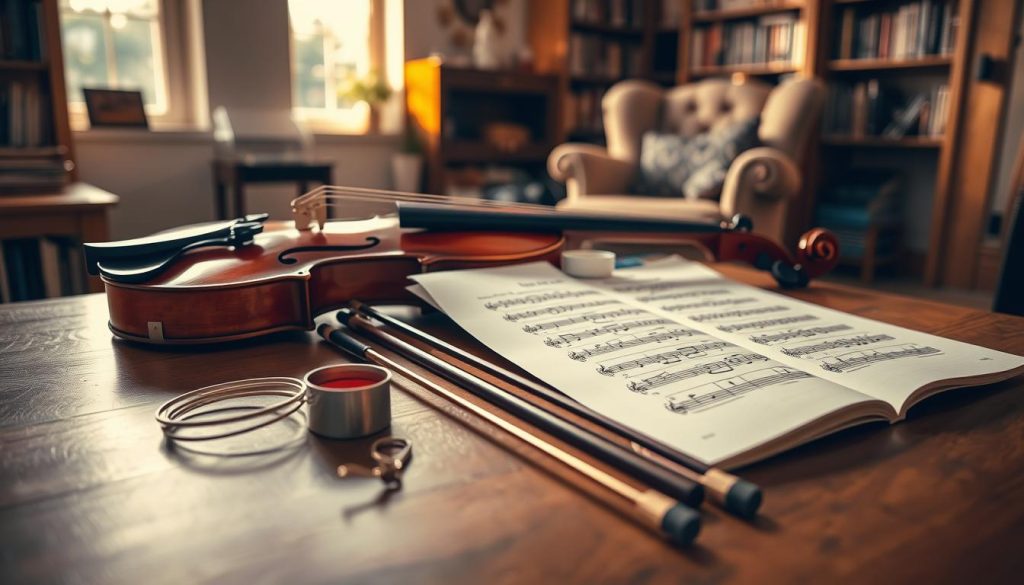
Pick a violin that’s high-quality and comfortable. A good violin set usually has the instrument, bow, case, chin rest, and rosin.
New players don’t need to buy expensive instruments right away. Focus on finding a violin that feels right for you.
Essential Violin Accessories
- Violin Strings: Choose synthetic strings for beginners3
- Bow: Critical for producing sound and technique
- Shoulder Rest: Reduces neck tension during practice4
- Rosin: Ensures proper bow grip and sound quality4
Understanding Violin Sizes and Care
Getting the right violin size is key for comfort and playing well. Different sizes fit various player heights and ages.
Take care of your instrument by watching humidity levels. Store it properly to keep it in good shape.
| Accessory | Purpose |
|---|---|
| Humidifier | Protect wooden instrument from cracking3 |
| Hygrometer | Monitor humidity levels3 |
| Repair Kit | Handle minor maintenance needs3 |
Investing in quality Violin Strings and accessories will enhance your musical journey and sound production.
Good equipment makes violin lessons more fun. It helps you play better and enjoy your musical journey.
How to Play the Violin: Basic Techniques
Mastering fundamental techniques is crucial for violin performance. Patience, precision, and dedicated practice are key to learning this beautiful instrument5.
Developing essential skills is vital for aspiring violinists. Let’s explore the core techniques needed for violin mastery.
Proper Posture and Instrument Positioning
Good posture is the foundation of violin playing. Rest the instrument on your collarbone, supported by your jaw6.
Key elements of proper positioning include:
- Keeping your back straight
- Relaxing your shoulders
- Maintaining a balanced stance
Mastering Bowing Techniques
Bowing requires careful attention to detail. The bow’s balance point is crucial for even weight distribution6.
Practice these fundamental bowing skills:
- Hold the bow with a relaxed grip
- Maintain consistent pressure
- Practice smooth string transitions
Fingering and Note Production
Precise finger placement on the fingerboard produces beautiful notes. Experts recommend separating left and right hand practice to avoid frustration6.
Pro Tip: Break down complex passages to tackle technical challenges. Aim for 30 minutes of daily practice to progress steadily6.
Remember, learning violin is a journey of growth. Even seasoned musicians constantly refine their skills5.
Developing Your Violin Skills: Practice Tips and Next Steps
Mastering the violin demands focused practice and smart learning strategies. Beginners should start with brief sessions to build skills and confidence. Experts suggest 20-30 minutes of daily practice, increasing as you improve.
Practicing scales for 30 minutes daily can boost your musical foundation. This method can improve intonation learning 300% faster than just practicing songs.
A structured plan is key for progress. Mix scales, new pieces, and familiar works in your routine. This approach helps develop well-rounded skills.
Many musicians find that creating a consistent practice habit keeps them motivated and technically sharp. Your violin repertoire grows through regular, thoughtful practice.
Learning violin is a journey. Adult beginners often take 1-5 years to reach orchestra-level skills. Playing with other musicians and attending concerts can offer great learning chances.
Celebrate small wins like mastering a scale or improving a tricky technique. These victories keep your musical passion burning bright7.
FAQ
How long does it take to learn the violin?
Learning the violin is a unique journey for everyone. Most beginners can play simple melodies within a few months. Mastering the violin takes years of dedicated practice.
You’ll need about 6-12 months to get comfortable with basic techniques. Becoming proficient can take several years of consistent effort.
Do I need to have musical experience to start learning violin?
No musical background is necessary to start learning violin. What matters most is your passion and dedication to regular practice. Many successful violinists began with no prior musical training.
What is the best age to start learning violin?
There’s no perfect age to start learning violin. Children as young as 4 or 5 can begin with small violins. Adults can successfully start at any age.
The key is having motivation, patience, and genuine interest in the instrument. Many pros began learning in their teens or as adults.
How much does a beginner violin cost?
Decent student violins range from 0 to 0. Rental options are also available for those not ready to invest. Some stores offer rent-to-own programs, applying fees towards purchase.
Avoid violins under 0, as they may be hard to play. These cheap instruments can discourage learning.
How often should I practice violin?
Consistency is more important than long practice sessions. Aim for 30 minutes to an hour, 4-5 times a week. Short, focused practices are more effective than infrequent, marathon sessions.
Beginners should start with 15-30 minutes daily. Focus on proper technique and enjoy the learning process.
Do I need to learn to read music to play violin?
Reading music is crucial for becoming a proficient violinist. It helps you understand rhythm, pitch, and complex pieces. Many beginners start with simple sheet music and build their skills gradually.
Method books and online resources can help you learn music reading alongside playing techniques.
What are the most challenging aspects of learning violin?
Maintaining proper posture and producing a clear tone are challenging for beginners. Coordinating bow and finger movements also takes time to master. The violin requires precise technique for the best sound quality.
These challenges are normal parts of learning. Don’t get discouraged if you struggle at first.
Can I learn violin online or do I need in-person lessons?
Both online and in-person lessons have their advantages. Online lessons offer flexibility and can be more affordable. In-person lessons provide immediate feedback on technique and personalized instruction.
Many students find a combination works best. They take occasional in-person lessons and supplement with online resources.
Source Links
- How to Play the Violin: 14 Steps (with Pictures) – wikiHow – https://www.wikihow.com/Play-the-Violin
- Starting on the Violin as an Adult Beginner: What to Expect – https://www.violinist.com/blog/laurie/20185/27306/
- 10 violin accessories and tools every violin player needs to have – https://www.soundbrenner.com/blogs/articles/top-10-violin-accessories-and-tools-every-violinist-needs-to-have?srsltid=AfmBOooRo_mb71r-o4O4ZsAuHw1K9G9H26Gp-NeuXPgC7khJR-kNVBob
- The Accessories Every Violinist Needs – https://fiddlershop.com/blogs/fiddlershop-blog/the-accessories-every-violinist-needs?srsltid=AfmBOoqC5TLN5E1Oi-w0nVB_qKYxZxgep0sy0VRIbK3PTh4h5YdHC0TM
- Violin Self Study Tips: Learn to Play the Violin Fast – https://violinlounge.com/article/violin-self-study-tips-learn-to-play-the-violin-fast/
- Learn to Play Violin in 20 Steps — Meadowlark Violin Studio – https://meadowlarkviolin.com/violinblog/learn-to-play-violin-yourself-20-steps
- How to Practice the Violin in 8 Steps: Ultimate Practice Routine – Ronald Sachs Violins – https://ronaldsachs.com/blog/how-to-practice-the-violin-in-8-steps/?srsltid=AfmBOoq8txl-4FeDA6uQnGMfzxedKaC9p95F8RDtbt5EgPU4eoqxihnj

