
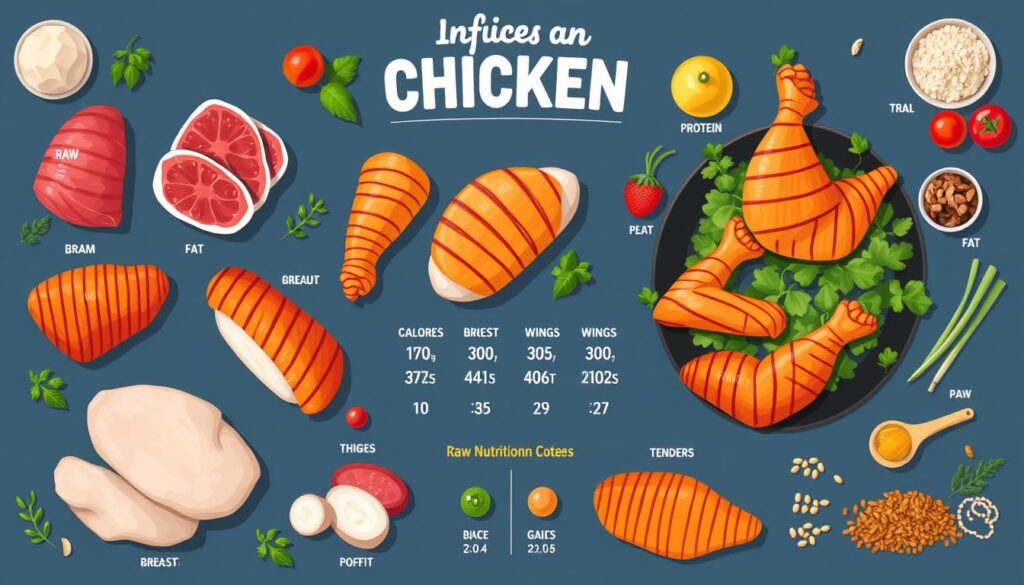
Knowing chicken’s calorie content helps you make smart food choices. Chicken is a popular protein source with varying calories. The calorie count depends on the cut and how it’s cooked1.
Different chicken parts have unique nutritional profiles. Chicken breast is the leanest, with about 165 calories per 3.5-ounce serving1. Chicken wings have more calories, up to 203 per 3.5 ounces1.
Your choice of chicken part can really affect your calorie intake2. How you prepare chicken also changes its nutritional value. Skinless, boneless chicken has fewer calories than chicken with skin3.
Cooking methods play a big role in the final calorie count. For example, a chicken breast with skin has more calories than a skinless one3. The way you cook it can add or reduce calories.
Key Takeaways
- Chicken calorie content ranges from 155 to 203 calories per 3.5-ounce serving
- Chicken breast is the leanest cut with the lowest calorie count
- Skin and cooking method significantly impact chicken’s calorie content
- Protein in chicken supports muscle maintenance and bone health
- Different chicken parts offer varying nutritional profiles
Understanding Calories in Chicken
Chicken offers various nutritional profiles across different cuts. Your choice of chicken part affects your calorie and protein intake. Each cut provides unique benefits for your diet.
Calorie Content in Different Chicken Parts
Chicken breast is the leanest option, with 166 calories per 100 grams4. Other cuts vary in their calorie content. Let’s explore the calories in different chicken parts.
- Chicken Breast: 166 calories per 100g4
- Chicken Thighs: 176 calories per 100g4
- Chicken Drumsticks: 149 calories per 100g4
- Chicken Wings: 254 calories per 100g4
Impact of Skin on Calorie Count
Chicken skin greatly increases calories. A skinless chicken breast has 284 calories. With skin, it jumps to 386 calories5. Removing the skin can help manage calorie intake.
Protein to Fat Ratio in Chicken
Different chicken parts offer varying protein distributions. Knowing these can help you make informed dietary choices.
- Chicken Breast: 80% protein, 20% fat5
- Chicken Thighs: 53% protein, 47% fat5
- Chicken Wings: 64% protein, 36% fat5
- Chicken Drumsticks: 70% protein, 30% fat5
“Knowing your chicken’s nutritional profile empowers healthier eating decisions.”
These facts show how different chicken cuts meet various nutritional needs. Choose the right cut to match your protein and calorie goals45.
How Cooking Methods Affect Chicken Calories
Your cooking technique shapes the nutritional value and calorie count of chicken. The right method preserves both flavor and health benefits. Healthy cooking methods maintain chicken’s nutritional profile6.
Cooking methods can drastically change chicken’s calorie content and nutritional value. Let’s explore some key factors to consider.
- Stir-frying retains the most nutrients while maintaining low fat content7
- Grilling and roasting help preserve protein levels6
- Deep frying substantially increases calorie and fat content7
The USDA recommends cooking chicken to 165 degrees Fahrenheit. This temperature kills harmful bacteria and keeps nutrients intact7. Safe cooking ensures you get the best nutritional value6.
Cooking method matters more than you might think for maintaining chicken’s nutritional benefits!
Your cooking approach directly affects chicken’s calorie count. Baking, steaming, and air frying add minimal extra calories. Frying in oil, however, can dramatically increase fat content.
A roasted chicken thigh has fewer calories than a fried one7. Marinades and sauces can add extra calories too.
Choose low-fat cooking methods to keep chicken’s lean protein benefits6. Opt for techniques that preserve nutrients while keeping calories in check7.
Conclusion
Chicken offers impressive health benefits beyond just protein. It’s packed with essential amino acids and minerals. Smart choices in cuts and cooking methods can boost your overall wellness8. The nutritional value of chicken is crucial for your body’s optimal functioning9.
Chicken is a versatile and excellent protein source. Its protein content ranges from 15% to 35%. This makes it ideal for maintaining muscle health8. Both white and dark meat offer unique nutritional advantages9.
Consider the protein-to-fat ratio when choosing chicken. Removing skin can maximize nutritional benefits. Opt for grilled or baked preparations to minimize unnecessary calories89.
FAQ
How many calories are in a typical chicken breast?
A skinless chicken breast has about 165 calories per 3.5-ounce serving. With skin, it increases to 197 calories. Chicken breast is a lean protein option, with 80% of calories from protein.
Do different parts of the chicken have different calorie counts?
Yes, chicken parts vary in calories. Drumsticks have the lowest at 155 per 3.5 ounces. Wings have the highest at 203 calories. Thighs fall in the middle with 179 calories.
How does chicken skin affect calorie content?
Chicken skin adds calories and fat. A skinless breast has 165 calories, while skin-on has 197. Wings jump from 203 to 290 calories with skin. Removing skin easily cuts calories and fat.
What cooking methods are best for keeping chicken calories low?
Baking, steaming, grilling, and air frying add minimal extra calories. Avoid deep frying or pan frying in oil or butter. These methods increase calorie and fat content significantly.
A roasted chicken thigh has fewer calories and less fat than a fried one.
Is chicken a good protein source for weight management?
Yes! Chicken is lean protein, great for weight management. It’s high in protein and low in fat, especially skinless white meat. Protein helps you feel full longer and supports muscle building.
How do different chicken parts compare in protein and fat content?
Chicken parts have varying protein-to-fat ratios. Breast has the highest protein, with 80% of calories from protein. Thighs have a balanced profile: 55% protein, 45% fat.
Drumsticks and wings offer 64-65% of calories from protein, making them relatively lean.
Are there any health benefits to eating chicken?
Chicken is nutrient-dense with many health benefits. It provides essential amino acids, vitamins, and minerals. These support brain function, muscle building, heart health, and bone strength.
Dark meat has more vitamins and minerals than white meat. Eating chicken regularly may lower risks of certain cancers, heart disease, and diabetes.
Source Links
- How Many Calories in Chicken? Breast, Thigh, Wing and More – https://www.healthline.com/nutrition/calories-in-chicken
- Chicken Breast Macros, Calories, Nutrition Facts, and Benefits – https://www.verywellfit.com/how-many-calories-in-chicken-breast-3495665
- Chicken calories: Amounts for different cuts and cooking methods – https://www.medicalnewstoday.com/articles/326767
- How Much Protein in Chicken? Breast, Thigh and More – https://www.healthline.com/nutrition/protein-in-chicken
- How Many Total Calories Are in Chicken? – Docindia.org – https://www.docindia.org/healthblog/articles/calories-in-chicken-how-many-total-calories-are-in-chicken
- No title found – https://larosachicken.com/Why-Chicken-The-Nutritional-Benefits-of-Chicken-Meat
- How Long Should You Cook a Chicken, and What Is the Healthiest Method? – https://www.medicinenet.com/how_long_cook_chicken_healthiest_method/article.htm
- Role of poultry meat in a balanced diet aimed at maintaining health and wellbeing: an Italian consensus document – https://pmc.ncbi.nlm.nih.gov/articles/PMC4462824/
- PDF – https://www.ciwf.com/media/7429726/declining-nutritional-value-of-factory-farmed-chicken.pdf

