
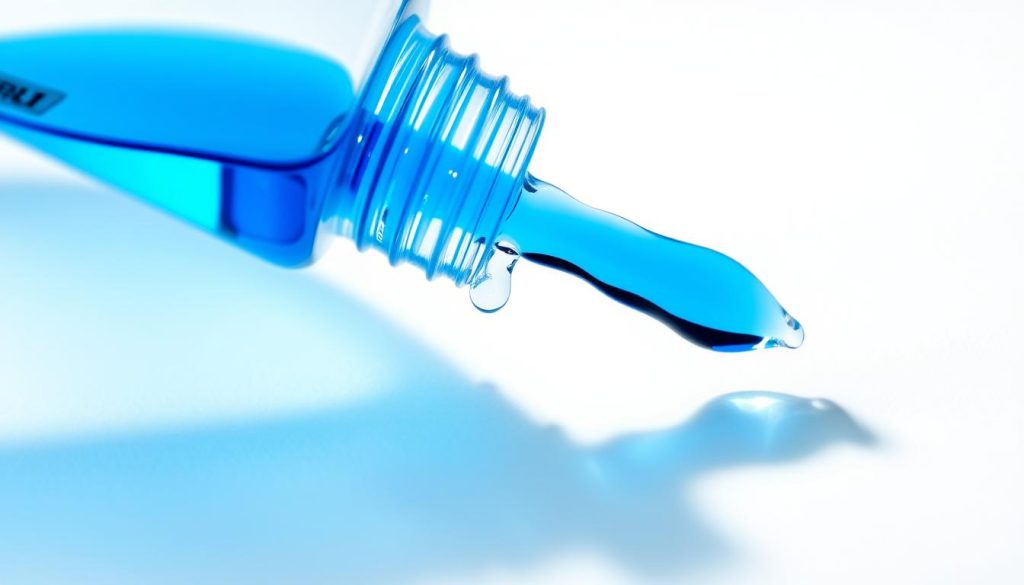
Precise dosing of liquid medication requires knowing the drops-to-milliliters ratio. For medical solutions and essential oils, accuracy is vital. One milliliter typically contains 20 standard drops, a key conversion for healthcare pros1.
To convert drops to milliliters, multiply the number of drops by 0.05. This method helps patients and doctors ensure exact dosages. It’s crucial for proper medication administration2.
Drop size can vary between liquid formulations. This makes precise dosing critical for medical treatments. Researchers study drop volume to improve medication delivery and patient safety3.
Key Takeaways
- 1 mL equals 20 standard drops
- Precise dosing requires careful drop measurement
- Conversion formula: drops × 0.05 = milliliters
- Drop size can vary between different liquid medications
- Accurate measurement is crucial for medical treatments
Understanding Drops in 1 mL
Measuring liquid volumes can be tricky, especially for eye drops or ophthalmic solutions. Knowing how drops relate to milliliters is vital for accurate medication dosing4.
A single drop typically equals 0.05 mL4. This means one milliliter contains about 20 drops4.
Healthcare pros and patients use these micro-volume measurements for single-dose eye drops. Precise dosing is crucial for effective treatment.
Drop Measurement Basics
Let’s explore some practical examples of drop-to-milliliter conversion:
- 1 mL contains 20 drops4
- 1 liter (1000 mL) has 20,000 drops4
- A standard cup (237 mL) equals 4,740 drops4
Practical Conversion Insights
Doctors often use calibrated droppers for precise liquid medication delivery. These conversions help measure ophthalmic solutions accurately5.
Patients and healthcare providers benefit from understanding these measurements. It ensures they administer the correct dose every time.
“Precision in liquid measurement can make a significant difference in treatment effectiveness.”
Volume Unit Relationships
One mL equals about 0.034 US fluid ounces. A single drop is roughly 0.0017 US fluid ounces4.
These tiny measurements matter a lot. They’re crucial for medications that need exact dosing.
Practical Applications for Liquid Measurement
Precise liquid measurements are vital for safe medication delivery. Even small errors can greatly affect patient health. A study found that 99% of parents make mistakes when dosing liquid medications. This highlights the need for proper measuring tools like accurate medical dosing6.
Medical experts recommend using specialized tools such as oral syringes for exact measurements. Dosing cups are four times more likely to cause errors than oral syringes6. The American Academy of Pediatrics warns against using household spoons for medication6.
Different situations need unique measurement methods. In medical settings, drop measurements vary widely. IV drips can deliver 10, 15, 20, or 60 drops per milliliter7. Pharmacists now prefer metric measurements, with one drop equaling 0.05 mL7.
Choosing the right measuring tool is crucial for accurate administration. This applies to medication, cooking ingredients, and essential oils. Understanding volume conversions can prevent health risks and ensure precise liquid handling.
Practice and using tools with clear markings can improve measurement accuracy over time. This skill is important for both medical professionals and everyday users.
FAQ
How many drops are typically in 1 milliliter (mL)?
The number of drops in 1 mL varies based on liquid thickness and dropper type. Most eye drops and liquid meds have 20 to 25 drops per mL. This can change depending on the liquid and dropper used.
Why do drop measurements matter for medications?
Precise dosing ensures medication safety and effectiveness. Accurate measurement is key for ophthalmic solutions and liquid meds. Knowing drops per mL helps patients follow instructions and avoid dosing errors.
How can I accurately measure drops at home?
Use a calibrated dropper made for your specific medication or liquid. Hold the dropper straight up and squeeze gently for consistent drops. For eye drops, follow your doctor’s instructions carefully.
Count drops precisely to ensure the right dose. This helps maintain the medication’s effectiveness and your safety.
Do different liquids have different drop sizes?
Yes! Viscosity greatly affects drop size. Essential oils, thick meds, and water create different-sized drops. Liquid density, surface tension, and dropper design impact drops per milliliter.
What tools can help me measure micro-volumes accurately?
Several tools aid precise liquid medication measurement:
– Calibrated droppers – Graduated medical syringes – Precision measuring pipettes – Digital micro-volume scales
These tools are vital for single-dose meds and essential oils. They ensure exact measurements for critical applications.
Are drop measurements the same worldwide?
No, drop measurements can differ between countries and medical systems. The United States Pharmacopeia (USP) provides standard guidelines. However, international variations exist.
Always check local medical guidelines or ask a healthcare pro. They’ll give you accurate info for your region.
How do I convert drops to other liquid measurements?
Common conversions include:
– About 20-25 drops = 1 milliliter
– 1 teaspoon ≈ 100 drops
– 1 tablespoon ≈ 300 drops
Remember, these are rough estimates. Actual ratios may vary based on the liquid’s properties.
Source Links
- Convert Milliliter to Drop – https://www.unitconverters.net/volume/milliliter-to-drop.htm
- Convert Drop to Milliliter – https://www.unitconverters.net/volume/drop-to-milliliter.htm
- An objective assessment of the variability in number of drops per bottle of glaucoma medication – BMC Ophthalmology – https://bmcophthalmol.biomedcentral.com/articles/10.1186/s12886-017-0473-8
- Drops to ml Conversion – https://www.omnicalculator.com/conversion/drops-to-ml-conversion
- Calculate IV Drip Rates: Drop Factor Formula – https://www.nursetogether.com/calculate-iv-drip-rate-drop-factor-formula/
- Measurement Mishaps with Liquid Medicines – https://www.consumermedsafety.org/safety-articles/measurement-mishaps-with-liquid-medicines
- Drop (unit) – https://en.wikipedia.org/wiki/Drop_(unit)

