
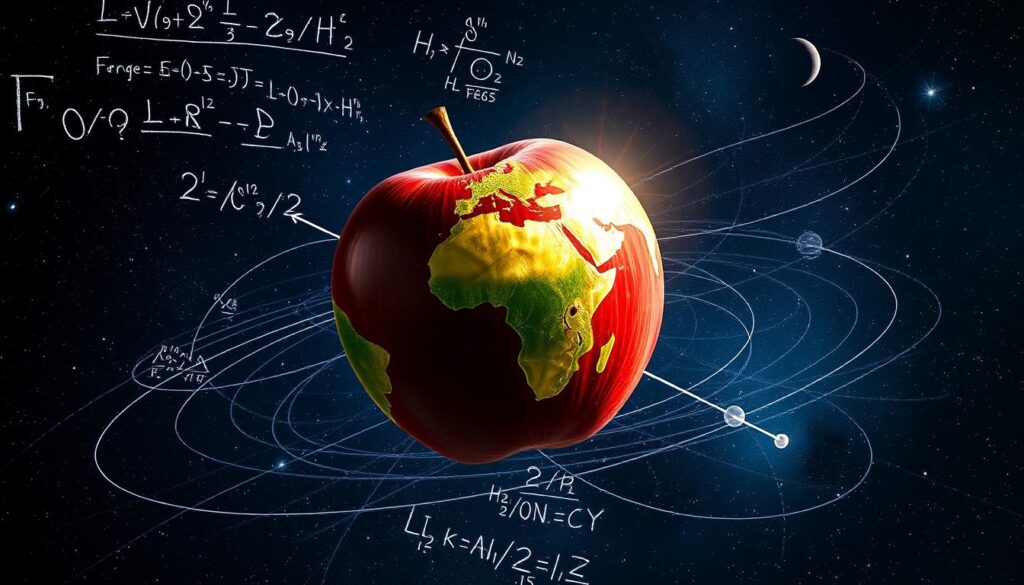
Gravity affects everything around us. It’s a key force of nature that shapes our world. Learning to calculate gravity can deepen your understanding of physics1.
Calculating gravity force may seem tricky at first. But with the right tools, you can grasp this vital concept. It involves using formulas and grasping key physical principles.
Gravity influences planet motion and falling objects on Earth. By learning to calculate it, you’ll uncover hidden links between masses in our universe.
Key Takeaways
- Gravity is a universal force connecting all objects with mass
- Newton’s law provides the foundation for gravity force calculation
- Precise measurements are crucial for accurate results
- Gravity affects objects differently based on their mass and distance
- Understanding gravity helps explain numerous natural phenomena
Understanding the Concept of Gravity
Gravity is a key force shaping our universe. It affects everything from tiny atoms to huge celestial bodies. This force determines how objects interact and move.
Gravity helps us understand our physical world better. It’s essential for explaining many everyday phenomena we observe.
What is Gravity?
Gravity is an attractive force between objects with mass. Scientists use the gravitational force formula to measure this attraction1. Every object in the universe has a gravitational pull.
The strength of gravity depends on mass and distance. Larger objects create stronger gravitational forces. Objects farther apart have weaker gravitational attraction.
- Gravity pulls objects toward each other
- Larger masses create stronger gravitational forces
- Distance significantly impacts gravitational strength
Importance of Gravity in Everyday Life
Gravity influences our daily experiences constantly. It explains why we stay grounded and why objects fall. The gravity calculation equation shows how planets orbit.
Without gravity, our world would be completely different. We’d float away instead of staying on Earth’s surface.
| Gravity’s Impact | Example |
|---|---|
| Keeping Us Grounded | Prevents floating away |
| Ocean Tides | Moon’s gravitational pull |
| Planetary Motion | Orbits of planets and moons |
The Universal Law of Gravitation
Sir Isaac Newton’s law of gravitation changed how we view this force. A gravity force calculator helps show how masses interact2. Newton found that gravity depends on object masses and distance.
“Gravity explains the motions of the planets, but it cannot explain who sets the planets in motion.” – Isaac Newton
Understanding gravity’s principles gives us insights into our physical universe3. It helps explain many amazing things we see around us.
The Formula for Calculating Force of Gravity
The gravity formula calculation is key to understanding how objects interact in space. It lets you explore the basic principles of attraction between masses1. Gravity is a precise mathematical relationship you can measure and predict.
The Gravitational Force Equation
Newton’s universal law of gravitation is the heart of gravity force calculation. The formula is F = G * (m1 * m2) / r². Each symbol represents a vital part of gravitational interaction.
- F represents the gravitational force
- G is the gravitational constant
- m1 and m2 are the masses of two objects
- r is the distance between the object centers
Variables in the Equation
Calculating gravity force requires exact measurements of mass and distance. The gravitational constant (G) stays at 6.674 × 10⁻¹¹ N(m/kg)².
| Variable | Description | Unit |
|---|---|---|
| Mass (m) | Weight of objects involved | Kilograms (kg) |
| Distance (r) | Space between object centers | Meters (m) |
| Gravitational Constant (G) | Universal gravitational parameter | N(m/kg)² |
Units of Measurement for Gravity
Accuracy is crucial in gravity formula calculation. Scientists use standard international units for precision. The resulting gravitational force is measured in Newtons (N).
“Gravity is not just a force, but a fundamental language of the universe.” – Physics Insight
Grasping these components helps you uncover gravitational interactions at different scales. From tiny particles to massive celestial bodies, gravity shapes our universe.
Step-by-Step Guide to Calculate Force of Gravity
Calculating gravity force is simpler than you might think. You’ll need a formula and basic measurements to determine gravitational attraction. The process involves precise measurements and applying the universal gravitational equation.
Measuring Mass and Distance
To start, you’ll need two key measurements: object masses and the distance between them. Use a precise scale for mass in kilograms. Measure the distance between object centers with standard tools.
Accurate measurements are crucial for reliable results when calculating gravitational forces.
Performing the Calculation
To find gravity force, multiply the masses of both objects. Then divide by the squared distance between them. The gravitational constant (G = 6.67 × 10^-11 N·m²/kg²) is key in this calculation2.
Physicists and engineers use this method to understand gravitational interactions in various scientific contexts.
Example of Force of Gravity Calculation
Let’s look at two objects: 10 kg and 20 kg, 5 meters apart. Using the formula, we can find their exact attraction.
This example shows how scientific principles make abstract concepts measurable and understandable3. Practice these calculations to boost your grasp of gravitational interactions.
FAQ
What exactly is gravity?
Gravity is a key force of nature. It pulls objects with mass together. This invisible force keeps planets orbiting and makes things fall to the ground.
How do I calculate the force of gravity between two objects?
Use Newton’s law of gravitation: F = G(m1 * m2)/r². F is the gravitational force, G is the gravitational constant. M1 and m2 are the masses of the objects.
R is the distance between their centers. The gravitational constant is 6.674 × 10⁻¹¹ N·m²/kg².
Why do different planets have different gravitational forces?
Gravitational force depends on mass and distance. Planets with more mass have stronger gravity. This is why you’d weigh differently on Mars or Jupiter compared to Earth.
Do I need special equipment to calculate gravitational force?
No special equipment is needed. You just need accurate mass and distance measurements, plus a calculator. Many online gravity force calculators are available for easy calculations.
Is gravity the same everywhere on Earth?
Gravity varies slightly across Earth. Factors like latitude, altitude, and local geology affect it. The standard gravity at sea level is about 9.8 m/s².
This value can change based on your location.
Can gravity be negative?
No, gravity is always an attractive force. It’s represented by a positive value. The strength of gravity can be calculated, but it’s always a pull between objects.
How does gravity affect space exploration?
Gravity is crucial in space exploration. It helps plan spacecraft paths, orbital moves, and landings. Understanding gravity aids in predicting celestial body movements.

