
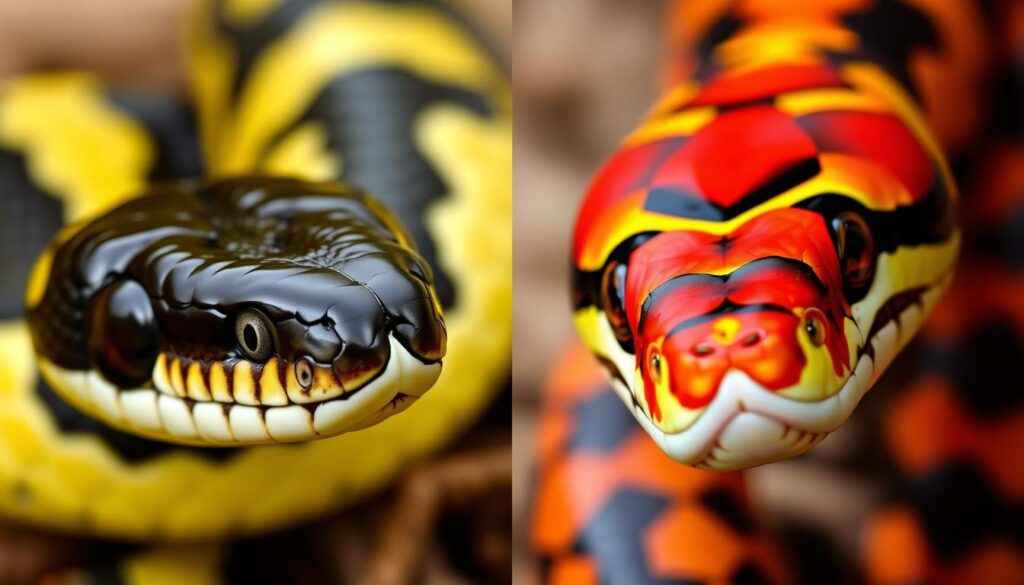
Knowing how to spot the difference between king and coral snakes is vital for safety in nature. With key insights, you’ll become an expert at identifying these fascinating reptiles1.
Scarlet king snakes and coral snakes are similar in size, usually 14 to 36 inches long1. Their color patterns are the main way to tell them apart.
Remember this rule: if red and yellow bands touch, it’s a coral snake1. This key difference can help keep you safe.
Regional changes make identifying these snakes even more interesting. Scarlet kingsnakes have become great mimics to fool predators2.
These snakes have developed clever ways to survive in different habitats2. Their adaptations show nature’s amazing ability to evolve.
Key Takeaways
- Color patterns are the primary way to distinguish between king and coral snakes
- Red and yellow touching indicates a venomous coral snake
- Both species typically range from 14 to 36 inches in length
- The identification rule may vary outside the United States
- Mimicry plays a crucial role in snake survival
Overview of King Snakes and Coral Snakes
King snakes and coral snakes are two fascinating reptile species with remarkable similarities and unique distinctions. These serpents captivate herpetology enthusiasts with their intriguing traits. Their survival strategies make them interesting subjects to study1.
Physical Characteristics
King snakes and coral snakes have fascinating physical attributes that make them interesting to compare. Both species typically range between 14 to 36 inches long1. Their similar size makes quick identification challenging, so careful observation is crucial.
- Coral snakes feature distinctive red and yellow rings touching each other1
- King snakes display red and black rings in contact1
- Coral snakes have a black head with a short snout1
- King snakes possess a red head with an elongated snout1
Habitat and Distribution
These serpents inhabit diverse ecosystems across the southeastern United States. They can thrive in various environments, from pine forests to sandy terrains3. Their adaptability allows them to survive in different habitats.
Behavior and Diet
Hunting strategies differ between these snake species. Coral snakes primarily target lizards and smaller snakes3. They are typically diurnal, staying active during daylight hours3.
Understanding snake behavior helps us appreciate their critical role in ecosystem balance.
| Characteristic | Coral Snake | King Snake |
|---|---|---|
| Average Length | 20-30 inches | 14-36 inches |
| Primary Habitat | Sandy, well-drained areas | Diverse southeastern regions |
| Hunting Method | Neurotoxic venom | Constriction |
These snakes might seem similar, but their unique characteristics set them apart. Each species offers a fascinating subject for study2. Learning about them can deepen our appreciation for nature’s diversity.
Key Differences Between the Two Species
Knowing how to spot King Snakes and Coral Snakes is vital for safe encounters. These reptiles have unique traits that set them apart.
Color Patterns and Markings
The most noticeable difference between these species is their color patterns. Their ring patterns are distinctly different4:
- Coral snakes feature red, yellow, and black rings with red and yellow bands touching4
- King snakes display red, black, and yellow rings with red and black bands adjacent4
Size and Shape Comparison
These snake species differ greatly in size. King snakes typically grow much larger5:
| Snake Species | Length | Weight |
|---|---|---|
| King Snake | Up to 6 feet (1.8 meters) | Up to 4 pounds (1.8 kg) |
| Coral Snake | 2 to 4 feet (0.6 to 1.2 meters) | Weight not specified |
Venomous vs. Non-Venomous Nature
The most crucial difference is their venom status. Coral snakes are highly venomous. Their potent neurotoxic venom can be deadly if not treated4.
King snakes, however, are non-venomous constrictors. They actually hunt and eat other snakes6.
“Know the difference – your life might depend on it.”
Coral snakes have short, fixed fangs at the front of their mouth. They rarely show aggressive behavior in the wild4.
King snakes are generally more docile. They play a key role in controlling rodent and snake populations6.
How to Identify These Snakes in the Wild
Spotting king snakes and coral snakes requires careful observation. Learning to tell them apart can keep you safe outdoors. This knowledge is crucial for your adventures7.
Best Practices for Observation
Stay safe when identifying snakes. Keep your distance and use binoculars. Learn the color pattern rhyme to tell king and coral snakes apart8.
- Keep vegetation cleared to reduce snake encounters7
- Wear protective footwear in snake-prone areas
- Use field guides with detailed color illustrations
When to be Cautious
Coral snakes prefer sandy, well-draining soil. They’re most active during cooler parts of the day8.
Be extra alert at dawn and dusk. Snakes are more likely to be moving then7.
| Snake Type | Active Period | Habitat Preference |
|---|---|---|
| Coral Snake | Dawn/Dusk | Sandy, damp areas |
| King Snake | Daytime | Varied habitats |
Essential Field Guides
Get local snake guides with detailed info on regional species. Remember that color pattern rules can vary by geographic location9.
“Knowledge is your best defense when encountering wild snakes”
Safety first: don’t handle snakes without training8. If unsure about a snake’s identity, ask local wildlife experts for help.
Safety Tips for Snake Encounters
Knowing how to handle snake encounters is vital when exploring outdoors. Your main goal is to avoid dangerous interactions. Stay calm and follow snake safety guidelines for careful observation and respect10.
When identifying King Snake vs Coral Snake species, look at color patterns and head shapes. Venomous snakes often have triangular heads and vertical slit pupils10. Non-venomous king snakes usually have round pupils and mimic warning colors11.
Remember: “If red touches yellow, you’re a deadly fellow.” This helps distinguish between these species.
If you spot a potentially venomous snake, like a coral snake, keep your distance. Slowly back away and never try to handle or provoke it12.
Wear protective clothing in snake habitats. Watch your step and avoid disturbing leaf piles or logs. If unsure about a snake’s species, treat it as dangerous11.
Knowing the differences between King and Coral Snakes can prevent risky encounters. For snake bites, get immediate medical help. Coral snake venom can cause severe symptoms like breathing problems12.
Stay informed and cautious in snake-populated areas. This is your best defense against potential dangers.
FAQ
How can I tell the difference between a king snake and a coral snake?
The color pattern is the main difference. For North American species, remember “red touch yellow, kill a fellow”. If red and yellow bands touch, it’s a coral snake. King snakes have red and black bands touching.
Coral snakes have black heads with short snouts. King snakes typically have red heads with longer snouts.
Are coral snakes venomous?
Yes, coral snakes are highly venomous. They belong to the Elapidae family and have potent neurotoxic venom. Their venom can cause respiratory failure.
King snakes, however, are non-venomous constrictors. They kill prey by squeezing.
Where are coral snakes typically found?
Coral snakes live in the southeastern United States. They range from North Carolina to eastern Louisiana. These snakes prefer well-drained, sandy soil habitats.
They like longleaf pine stands and sandhills. Coral snakes are nocturnal but can be active at various times. They often spend time underground.
What should I do if I encounter a coral snake?
If you see a coral snake, stay calm and back away slowly. Don’t try to handle or kill it. Wear protective clothing in snake areas.
Watch your step and avoid disturbing leaf piles or logs. If bitten, get medical help immediately. Their venom is extremely dangerous.
Do the color identification rules work everywhere?
No, the “red touch yellow” rule only works for North American coral snakes. In other regions, snake color patterns can vary a lot.
Always use local field guides and region-specific resources to identify snakes.
What do king snakes and coral snakes typically eat?
Both species eat similar animals like smaller snakes, lizards, and frogs. Their hunting methods differ, though. Coral snakes use venom to paralyze prey.
King snakes are constrictors. They squeeze their prey to subdue it.
How big are these snakes?
King snakes and coral snakes are usually similar in size. They range from 14 to 36 inches long. Coral snakes are more slender with smooth, shiny scales.
King snakes may have a slightly more robust build.
Source Links
- How to Tell the Difference Between a King and Coral Snake – https://www.wikihow.com/Tell-the-Difference-Between-a-King-Snake-and-a-Coral-Snake
- Coral Snakes and their Mimics – The Orianne Society – https://www.oriannesociety.org/science-of-scales/coral-snakes-and-their-mimics/
- Harlequin Coralsnake – https://www.floridamuseum.ufl.edu/florida-snake-id/snake/harlequin-coralsnake/
- The Difference Between a Coral Snake and a King Snake – https://www.bilibili.com/read/cv27407999/
- King Snake vs Coral Snake: See Who Wins | Animal Matchup – https://www.animalmatchup.com/vs/king-snake-vs-coral-snake
- Coral Snake vs King Snake: Main Differences – Ocean Info – https://oceaninfo.com/compare/coral-snake-vs-king-snake/
- Venomous Snake Control? – https://www.backyardherds.com/threads/venomous-snake-control.35694/
- Coral Snake – https://www.evergladesholidaypark.com/attractions/everglades-animals/coral-snake/
- PDF – https://gadnr.org/sites/default/files/wrd/pdf/fact-sheets/Venomous Snakes – Eastern Coral Snake.pdf
- How to Tell if a Snake Is Venomous – https://urbanjunglewildliferemoval.com/blog/how-to-tell-venomous-snake/
- How to identify different types of snakes – https://www.bugoutservice.com/blog/how-to-identify-different-types-of-snakes/
- The Difference Between a Coral Snake and a King Snake – https://www.americanoceans.org/facts/coral-snake-vs-king-snake/

