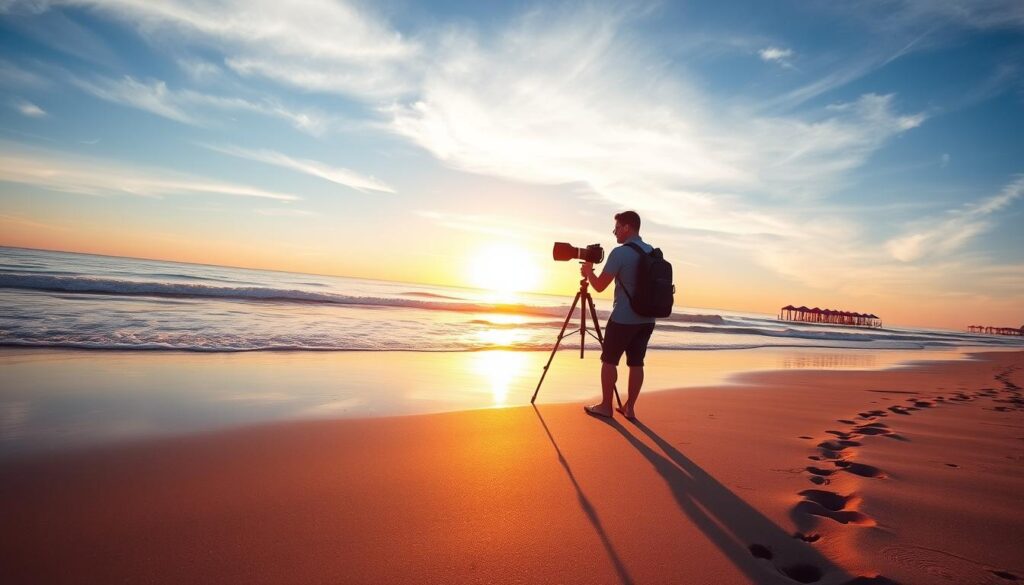
Beach photography blends technical skill with creative vision. It’s more than just aiming your camera at the ocean. Stunning coastal landscapes require careful preparation and technique1.
Shooting in RAW format offers flexibility for post-processing ocean wave images1. Use specialized software like Adobe Lightroom or Capture One to enhance your beach photos1.
Timing is crucial for remarkable beach photographs. The golden hour provides soft, magical lighting for your shots1.
Shoot shortly after sunrise or before sunset. This helps avoid harsh midday sunlight and creates compelling visual stories.
Key Takeaways
- Master the golden hour for optimal beach photography lighting
- Shoot in RAW format for maximum post-processing flexibility
- Use professional editing software to enhance your images
- Choose the right time of day for stunning seascapes
- Experiment with different camera settings and techniques
Prepare Your Gear for Beach Photography
Beach photography demands careful prep and the right gear. Your adventure begins with choosing equipment that can handle tough coastal conditions. Stunning Shore Portraits and Beach Weddings await your capture.
Your camera is crucial for beach and Drone Aerial Shots. Pros suggest a weather-sealed camera to resist sand, salt, and moisture2. Look for a sturdy build to ensure it lasts in harsh environments.
Choosing the Right Camera
Pick a versatile camera for beach photography. Seek these features:
- Weather-sealed body
- High dynamic range
- Good low-light performance
- RAW shooting capability2
Essential Lenses for Beach Shots
Your lens choice can make or break beach photos. Pros recommend a 24-70mm focal range lens2. This reduces lens changes and sand exposure.
| Lens Type | Best For |
|---|---|
| Wide-angle | Landscape shots |
| Telephoto | Distant subjects |
| Standard zoom | Versatile shooting |
Accessories to Consider
Shield your gear with these key accessories:
- Lens hood to reduce glare2
- UV filter for lens protection2
- Waterproof camera bag
- Portable tripod for stability2
Pro tip: Always carry a microfiber cloth and air blower to keep your equipment clean from sand and salt spray.
Remember, the right gear prepares you to capture breathtaking beach memories that will last a lifetime.
Mastering the Best Lighting Conditions
Beach photography relies on understanding light and timing. The right lighting can transform ordinary coastal landscapes into breathtaking visuals. Your success depends on choosing perfect moments and techniques.
Timing is crucial for coastal landscapes. The golden hours offer magical lighting conditions. During these times, light is softer and warmer, creating stunning effects3.
Sunrise vs. Sunset Photography
Sunrise and sunset offer unique coastal photography opportunities. For sunrise shots, arrive early to capture dawn’s transitional phases. Early morning light provides soft, ethereal qualities for memorable images4.
- Use a tripod to stabilize your camera during low-light conditions4
- Experiment with slow shutter speeds to create smooth water effects4
- Capture the changing colors of the sky during golden hours
Avoiding Harsh Midday Sun
Midday sunlight can be challenging for beach photography. Try these techniques to manage harsh light:
- Use recommended settings like 1/400 sec, f/4.0, and ISO 1003
- Position subjects to minimize squinting3
- Utilize natural diffusers like sand and open sky3
Utilizing Natural Reflections
Natural reflectors can enhance your coastal landscapes. White sand acts as an excellent fill light source. It helps balance shadows and highlights5.
Consider using additional reflectors to bounce light onto subjects. This can create depth in your images5.
“Photography is about capturing light, and the beach offers some of the most spectacular lighting conditions imaginable.”
Pro tip: Don’t fear experimenting with different techniques. Wide-angle lenses capture expansive coastal beauty4. Playing with shutter speeds creates dreamy, motion-filled images4.
Composition Techniques for Stunning Shots
Great beach photography goes beyond simple snapshots. Mastering composition techniques can turn ordinary photos into captivating visual tales6. These skills will elevate your surf photography to new heights.
Rule of Thirds and Leading Lines
The rule of thirds can vastly improve your ocean waves photography6. Divide your frame into a 3×3 grid. Place key elements along these lines or at their intersections.
This method creates more engaging sandy beaches images7. It adds visual interest and draws the viewer’s eye through the photo.
- Place horizon lines on the upper or lower third
- Position subjects at intersection points
- Use leading lines to guide viewer’s eye
Incorporating Beach Elements
Add life to your beach photos with thoughtful foreground elements. Shells, driftwood, or beach gear can bring depth to your composition7. These natural objects help tell a more compelling story.
Experimenting with Perspectives
Try unique viewpoints in your beach photography. Get low to highlight sand textures. Use aerial shots to capture the vast landscape7.
Minimalist compositions can be striking. Focus on a single subject against the expansive ocean backdrop6. This approach creates powerful visual statements.
| Technique | Description | Impact |
|---|---|---|
| Low Angle | Shoot from ground level | Emphasizes textures and scale |
| Aerial View | Use drone or elevated position | Reveals landscape patterns |
| Minimalist Approach | Focus on single element | Creates powerful visual statement |
Pro tip: Keep an eye on your frame edges. Maintain visual balance in your beach photography compositions6. This ensures a polished, professional look.
Post-Processing Tips for Beach Photography
Smart post-processing can turn good beach photos into stunning ones. Shoot in RAW format for more editing flexibility. This allows for precise adjustments without losing image quality. Post-processing techniques can greatly enhance your beach photography8.
Color enhancement is key in beach photography. Bring out vibrant blues and greens while keeping natural tones. Adjust saturation and vibrancy carefully to make seascapes pop. Try graduated filters to balance bright skies with darker foregrounds9.
Professional tools like Adobe Lightroom offer powerful options for photo refinement. Mobile apps like Snapseed provide quick on-the-go adjustments. Remember, subtlety is crucial in enhancing beach scenes’ natural beauty.
Your editing should always respect the original scene’s essence. This applies to dramatic black and white compositions or preserving warm golden hour tones8.
FAQ
What camera settings are best for beach photography?
Shoot in RAW format to keep more image data. Use a lower ISO (100-400) to reduce noise. Set your aperture between f/8 and f/16 for greater depth of field.
Adjust your Exposure Value (EV) dial to balance bright sand and sky. Typically, increase by +0.3 to +1 stop to prevent underexposure.
How can I protect my camera equipment at the beach?
Use a weather-sealed camera if possible. Bring an air blower and lens cloths to remove sand and salt. Invest in a waterproof camera bag and use a lens hood or UV filter.
Avoid changing lenses in windy conditions. Clean your equipment thoroughly after each beach shoot.
What are the best times of day for beach photography?
The golden hours offer stunning lighting conditions. These times are shortly after sunrise and before sunset. They provide soft, warm light that reduces harsh shadows and overexposure.
Arrive early for sunrise shots to capture changing light. Stay after sunset to photograph the colorful afterglow.
Which lenses work best for beach photography?
A wide-angle lens (16-35mm) is great for expansive landscapes and seascapes. A telephoto lens (70-200mm) works well for distant subjects and detailed shots.
For versatility, a zoom lens covering 24-70mm can be an excellent all-purpose option.
How do I create interesting compositions on the beach?
Apply the rule of thirds by placing key elements along imaginary grid lines. Use leading lines like shorelines or pier edges to guide the viewer’s eye.
Include interesting foreground elements like shells, driftwood, or beach chairs. Try different perspectives – get low or use aerial drone shots.
What post-processing techniques work best for beach photos?
Start by adjusting exposure, contrast, and white balance. Use graduated filters to balance bright skies with darker foregrounds. Enhance blues and greens slightly, but keep it natural.
Consider black and white conversions for dramatic seascapes. Popular editing software includes Adobe Lightroom and Capture One.
How can I capture water movement in beach photos?
Use a tripod and slower shutter speeds (1-30 seconds) for smooth, silky water effects. For wave motion, try shutter speeds between 1/15 and 1 second.
Use a neutral density filter in bright conditions. This allows for longer exposures without overexposing the image.
What should I do about harsh midday sun?
Avoid shooting during peak sunlight hours if possible. If you must, seek shade or use a diffuser to soften harsh light.
Use a polarizing filter to reduce glare and enhance color saturation. Position subjects with the sun behind them or use fill flash.
Source Links
- 13 Tips for Great Beach Photography – Mimeo Photos – https://blog.mimeophotos.com/post/13-tips-for-great-beach-photography
- Guide to Beach Photography | 25 Tips for Beginners – https://shotkit.com/beach-photography/
- Harsh Light Photography: How to Work It and Love It – https://rangefinderonline.com/gear/lighting/harsh-light-photography-how-to-work-it-and-love-it/
- 38 Tips to Master Beach Photography Like a Pro – 30A – https://30a.com/beach-photography-tips/
- How to take photos in harsh lighting at the beach – https://www.theclickcommunity.com/blog/harsh-light-beach-photos/
- 21 Essential Photography Composition Techniques and Rules Every Photographer Should Master – https://www.katebackdrop.com/blogs/photography-tutorials/photography-composition-techniques?srsltid=AfmBOopWkF1SONlNN5RifCs4xWcECNXpvkQsUQ3EKTZxwTJOOrLFRB1u
- 12 Travel Photography Composition Tips (to Instantly Improve Your Shots!) – https://digital-photography-school.com/travel-photography-composition-tips/
- Sharing a Guide to Taking Great Beach Pictures Every Time – https://www.kristahorton.com/blog/how-to-take-a-good-beach-picture
- Invaluable Beach Photography Tips to capture Breathtaking Photos – https://visualwilderness.com/fieldwork/invaluable-beach-photography-tips-to-capture-breathtaking-photos