
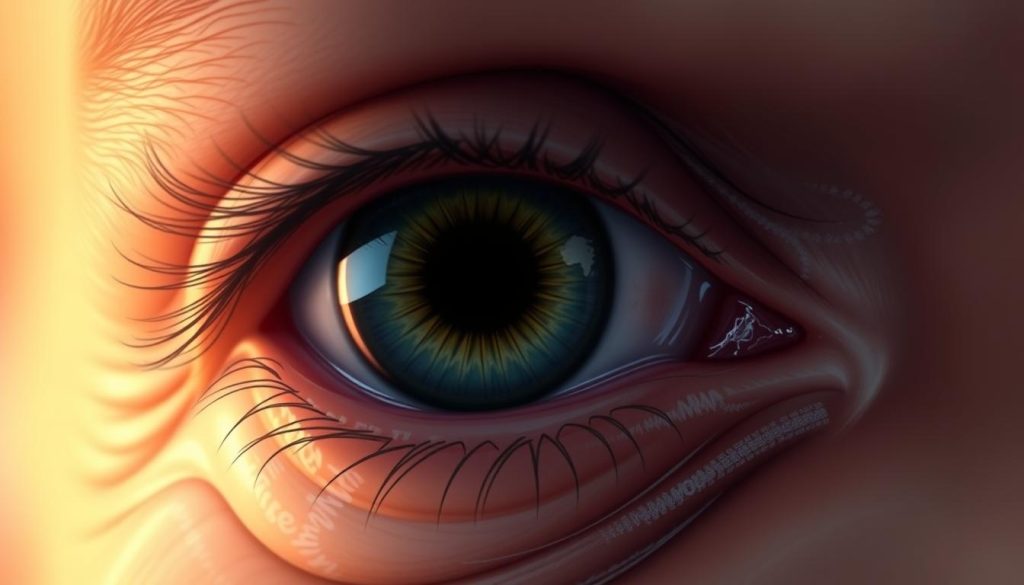
Death changes the human body in mysterious ways, especially the eyes. Postmortem eye changes can be startling for those unfamiliar with them1. The eyes go through remarkable transformations that offer clues about the body’s final moments1.
Eyes may start changing even before death occurs. Pupils enlarge quickly, becoming fixed and unresponsive to light1. These changes can reveal important details about a person’s passing.
Corneal opacity develops over time, causing noticeable visual changes. The eye may look dark blue or grey, creating an eerie appearance1. Dust particles can gather, adding to the unusual look of postmortem eyes1.
Doctors and forensic experts study these eye changes closely. The Kevorkian sign, showing blood vessel fragmentation, can appear shortly after death1. This sign provides crucial information for forensic investigations.
Key Takeaways
- Eyes undergo significant changes immediately after death
- Pupil enlargement occurs rapidly post-mortem
- Corneal opacity creates unique visual transformations
- Eye changes can provide forensic insights
- Muscle tone reduction impacts eye appearance
Understanding Post-Mortem Eye Changes
The human eye transforms fascinatingly after death. Forensic experts study these changes closely. They provide key insights into the timing and circumstances of a person’s passing.
Eye changes start right after the heart stops beating. Muscles relax, causing eyes to open slightly or stay neutral. Pupils enlarge and become fixed, unresponsive to light2.
Immediate Physiological Transformations
Within minutes of death, the eyes undergo significant changes:
- Fibrin bridges in retinal vessels begin to segment3
- Intraocular pressure begins to decrease at approximately 2 mmHg per hour3
- Retinal folds are observed in 63.3% of deceased individuals3
Time-Based Eye Transformations
Eye changes in the deceased follow a predictable pattern:
| Time After Death | Ocular Changes |
|---|---|
| 0-2 hours | Minimal corneal opacity in 74% of cases3 |
| 12-24 hours | 15-25% of cases show developing corneal opacity3 |
| 24-36 hours | 75% of cases exhibit significant corneal opacity3 |
| 48-72 hours | Iris and cornea begin to collapse, forming subepithelial bubbles3 |
The vitreous humor remains remarkably stable, resisting bacterial degradation and providing valuable metabolite analysis opportunities for forensic investigators3.
The eyes tell a silent story after life has ended, revealing intricate details about the moments following death.
Dead Person’s Eye Changes: Medical Explanation
After death, human eyes undergo fascinating changes. These transformations involve complex physiological processes. Forensic experts study these changes carefully to gain valuable insights.
Body muscles relax quickly after death, causing pupils to enlarge. This results in fixed pupils that no longer react to light.
The eye appearance in the deceased undergoes several critical changes:
- Corneal opacity increases with time since death4
- A hazy film develops on the eyeball, changing color to dark blue or grey4
- Blood vessels may fragment, creating the Kevorkian sign within minutes of death4
Environmental factors play a big role in these eye changes. Temperature, body composition, and surrounding conditions affect how quickly eyes change after death5.
| Post-Mortem Eye Change | Typical Timeframe |
|---|---|
| Pupil Dilation | Within Minutes |
| Corneal Opacity | 1-6 Hours |
| Color Transformation | 2-8 Hours |
These eye changes help forensic investigations greatly. They also teach medical professionals about the body’s shutdown process. Understanding these changes provides valuable knowledge for various fields.
Conclusion
The human eye changes remarkably after death, challenging common beliefs about postmortem features. These changes follow a gradual process influenced by various factors. Forensic experts study these transformations to improve investigation techniques6.
Surprisingly, iris recognition can remain possible hours after death. This discovery provides valuable insights for identification procedures. The eye’s resilience showcases the complex nature of postmortem changes7.
This topic blends scientific observation with human experience. It helps professionals approach death with precision and compassion. The eye’s alterations highlight the complexity of our biological systems.
Studying postmortem eye changes reveals the transition between life and death. It emphasizes the importance of scientific curiosity in understanding the body’s final processes.
FAQ
What happens to a person’s eyes immediately after death?
After death, eyes undergo several changes. Pupils settle into a neutral position, not fully dilating. Muscle relaxation affects the eye’s appearance. The eye loses its natural moisture and clarity.
How quickly do eyes change after a person dies?
Eye changes begin almost immediately after death. Corneal clouding can start within 2-3 hours. More significant changes occur within 12-24 hours.
Environmental factors and individual differences can impact the rate of these changes.
Can eyes still be used for identification after death?
Iris patterns remain stable even hours after death. Forensic experts can use eye identification methods post-mortem. The resilience of iris characteristics makes them valuable for identification processes.
Why do the eyes look different after death?
Changes are due to several physiological processes stopping after death. Muscle relaxation, tear production stoppage, and cellular breakdown contribute to the altered appearance.
Eyes lose moisture, become cloudy, and may change color or texture.
Do environmental conditions affect post-mortem eye changes?
Environmental conditions significantly impact post-mortem eye changes. Temperature, humidity, and exposure can affect the process of corneal clouding and color changes. Warmer temperatures typically speed up these changes.
What is the Kevorkian sign in post-mortem eye changes?
The Kevorkian sign is a specific post-mortem eye phenomenon. It involves alterations in the eye’s structure and color. Forensic experts use it to help determine time and conditions of death.
Can the eyes reveal the cause of death?
Eyes can provide some insights, but aren’t definitive proof of death cause. Forensic experts look for specific changes that might indicate underlying conditions. A comprehensive examination is necessary for accurate determination of death causes.
How long do eye changes continue after death?
Eye changes continue for several hours to days after death. Initial changes begin within hours. Significant alterations occur in the first 24-48 hours.
Complete decomposition can take much longer, depending on environmental conditions and individual factors.
Source Links
- Do Your Eyes Change When You Die? – https://www.willed.com.au/guides/do-your-eyes-change-when-you-die/?srsltid=AfmBOopMXRZhXtyELNGsHtrAjBX1zEYbpzrrH4t2djfG38K9C_NFvE46
- Do Your Eyes Change When You Die? – https://www.willed.com.au/guides/do-your-eyes-change-when-you-die/?srsltid=AfmBOoo1PcjFkF6_NHyrZQU-QMFTXXedBO-gh5PCYs-zSuDJKNgiIvgx
- Postmortem Interval Ocular Indicators – https://www.intechopen.com/chapters/1104631
- Do Your Eyes Change When You Die? – https://www.willed.com.au/guides/do-your-eyes-change-when-you-die/?srsltid=AfmBOorfoFNAePZ6qOr5MbuRW5OULnjhmuKBzS7Q5P0aozjGlmahf9ZA
- Postmortem Changes – StatPearls – NCBI Bookshelf – https://www.ncbi.nlm.nih.gov/books/NBK539741/
- Evaluation of Postmortem Changes – StatPearls – https://www.ncbi.nlm.nih.gov/books/NBK554464/
- Postmortem Changes: Overview, Definitions, Scene Findings – https://emedicine.medscape.com/article/1680032-overview

