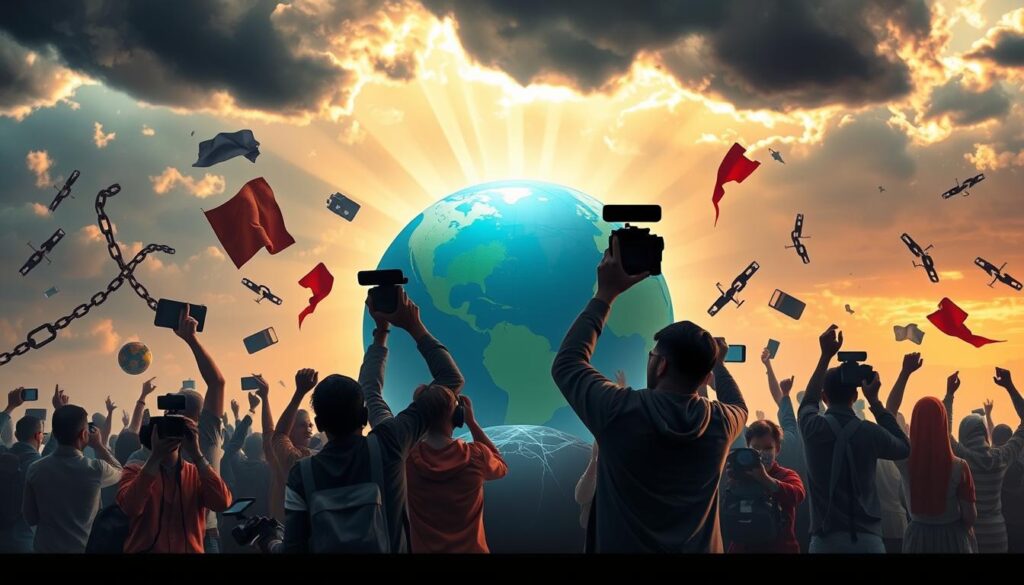
The media is key in showing human rights abuses around the world. It uses both traditional and social media to highlight injustices. This makes the media a big player in today’s conflicts, helping to either make things worse or better.
Traditional media like newspapers and TV are important for news. Social media has made news more accessible and interactive. It also lets people share their stories and voices, helping those who are often ignored.
The relationship between media and human rights is complex. Media can draw attention to abuses, pushing governments to act. But, it can also spread false information, making it hard to fight for rights. This shows why we need to think critically and understand media well.
Key Takeaways
- The media plays a vital role in exposing human rights violations and promoting awareness about sensitive issues.
- Traditional media and social media platforms are essential tools for shedding light on injustices and abuses.
- The media’s responsibility in advocating for human rights involves the dissemination of accurate information and the promotion of awareness.
- The rise of social media has led to an increase in citizen journalism and the expansion of news reach and accessibility.
- The intersection of media and human rights is complex, with the ability to have both positive and negative effects.
- Critical thinking and media literacy are essential for navigating the complex media landscape and promoting human rights.
The Historical Context of Media and Human Rights
The bond between media and human rights has grown a lot over time. Old print media was key in sharing human rights stories. This set the stage for today’s wide range of media platforms.
Evolution of Human Rights Reporting
New tech changed how we report human rights. Now, we have multimedia that lets us share news fast. This helps people around the world know what’s happening1.
Groups like UNESCO have given tools and training for journalists. This helps them report freely without fear2.
Milestones in Media Coverage of Rights Violations
Big events have shown media’s power in fighting for rights. The Vietnam War got a lot of media attention. This changed public views and policies2.
The Arab Spring was another key moment. Social networks and digital media helped organize protests and spread news worldwide32.
- February 2004: Facebook’s start changed how we use social media3.
- 21 March 2006: Twitter helped people talk instantly during the Great American Boycott3.
- 18 December 2010: The Arab Spring showed how vital digital media is in social movements32.
The Media’s Responsibility in Advocacy
The media is key in fighting for human rights. They highlight injustices and speak for those who are ignored. This role requires them to follow ethical rules and seek the truth.
Ethical Standards in Reporting
Media must report truthfully and with respect, even in tough cases. They must protect the dignity and safety of those they cover4. Good journalism means checking facts, avoiding drama, and staying fair to gain trust.
The Impact of Investigative Journalism
Investigative journalism can reveal big human rights issues and push for change. It digs deep to find truths that might be hidden, leading to action from both officials and the public5. People are now more interested in in-depth stories, which help with detailed investigations and storytelling6.
| Aspect | Ethical Standards | Investigative Journalism |
|---|---|---|
| Accuracy | Verify all information before publication | Thorough fact-checking and evidence collection |
| Impartiality | Avoid bias and maintain neutrality | Present multiple perspectives on issues |
| Protection | Safeguard sources and victims | Ensure the safety of journalists in conflict zones |
| Impact | Foster public trust and accountability | Drive policy changes and societal awareness |
Case Studies of Media Intervention
Media is key in showing human rights abuses and getting people to act. Social media and traditional media can change public views and spark action.
The Role of Social Media in Awareness Campaigns
Sites like Twitter and Facebook are now big for talking about human rights. Campaigns like #BringBackOurGirls use them to spread news fast and get support worldwide7. People can share their stories on social media, making things more open and honest8. Community radio also plays a big part, teaching people about important topics like health and development9.
Traditional Media Coverage of Specific Incidents
Big news groups have always reported deeply on human rights issues. The BBC and CNN have found many wrongs, making them known to everyone7. Their detailed reports help shape public opinion and guide laws. Also, combining community radio with big media makes sure everyone gets the news they need, helping human rights movements grow9.
| Media Type | Impact | Example |
|---|---|---|
| Social Media | Rapid information spread and global mobilization | #BringBackOurGirls |
| Traditional Media | In-depth reporting and policy influence | BBC Investigative Reports |
| Community Radio | Reaching underserved populations and promoting grassroots awareness | Local Health Education Programs |
Challenges Faced by the Media
The media is key in exposing human rights abuses. But, it faces many obstacles. These issues affect how well media can share news with the public.
Censorship and Government Restrictions
Many media groups face strict censorship and government rules. These rules stop them from sharing human rights abuses. They also weaken the media’s role as a watchdog.
Safety Risks for Journalists in Conflict Zones
Journalists in war zones are at great risk. They face physical dangers and mental stress. UNESCO research shows 73% of women journalists have been threatened online for their work10.
UNESCO works to protect these journalists. They aim to keep them safe.
The Spread of Misinformation and Its Effects
Misinformation is a big problem for accurate reporting. Digital media trends make it easy for false news to spread fast. This hurts the credibility of media outlets.
To fight disinformation, strong strategies are needed. These strategies help keep the public informed with reliable news.
FAQ
What role does media play in exposing human rights violations?
Media is key in showing us human rights abuses around the world. It uses old media like newspapers and TV, and new ones like Twitter and Facebook. This helps spread news fast, making people aware and pushing for change globally.
How has the relationship between media and human rights advocacy evolved over time?
Media’s role has changed a lot. It used to rely on print, but now it uses digital and multimedia. New tech lets us report on human rights issues quickly and widely. This helps advocacy efforts and brings people together worldwide.
What are some key milestones in media coverage of human rights violations?
Big moments include the Vietnam War and the Arab Spring. The Vietnam War got the world’s attention to its human rights issues. The Arab Spring showed how social media can organize protests and share abuses, showing media’s power in politics and human rights.
What ethical responsibilities do media outlets have in reporting human rights issues?
Media must report on human rights while protecting victims and sources. They need to follow strict ethics. This means checking facts, avoiding sensationalism, and respecting privacy to keep their word and trust with viewers.
How has investigative journalism impacted human rights advocacy?
Investigative journalism has uncovered many human rights abuses. It can lead to big changes and hold wrongdoers accountable. This shows how media can change the world by revealing important issues.
How do social media platforms contribute to awareness campaigns on human rights?
Social media helps spread news fast, like the #BringBackOurGirls campaign. It lets people share their stories and get support. This creates a global community for human rights causes.
What challenges do journalists face when reporting on human rights violations?
Journalists face many challenges, like censorship and safety risks. They might face threats or trauma in dangerous places. Overcoming these is key to reporting human rights abuses.
How does misinformation impact human rights reporting?
Misinformation can confuse people and harm trust in media. It makes it hard to know what’s true. Fighting it requires careful fact-checking and smart media use.
In what ways have digital media and multimedia platforms transformed human rights reporting?
Digital media has changed reporting by making it faster and more engaging. It uses videos, graphics, and updates to tell stories better. This reaches more people and boosts advocacy efforts.
What is the future of media’s role in human rights advocacy?
The future of media in advocacy will depend on tech and how we use it. As digital media grows, outlets must find new ways to report and connect. This will keep human rights in the spotlight.
Source Links
- Human Rights and Electronic Media: a CRL Study – https://www.crl.edu/focus/article/7498
- Microsoft Word – Chapter 1 Tumber&Waisbord .docx – https://openaccess.city.ac.uk/17264/1/Tumber Waisbord Media and Human Rights- Mapping the Field.pdf
- Social Media and Human Rights: A Timeline – EachOther – https://eachother.org.uk/social-media-and-human-rights-a-timeline/
- Chapter 34. Media Advocacy | Section 1. Working with the Media | Main Section – https://ctb.ku.edu/en/table-of-contents/advocacy/media-advocacy/working-with-media/main
- Issue 1: What is media advocacy? – Berkeley Media Studies Group – https://www.bmsg.org/resources/publications/issue-1-what-is-media-advocacy/
- Media’s Crucial Role in Advocating for Human Rights within Society • Journalism University – https://journalism.university/media-and-society/medias-role-advocating-human-rights-society/
- Digital Media-based Health Intervention on the promotion of Women’s physical activity: a quasi-experimental study – BMC Public Health – https://bmcpublichealth.biomedcentral.com/articles/10.1186/s12889-018-5025-5
- Mass media interventions for reducing mental health‐related stigma – https://pmc.ncbi.nlm.nih.gov/articles/PMC9773732/
- Exposure to a media intervention helps promote support for peace in Colombia – Nature Human Behaviour – https://www.nature.com/articles/s41562-022-01330-w
- Media Mistrust Has Been Growing for Decades—Does It Matter? – https://www.pewtrusts.org/en/trend/archive/fall-2024/media-mistrust-has-been-growing-for-decades-does-it-matter