The Mughal Empire was a major force in history, starting in 1526 with Babur, a Timurid leader from Transoxiana. It lasted for over two centuries until 17481. At its biggest, the empire covered a huge area from Afghanistan to Bengal and down to the Deccan plateau. The early rulers, like Bābur, Humāyūn, and Akbar, were key in shaping the empire through their conquests and building efforts1.
The empire’s start was marked by important events, like Bābur’s capture of Delhi and Agra in 1526. This event set the stage for Mughal rule in the area1. The Mughal Empire had a big impact on India, with a strong, centralized government from 1556 to 1707. This showed the empire’s wealth and vast lands1.
Key Takeaways
- The Mughal Empire was founded in 1526 by Babur and spanned over two centuries1.
- The empire’s territorial coverage included Afghanistan, Bengal, and the Deccan plateau, highlighting the significance of the Mughal Empire timeline.
- The early Mughal rulers, such as Bābur, Humāyūn, and Akbar, played a critical role in shaping the empire’s path1.
- The Mughal Empire’s highly centralized organization from 1556 to 1707 reflected substantial resources and extensive territorial coverage1.
- The empire’s impact on the Indian subcontinent was profound, with significant cultural, architectural, and administrative contributions to the history of the Mughal Empire.
Origins and Establishment of the Mughal Empire
The Mughal Empire expansion started with Babur, a relative of Genghis Khan and Timur. He moved from Central Asia to India, starting a new chapter in history.
Babur: The Founder
Babur ruled from 1526 to 1530. He took control of Kabul, Ghaznī, and Samarkand before heading to India2. His leadership mixed Turkic, Persian, and Indian cultures, shaping Mughal culture.
The Battle of Panipat
The First Battle of Panipat in April 1526 was a key victory for Babur2. He used gunpowder and smart tactics to defeat the Delhi Sultanate, showing his strategic genius.
Early Expansion and Consolidation
After winning, Babur had to work hard to keep his rule. His son, Humayun, kept the Mughal Empire expansion going. He fought off Afghans and Rajputs to win back Delhi and Agra in 15552. This period made the empire’s government stronger, ready for more growth.
| Ruler | Reign | Key Contributions |
|---|---|---|
| Babur | 1526–1530 | Established Mughal Empire, Victory at Panipat |
| Humayun | 1530–1556 | Consolidated Empire, Recovered Delhi and Agra |
Golden Age of the Mughal Empire
The Mughal Empire’s golden age was under Akbar the Great. His leadership made the empire a cultural and architectural wonder. Akbar’s reforms brought prosperity and unity to the diverse empire.
Akbar’s Reforms and Policies
Akbar introduced the Dahsala tax system for better revenue collection3. He appointed Zamindars to manage taxes efficiently across the empire3. By removing the Jizyah tax, he promoted religious tolerance3.
Cultural Flourishing and Architectural Marvels
Akbar’s support for art and architecture made the empire’s culture thrive. Fatehpur Sikri, a city he built, shows the Mughal style’s grandeur4. The Hamzanama, a collection of illustrated volumes, combined Iranian and Hindustani art4.
The Role of Religion and Tolerance
Akbar’s Sulh-I-Kul policy gave equal rights to all, showing the empire’s religious harmony3. The House of Worship was a place for interfaith talks3. This inclusivity made the empire a cosmopolitan society.
Decline of the Mughal Empire
The Mughal Empire’s decline was a big change in South Asian history. It started to weaken after years of success. This was due to both internal and external problems.
Aurangzeb and His Policies
Aurangzeb’s rule is seen as a key moment in the history of Mughal Empire. His strict religious rules made many people unhappy5. The constant wars also used up the empire’s money, speeding up its fall.
Internal Conflict and External Pressures
Internal fights weakened the Mughal Empire’s power. Rebellions by groups like Rajputs, Sikhs, and Marathas broke the empire’s control6. Also, fights over who should rule made things worse. This made the empire easy prey for outside enemies.
The Impact of Colonialism
The growth of European colonial powers made the Mughal Empire decline worse. The British East India Company grew stronger, taking advantage of the empire’s weakness5. By the mid-18th century, the Mughal Empire couldn’t fight off colonial rule. It eventually fell apart in 18576.
Legacy of the Mughal Empire
The Mughal Empire’s impact is deep in modern South Asian society. It shapes daily life and cultural norms.
Influence on Indian Culture and Society
Mughal Empire culture brought Mughlai cuisine, known for its rich flavors, into Indian kitchens7. The Urdu language emerged, blending Persian, Arabic, and local Indian tongues, enriching the area’s language scene7. Miniature painting flourished, mixing Persian, Indian, and European styles879.
Architectural Contributions
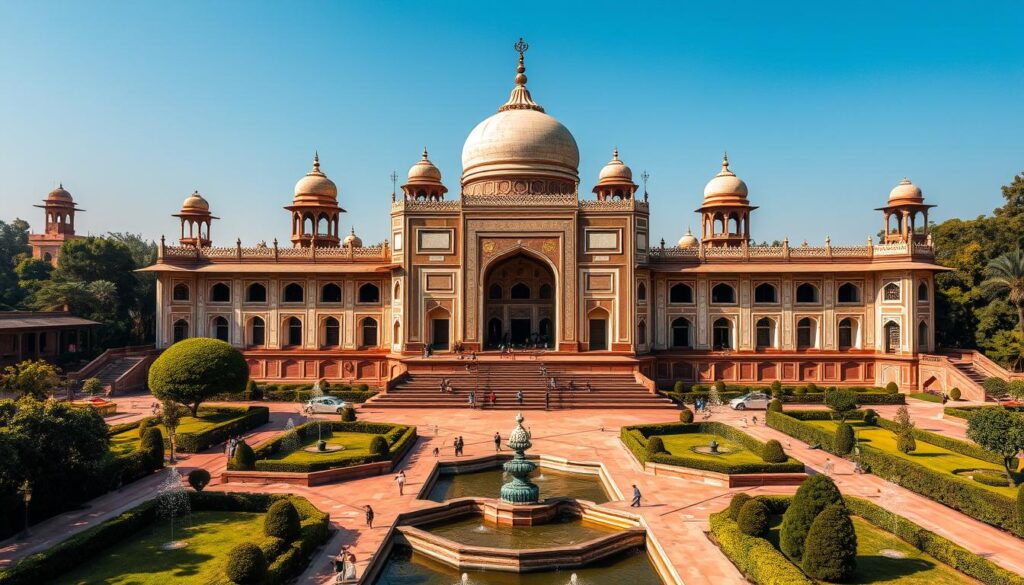
Mughal Empire architecture is famous globally. The Taj Mahal is a UNESCO World Heritage Site and a Seven Wonders of the World7. The Red Fort, Humayun’s Tomb, and Fatehpur Sikri show the empire’s architectural range and creativity87.
These buildings are not just beautiful. They also show the Mughal rulers’ advanced governance and artistic vision89.
The Mughal Empire’s Role in Modern History
The Mughal Empire’s legacy is seen in modern history. Its buildings and cultural practices are key to India’s identity87. Scholars today discuss the empire’s impact on society and culture, seeing both its good and its challenges9.
This lasting impact makes us think about how empires can affect us long after they’re gone8.
FAQ
What is the Mughal Empire and why is it significant in South Asian history?
The Mughal Empire was a major force in South Asia from the early 16th to the mid-18th century. It is known for its rich culture, stunning architecture, and smart governance. These factors greatly shaped the history, society, and culture of the Indian subcontinent.
Who was Babur and how did he establish the Mughal Empire?
A: Babur, a descendant of Timur and Genghis Khan, started the Mughal Empire in 1526. He won the Battle of Panipat and used better military tactics and weapons. This victory helped him defeat the Delhi Sultanate and begin a powerful empire.
Can you outline the timeline of the Mughal Empire’s rise and decline?
The Mughal Empire began in 1526 with Babur. It reached its peak under Akbar the Great in the late 16th century. But, it started to decline in the 18th century due to internal fights and outside pressures. The empire officially ended in 1857 when the British removed the last emperor, Bahadur Shah II.
What were the major achievements of the Mughal Empire?
The Mughal Empire is famous for its architectural wonders like the Taj Mahal. It also made great strides in art, literature, and governance. The empire mixed different cultures, creating a unique South Asian culture.
How did Mughal architecture evolve during the empire’s existence?
Mughal architecture grew by mixing Persian, Islamic, and Indian styles. The grand forts of Agra and Fatehpur Sikri and the Taj Mahal show the empire’s skill in design and engineering.
In what ways did the Mughal Empire influence South Asian culture?
The Mughal Empire greatly influenced South Asian culture. It promoted Persian art and literature, created unique foods, and spread music and dance. The empire’s tolerance of different religions also enriched the culture and diversity of the region.
What factors contributed to the expansion of the Mughal Empire?
The Mughal Empire grew thanks to strong leaders, smart governance, and alliances. Rulers like Aurangzeb expanded the empire through conquests. A strong bureaucracy helped keep control over vast territories.
What led to the decline of the Mughal Empire?
The Mughal Empire declined due to internal struggles and outside threats. Succession fights and poor administration weakened the empire. Policies of rulers like Aurangzeb also drained resources and made governance harder.
What is the legacy of the Mughal Empire in modern South Asia?
The Mughal Empire’s legacy is seen in South Asia’s culture, architecture, and governance today. The Taj Mahal attracts millions, and Mughal traditions are part of the region’s identity. The empire’s influence is also seen in how we view South Asian history and culture today.
How did the Mughal Empire manage religious diversity?
The Mughal Empire, under rulers like Akbar, was tolerant and inclusive. Akbar’s Din-i-Ilahi and his efforts to engage with various religions created a diverse and rich cultural environment. This helped the empire stay stable and culturally vibrant.
Source Links
- India – Mughal Empire, 1526-1761 | Britannica – https://www.britannica.com/place/India/The-Mughal-Empire-1526-1761
- Mughal dynasty | Map, Rulers, Decline, & Facts | Britannica – https://www.britannica.com/topic/Mughal-dynasty
- How the Mughal Empire began – Mughal India – KS3 History – BBC Bitesize – https://www.bbc.co.uk/bitesize/articles/z8jcdnb
- The arts of the Mughal Empire · V&A – https://www.vam.ac.uk/articles/the-arts-of-the-mughal-empire?srsltid=AfmBOorEoc06RaJEtILmUfszGJwqYE_w4PBpCM_kOPrGgjr3r0wleqvZ
- 7 reasons that led to the decline of Mughal Empire – https://timesofindia.indiatimes.com/etimes/trending/7-reasons-that-led-to-the-decline-of-mughal-empire/photostory/107915858.cms
- Decline of the Mughal Empire – https://en.wikipedia.org/wiki/Decline_of_the_Mughal_Empire
- What was the cultural legacy of the Mughal Empire? | TutorChase – https://www.tutorchase.com/answers/ib/history/what-was-the-cultural-legacy-of-the-mughal-empire
- Mughal Dynasty: Influence, Legacy | Vaia – https://www.vaia.com/en-us/explanations/history/the-mughal-empire/mughal-dynasty/
- The Mughal Empire in India – https://www.thoughtco.com/the-mughal-empire-in-india-195498