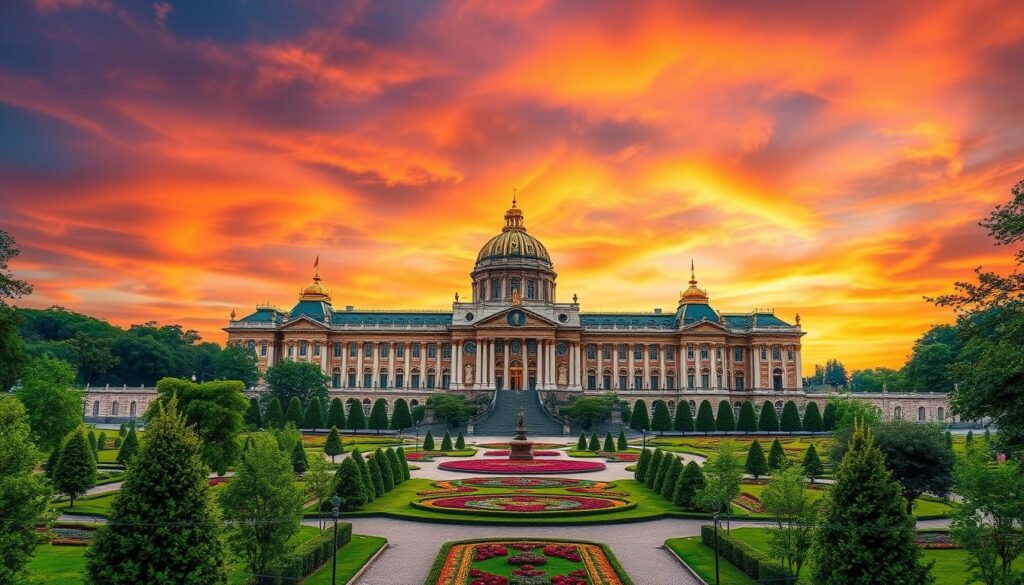
The Russian Empire, also known as Tsarist Russia or Imperial Russia, was a vast state from 1721 to 1917. It played a big role in European and Asian politics. Its history is key to understanding Russia1.
At its peak, the Russian Empire was the third-largest empire in history, covering about 22,800,000 km2. It had over 125 million people, showing great diversity in ethnicity, language, religion, and social class2.
The empire started on November 2, 1721, when Peter I was named emperor. It grew a lot, with the population rising from 15.5 million in 1720 to 164.0 million in 1914. This included new areas in the Baltic, Poland, Romania, and Asia2.
The empire faced a big famine in 1891-1892 and growing discontent. This led to the rise of revolutionary ideas like communism2.
Key Takeaways
- The Russian Empire was established in 1721 and lasted until 1917.
- The empire covered approximately 22,800,000 km2 at its height in the late 19th century.
- The Russian Empire was home to a diverse population of over 125 million people.
- The empire experienced significant population growth during its existence.
- The Russian Empire played a significant role in shaping European and Asian politics.
- The empire’s history is a key part of Russia’s past.
- The Russian Empire was also known as Tsarist Russia or Imperial Russia.
Origins and Foundation of the Russian Empire
The Russian Monarchy started in the late 15th century with Ivan III. Moscow grew from a small place to the center of Russian power. This set the stage for the Russian Expansion to come.
The Rise of the Grand Duchy of Moscow
The Grand Duchy of Moscow was key in uniting areas around it. By 1584, Moscow’s land grew to 5.4 million square kilometers. This was a big jump from its 20,000 square kilometers in the 13th century3.
Key Figures in Early Expansion
Leaders like Ivan III were key in growing Moscow’s area. Their work made the Russian state strong. This laid a solid base for the empire’s growth and conquests.
The Role of Ivan IV (Ivan the Terrible)
Ivan IV, or Ivan the Terrible, was important in making the Russian Monarchy strong. His rule started the conquest of Siberia. This move helped the Russian Expansion spread across Eurasia.
Expansion and Influence of the Empire
The Russian Empire grew a lot under great leaders. Between 1550 and 1700, it added about 35,000 km² each year4. This made Russia a big power in Europe and Asia.
Territorial Gains and Conquests
Peter the Great led Russia westward, creating St. Petersburg and gaining Baltic Sea access4. He also conquered Siberia, reaching far and cold places.
Catherine the Great then pushed Russia’s borders to the Black Sea and Crimea4. She won wars against the Turks and got parts of Central Asia. This boosted Russia’s power and wealth.
Cultural and Religious Assimilation
The Russian Empire was very diverse. About half the people spoke Russian and were Orthodox Christians5. The government tried to bring everyone together, keeping Russian culture on top.
- Promotion of Orthodox Christianity
- Implementation of the narodnost principle
- Suppression of non-Orthodox religions
Impact on Neighboring Nations
The empire’s growth changed the world around it. The partitions of Poland changed Eastern Europe’s politics4. Wars with the Ottoman Empire also shifted borders and power.
Also, taking over Georgia and Azerbaijan made Russia strong in the Caucasus5. But, this often led to long fights with local people.
Decline and Fall of the Russian Empire
The Russian Empire faced big challenges in the early 1900s. Political unrest and economic troubles grew. The 1905 Revolution showed people were unhappy with Tsarist Russia6.
The State Duma was set up to bring some order. But it didn’t stop the revolution feelings from growing.
Key Events Leading to Decline
Several key events made the empire weaker. Ending serfdom in 1861 was meant to modernize but caused big problems6. The Russo-Japanese War of 1904-1905 was a big defeat for Russia6.
A bad famine from 1891 to 1892 killed up to 400,000 people6. This made people even more unhappy.
The Impact of World War I
World War I put a lot of pressure on Russia. The war led to military losses and economic problems6. It drained resources, causing shortages and more unrest.
The war was not managed well. This made both soldiers and civilians very frustrated.
The Russian Revolution of 1917
In 1917, Tsar Nicholas II stepped down during the February Revolution6. This ended centuries of monarchy in Russia6. Then, the October Revolution saw the Bolsheviks, led by Vladimir Lenin, take power6.
This led to the creation of the Soviet Union6. These revolutions marked the end of Imperial Russia and started big changes in politics and society.
| Event | Date | Impact |
|---|---|---|
| Abolition of Serfdom | 1861 | Social upheaval and economic challenges |
| Russo-Japanese War | 1904-1905 | Military defeat and weakened international standing |
| Famine | 1891-1892 | High mortality and increased public discontent |
| February Revolution | March 8, 1917 | Abdication of Tsar Nicholas II |
| October Revolution | November 1917 | Bolsheviks seize power, leading to Soviet Union formation |
Legacy and Influence of the Russian Empire
The Russian Empire’s impact is felt today, shaping society and culture in many ways.
Contributions to Art and Science
Imperial Russia was a center for art and science. Famous authors like Leo Tolstoy and Fyodor Dostoevsky wrote classics like War and Peace and Crime and Punishment. These works are loved worldwide.
Scientists like Dmitry Mendeleev and Alexander Popov made big discoveries. Mendeleev created the periodic table, and Popov worked on radio technology. Their work has changed the world7.
Political and Social Changes
A big change came when Alexander II freed about 20 million serfs. This changed Russia’s social structure. It also set the stage for future political and modernization efforts7.
The Empire’s Role in Modern Russia
Today, Russia’s national identity and politics are shaped by its past. The vast lands once ruled by the empire add to its current influence and diversity8. Recent leaders have brought back some of the empire’s old ideas, showing its lasting impact8.
FAQ
What were the main factors behind the rise of the Russian Empire?
The rise of the Russian Empire was mainly due to the power consolidation in the Grand Duchy of Moscow. Key figures like Ivan III led the way. They expanded the empire by uniting surrounding areas. A centralized state and autocratic rule were key to Russia’s growth.
How did Ivan the Terrible contribute to the establishment of the Russian Empire?
Ivan IV, or Ivan the Terrible, was a major figure in the Russian Monarchy. His rule marked the start of the Romanov Dynasty. Ivan IV conquered Siberia, expanding the empire’s territory.
What role did Peter the Great play in the expansion and modernization of Russia?
Peter the Great modernized Tsarist Russia and made it a major European power. He founded St. Petersburg and reformed the military. His efforts expanded Russia’s territory and influence.
How did Catherine the Great influence the growth of the Russian Empire?
Catherine the Great built on Peter the Great’s work, expanding the empire. She conquered Central Asia and the Black Sea region. Her rule also promoted culture and learning.
What were the key events leading to the decline of the Russian Empire?
The Russian Empire faced many challenges that weakened it. These included political unrest, economic troubles, and social issues. Events like the 1905 Revolution and the State Duma showed growing discontent with the monarchy.
How did World War I impact the Russian Empire?
World War I severely affected the Russian Empire. It worsened economic and social problems. Military losses and high casualties hurt public support for the monarchy.
What was the significance of the Russian Revolution of 1917?
The Russian Revolution of 1917 was a turning point. It ended the Russian Monarchy and the Romanov Dynasty. The February and October Revolutions led by Vladimir Lenin changed Russia’s politics.
What is the legacy of the Russian Empire in modern Russia?
The Russian Empire left a lasting impact on modern Russia. It shaped the country’s identity, culture, and goals. Figures like Pushkin, Tolstoy, and Mendeleev continue to influence the world. The empire’s legacy also includes its bureaucracy and the emancipation of serfs.
How did the Russian Empire manage its diverse population?
The Russian Empire was home to many ethnic groups. It tried to integrate them through language and culture. But managing this diversity was a challenge that sometimes led to conflicts.
What were the major territorial gains of the Russian Empire?
The Russian Empire expanded through conquest and diplomacy. It gained vast areas of Siberia and Central Asia. It also influenced the Baltic states and the Caucasus.
Source Links
- Russian Empire | History, Facts, Flag, Expansion, & Map | Britannica – https://www.britannica.com/place/Russian-Empire
- Russian Empire – https://en.wikipedia.org/wiki/Russian_Empire
- 3.3: Russian History and Expansion – https://socialsci.libretexts.org/Bookshelves/Geography_(Human)/World_Regional_Geography_(Finlayson)/03:_Russia/3.03:_Russian_History_and_Expansion
- The Russian Empire (1721-1917) – VoegelinView – https://voegelinview.com/russian-empire-1721-1917/
- Russia – Expansion, Tsars, Revolution | Britannica – https://www.britannica.com/place/Russia/The-Russian-Empire
- Russian Revolution: Causes, Timeline & Bolsheviks | HISTORY – https://www.history.com/topics/european-history/russian-revolution
- The Russian Empire: Major Accomplishments – VoegelinView – https://voegelinview.com/russian-empire-major-accomplishments/
- Russian imperialism – https://en.wikipedia.org/wiki/Russian_imperialism