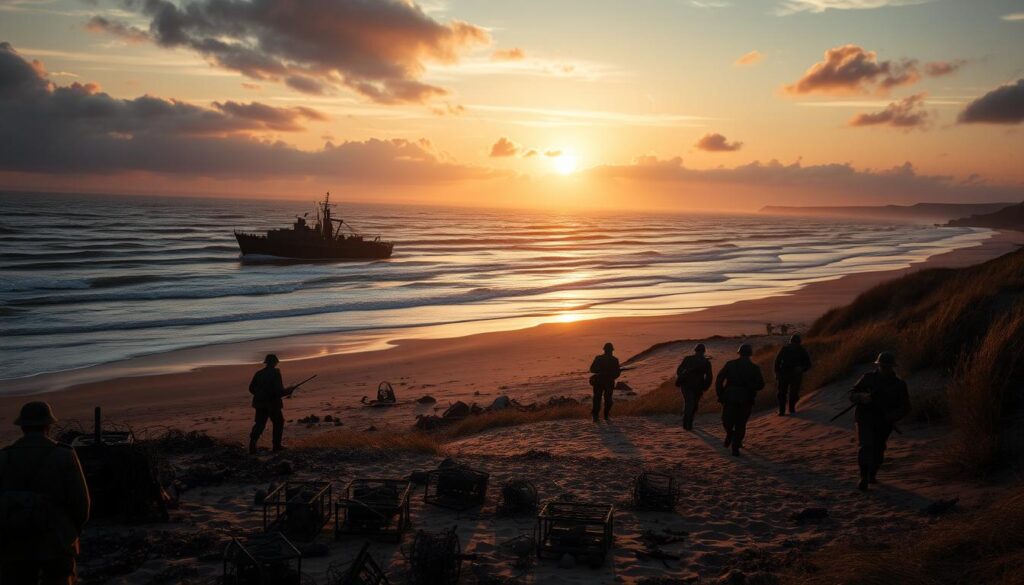
The Normandy landings, also known as D-Day, happened on June 6, 1944, in Normandy, France. It was a key event in WWII, with over 156,000 Allied troops landing on five beaches. This was part of Operation Overlord, aiming to free Western Europe from Nazi rule.
The Allies looked at several places for the invasion, including Brittany and Normandy. They chose Normandy for the big push1.
The landings were a major turning point in WWII. The Allies quickly took control of the five beaches on the first day1. More than 156,000 soldiers and 195,700 naval personnel were involved. Over 13,000 paratroopers also took part in the airborne assault2.
Key Takeaways
- The Normandy landings occurred on June 6, 1944, in Normandy, France, during WWII.
- Over 156,000 Allied troops landed on five beaches along the coast of Normandy.
- The operation was part of Operation Overlord, a major military operation aimed at liberating Western Europe from Nazi control.
- The Allies established beachheads at each of the five landing sites on the first day.
- The operation involved a total of 156,000 soldiers and 195,700 naval personnel from the Allies1.
- Paratroopers involved in the airborne assault totaled more than 13,000 men from various divisions2.
Overview of the Normandy Landings
The Normandy Landings were a key moment in WWII. They were the biggest amphibious invasion in history, starting on June 6, 19443. The plan began in 1943 to gain a foothold on French beaches.
Historical Context
By 1944, the Allies were gaining ground against the Axis powers. They knew a cross-Channel invasion was needed to open a new front in Western Europe4. Operation OVERLORD aimed to do this, using tricks like Operation Bodyguard to confuse German forces.
Significance of the Event
The Normandy Landings were vital in changing the war’s direction. Winning key areas on five beaches—Omaha, Gold, Juno, Sword, and Utah—was key. It helped secure a supply line and push into occupied Europe3. The risks were high, with many casualties and the chance of failure.
Key Players Involved
Supreme Allied Commander Dwight D. Eisenhower led the invasion, bringing together forces from the U.S., British Commonwealth, and others4. Field Marshal Erwin Rommel defended the Normandy coast for Germany, using strong positions to fight off the Allies4.
The Operation Details
The Normandy landings were a huge success thanks to careful planning and new strategies. The Allies had a lot of resources ready to make the operation work on France’s beaches.
Planning and Preparation
Getting ready meant organizing over 160,000 troops and nearly 7,000 ships and boats56. They built special tanks and artificial harbors, called Mulberry harbors5. These steps were key to keeping the invasion going.
- Gathering troops and ships in southern England
- Using Landing Craft Tanks (LCTs) for amphibious assaults6
- Building Mulberry harbors for quick supply
The D-Day Assault
On June 6, 1944, the Allies attacked five beaches: Utah, Omaha, Gold, Juno, and Sword5. Before landing, airborne units went in to take key spots and weaken German defenses56.
- Utah Beach: American forces faced less resistance.
- Omaha Beach: Heavy German defenses caused many casualties56.
- Gold Beach: British troops planned well and secured the area.
- Juno Beach: Canadian forces fought hard against strong opposition.
- Sword Beach: British and French units moved further inland.
Challenges Faced
The operation faced big challenges, like the Atlantic Wall— a 2,400-mile line of bunkers, mines, and fortifications5. Bad weather also made things harder, making it tough to move and supply troops5.
“The bravery of the soldiers overcoming these challenges was instrumental in the liberation of France.”
| Beach | Challenges | Outcome |
|---|---|---|
| Utah | Lighter resistance | Successful landing |
| Omaha | Heavy German defenses, high casualties | Secured after intense fighting |
| Gold | Strong fortifications | British success |
| Juno | Robust defenses | Canadian forces prevailed |
| Sword | Resistance to advance inland | British and French advancement |
Impact of the Normandy Landings
The Normandy landings were a major turning point in WWII. They changed history in France and worldwide. The invasion led to the freedom of Western Europe and changed military and international relations forever.
Military Outcomes
The Allies took five beaches in Normandy, France: Utah, Omaha, Gold, Juno, and Sword7. This victory showed their strong planning and resources. It led to Paris being freed by August 19448.
Germany lost a lot, with about 400,000 troops lost in the Normandy campaign8. The Allies proved that working together could beat strong defenses7.
Social and Political Repercussions
The Normandy landings had big social and political effects. They lifted the spirits of the Allies and those under Nazi rule7. The victory in France helped bring down Nazi Germany, leading to their surrender in May 19458.
Politically, D-Day led to the formation of the United Nations and NATO7. These changes shaped the world after the war. Today, we remember the bravery of those who fought, keeping the Normandy landings’ importance alive7.
Commemoration and Legacy
The Normandy landings are honored through memorials, museums, and ceremonies. These attract millions of tourists yearly. They remind us of the bravery and sacrifice during the invasion.
Memorials and Museums
Visitors can see important sites like the American Cemetery at Colleville-sur-Mer. It has 9,387 graves kept in perfect condition. The Caen Memorial Museum also stands as a tribute to D-Day and World War II9.
These places offer educational exhibits. They help us understand the landings’ impact on culture.
Annual Events and Observances
Every June 6th, ceremonies are held to honor D-Day veterans and fallen soldiers10. The 80th anniversary in 2024 is a National Day of Remembrance10. These events unite veterans, leaders, and civilians in remembrance.
The Lasting Influence on Warfare
The Normandy landings have shaped military strategy and international relations. They teach lessons that guide modern warfare and peacekeeping11. D-Day’s story is also told in films, books, and games10. This keeps its history alive in our culture.
FAQ
What was the primary objective of Operation Overlord during the Normandy landings?
Operation Overlord aimed to secure a foothold in Normandy, France. This was key to freeing Western Europe from Nazi control. The invasion opened a Western Front, drawing German forces away and speeding up the end of World War II.
How many troops were involved in the D-Day assault, and which beaches were targeted?
About 156,000 Allied troops attacked on June 6, 1944. They targeted five beaches: Utah, Omaha, Gold, Juno, and Sword. Each beach had its own challenges, with Omaha Beach facing intense German resistance.
Who were the key military leaders involved in planning and executing the Normandy landings?
Key leaders included General Dwight D. Eisenhower and British Field Marshal Bernard Montgomery. On the German side, Field Marshal Erwin Rommel played a big role in defending the coast.
What were some of the innovative strategies and technologies used during the D-Day invasion?
The Allies used Mulberry harbors for quick port setup and Hobart’s Funnies to clear beach obstacles. Airborne operations also helped secure key areas and weaken German defenses.
What were the immediate and long-term impacts of the Normandy landings on World War II?
The Normandy landings allowed the Allies to start moving across France. This led to the liberation of Paris and the defeat of Nazi Germany. The landings also shaped the post-war world, influencing military strategies and strengthening alliances.
How are the Normandy landings commemorated today, and what landmarks serve as reminders of this historic event?
The landings are honored on June 6th with ceremonies. Landmarks like the American Cemetery at Colleville-sur-Mer and the Caen Memorial Museum are key. These sites, along with many memorials and museums, remember the bravery and importance of D-Day.
In what ways have the Normandy landings influenced modern military strategy and international relations?
The Normandy landings showed the power of combined arms and planning. These lessons are now key in modern military strategy. The success of Operation Overlord also set a model for future international cooperation and peacekeeping, showing the value of unity in achieving global security goals.
Source Links
- Normandy landings – https://en.wikipedia.org/wiki/Normandy_landings
- D-Day | The United States Army – https://www.army.mil/d-day/history.html
- Normandy Invasion | Definition, Beaches, Map, Photos, Casualties, & Facts | Britannica – https://www.britannica.com/event/Normandy-Invasion
- World War II: D-Day, The Invasion of Normandy – https://www.eisenhowerlibrary.gov/research/online-documents/world-war-ii-d-day-invasion-normandy
- D‑Day ‑ Normandy Invasion, Facts & Significance | HISTORY – https://www.history.com/topics/world-war-ii/d-day
- Operation Overlord: Invasion of Normandy – https://www.history.navy.mil/browse-by-topic/wars-conflicts-and-operations/world-war-ii/1944/overlord.html
- D-Day and Its Profound Impact on American History – https://soldiersangels.org/d-day-and-its-profound-impact-on-american-history/
- Why D-Day Was So Important to Allied Victory – https://www.iwm.org.uk/history/why-d-day-was-so-important-to-allied-victory
- The last WWII vets converge on Normandy for D-day and fallen friends and to cement their legacy – https://www.latimes.com/world-nation/story/2024-06-04/the-last-wwii-vets-converge-on-normandy-for-d-day-and-fallen-friends-and-to-cement-their-legacy
- National Day of Remembrance of the 80th Anniversary of D-Day | The White House – https://www.whitehouse.gov/briefing-room/statements-releases/2024/06/05/national-day-of-remembrance-of-the-80th-anniversary-of-d-day/
- Reflecting on the Legacy of D-Day 80 years on | CWGC – https://www.cwgc.org/our-work/blog/reflecting-on-the-legacy-of-d-day-80-years-on/