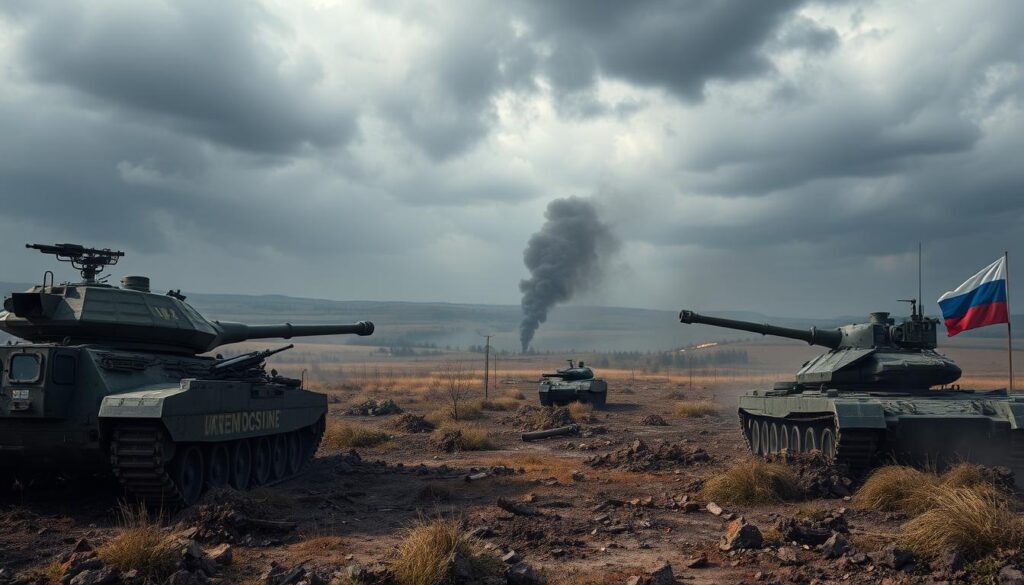
The Russo-Ukrainian War started in February 2014 after Ukraine’s Revolution of Dignity. It grew bigger in February 2022 with Russia’s invasion, becoming Europe’s biggest conflict after World War II1. This war has lasted over 10 years, with big changes like Russia taking Crimea and parts of four southeast Ukrainian areas1. It has caused hundreds of thousands of deaths and losses, with different numbers reported1.
The war’s ongoing nature makes it vital to grasp its start and the escalation of violence. Russia’s full-scale invasion in February 2022 has had major effects, making the Russo-Ukrainian War a big worry for regional and global stability. The US has given a lot of help to Ukraine, including a $61bn aid package for missiles, artillery, and air-defense systems2.
The conflict has also caused a big humanitarian crisis, with tens of thousands of deaths and a refugee crisis1. The world has strongly criticized Russia’s invasion, put sanctions on Russia, and helped Ukraine with aid and military support1. As the situation keeps changing, it’s important to keep up with the latest news on the Russo-Ukrainian War, also known as Russia’s invasion of Ukraine.
Key Takeaways
- The Russo-Ukrainian War started in February 2014 and escalated in February 2022 with Russia’s full-scale invasion of Ukraine.
- The conflict has resulted in significant territorial changes, including the Russian annexation of Crimea and parts of four southeast Ukrainian oblasts1.
- The war has had a substantial humanitarian impact, with tens of thousands of deaths and a refugee crisis1.
- The international community has condemned the Russian invasion and imposed sanctions against Russia1.
- The US has provided significant aid to Ukraine, including a $61bn aid package2.
- The conflict continues to be a significant concern for regional stability and global geopolitics.
Overview of the Russo-Ukrainian War
The Russo-Ukrainian War has changed Eastern Europe’s politics. It started with Russia taking Crimea in 2014. Then, Russia invaded Ukraine fully in February 2022, making the Ukrainian crisis worse3.
Timeline of Key Events
In February 2014, Russian troops secretly took over Crimea4. By 2014, over 14,000 people died in eastern areas4. The war got worse with Russia’s 2022 invasion3. Important events include the 2022 grain deal and its pause in October3.
Major Players Involved
The main groups are the Russian and Ukrainian governments, and groups fighting in the War in Donbass. Also, NATO and the EU play big roles. They shape the Eastern Ukraine conflict34.
Impact on Regional Stability
The war has hurt regional security. Millions have been forced to leave their homes, and many civilians have died3. It has also led to more sanctions on Russia and made NATO rethink its role4. This affects nearby countries and world politics.
| Statistic | Details | Source |
|---|---|---|
| Territory Recaptured by Ukraine | 54% | 3 |
| Russian Occupied Territory | 18% | 3 |
| Civilian Casualties | 30,000+ | 3 |
| Internally Displaced People | 3.7 million | 3 |
| Fled Ukraine | 6.5 million | 3 |
| Humanitarian Assistance Needed | 14.6 million | 3 |
| Russian Troop Involvement in Crimea (2014) | 25,000 | 4 |
| Support for Annexation Referendum | 95% | 4 |
Humanitarian Crisis Arising from the Conflict
The ongoing Conflict in Crimea and broader Russia-Ukraine tensions have sparked a severe humanitarian crisis, affecting millions of lives.
Displacement of Populations
Over 6 million refugees have fled Ukraine, seeking safety across Europe. An estimated 8 million remain displaced within the country5. By March 2022, one-quarter of Ukraine’s population had left their homes, with women and children making up 90% of refugees5.
This mass movement has strained neighboring countries. It has also created challenges in providing adequate shelter and resources.
Economic Consequences
The war has devastated Ukraine’s economy, disrupting trade and increasing inflation. Ukraine was a significant player in global exports, including 12% of maize and barley and 14% of rapeseed in 2020/215. Key economic impacts include:
- Disruption of global food supplies, leading to increased prices.
- Energy market instability affecting multiple regions.
- Supply chain interruptions causing delays and shortages.
These factors contribute to economic instability not only in Ukraine but also globally. They highlight the interconnectedness of today’s economies6.
International Aid Efforts
International organizations and nations have mobilized substantial aid to support those affected by the conflict. Humanitarian aid includes food, medical supplies, and shelter for displaced individuals6. The European Union extended the Temporary Protection Directive until March 2025, facilitating support for Ukrainian refugees across Europe5.
Also, criminal proceedings have been initiated in over 2,000 cases to address justifications of Russian aggression. This has resulted in 443 convictions6.
| Aspect | Statistics |
|---|---|
| Civilian Casualties | 28,711 recorded, including 10,058 deaths6 |
| Refugees in Europe | Over 6 million5 |
| Displaced Within Ukraine | Approximately 8 million by May 20225 |
| International Aid | EU Temporary Protection Directive extended to March 20255 |
International Response and Geopolitical Implications
The world has reacted strongly to Russia’s invasion of Ukraine. This has changed how countries relate to each other and the global balance of power. Each country has acted in its own way, affecting the situation differently.
Sanctions Imposed on Russia
The world has put tough sanctions on Russia to hurt its economy. These include limits on money moves, trade blocks, and freezing assets of important people and sectors7. The goal is to make Russia stop its invasion and follow international rules. But, it’s not clear if these sanctions will work in the long run.
NATO’s Role in the Conflict
NATO has played a key role in supporting Ukraine. The alliance has given military help, done joint training, and increased its presence in Eastern Europe7. NATO is not directly involved in the conflict but supports Ukraine to keep the region safe and stable8.
Future Prospects for Peace
Peace talks have been going on, but finding a solution is hard. The long fight, high death toll, and damage make peace hard to achieve9. Diplomats are working hard to find a way to stop the fighting and get Russian troops out of Ukraine, including Crimea9.
FAQ
What triggered the Russo-Ukrainian War?
The war started in 2014 after Ukraine’s revolution changed its politics. Russia then took Crimea and backed rebels in Eastern Ukraine. This led to ongoing fighting.
What is the timeline of major events in the Russo-Ukrainian War?
The war began with Ukraine’s 2014 revolution. Russia took Crimea and fighting started in Donbas. In 2022, Russia invaded Ukraine, causing widespread damage and global outrage.
Who are the major players involved in the Russo-Ukrainian War?
The main players are Ukraine, Russia, and rebels in Donbas. NATO and the European Union also play big roles, supporting Ukraine and addressing global issues.
How has the Russo-Ukrainian War impacted regional stability?
The war has changed Eastern Europe’s security, raising tensions between Russia and Ukraine. It has made NATO increase its presence, changing European security and raising fears of more conflicts.
What are the humanitarian consequences of the conflict?
Millions of Ukrainians have been displaced, facing hardships like lost homes and safety threats. The need for international help is urgent.
How has the conflict affected the global economy?
The war has hit the world economy hard, affecting energy and food markets. It has caused supply chain disruptions and inflation, leading to higher prices and shortages.
What international aid efforts are underway for those affected by the war?
Many groups and governments are helping those affected. They provide food, medical aid, and shelter, and offer financial help to rebuild communities.
What sanctions have been imposed on Russia due to its invasion of Ukraine?
The world has put strict sanctions on Russia, targeting its economy. These aim to stop Russia’s military actions and push for peace talks.
What role has NATO played in the Russo-Ukrainian War?
NATO has supported Ukraine with military aid, training, and intelligence. It has also boosted its presence in Eastern Europe to deter Russia and ensure security.
What are the prospects for peace in the Ukrainian-Russian conflict?
Finding lasting peace is hard due to deep political and territorial issues. Diplomatic efforts are ongoing, but trust and hostilities are big hurdles. Peace depends on both sides’ willingness to negotiate and seek international help.
Source Links
- Russo-Ukrainian War – https://en.wikipedia.org/wiki/Russo-Ukrainian_War
- Ukraine in maps: Tracking the war with Russia – https://www.bbc.com/news/world-europe-60506682
- War in Ukraine | Global Conflict Tracker – https://www.cfr.org/global-conflict-tracker/conflict/conflict-ukraine
- Russia-Ukraine War | Casualties, Map, Causes, & Significance | Britannica – https://www.britannica.com/event/2022-Russian-invasion-of-Ukraine
- Humanitarian impacts of the Russian invasion of Ukraine – https://en.wikipedia.org/wiki/Humanitarian_impacts_of_the_Russian_invasion_of_Ukraine
- Human rights in Ukraine – https://www.amnesty.org/en/location/europe-and-central-asia/eastern-europe-and-central-asia/ukraine/report-ukraine/
- Ukraine: Conflict at the Crossroads of Europe and Russia – https://www.cfr.org/backgrounder/ukraine-conflict-crossroads-europe-and-russia
- Putin’s Geopolitical Calculus and the War in Ukraine | GJIA – https://gjia.georgetown.edu/2024/08/28/demystifying-the-enemy-putins-geopolitical-calculus-and-the-war-in-ukraine/
- Stability Challenges and Opportunities Regarding the Russo-Ukrainian War – https://www.marshallcenter.org/en/publications/perspectives/stability-challenges-and-opportunities-regarding-russo-ukrainian-war-0