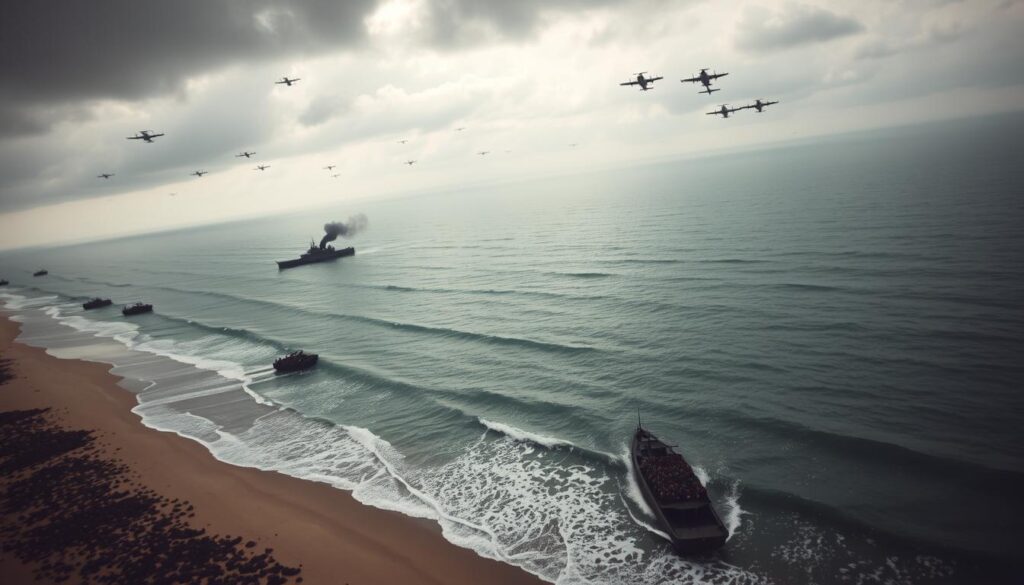
Operation Overlord, also known as D-Day, was a massive Allied invasion on June 6, 1944. It’s one of the largest amphibious invasions in history, involving land, air, and sea forces1. Over 5,000 vessels and 160,000 troops crossed the English Channel on the first day. This made it a key turning point in the war.
The operation was huge, with more than 133,000 troops from the U.S., British Commonwealth, and allies landing on D-Day1.
The Overlord operation was a complex and challenging task. It needed careful planning and coordination. About 160,000 Allied troops were set to land on five beaches: Sword, Juno, Gold, Omaha, and Utah during Operation Overlord2.
The invasion started in the pre-dawn hours of June 6, 1944. Thousands of paratroopers landed inland on Utah and Sword beaches. Their mission was to cut off exits and destroy bridges3.
Key Takeaways
- Operation Overlord was the largest amphibious invasion in military history, bringing together land, air, and sea forces of the allied armies.
- The invasion involved more than 5,000 vessels and 160,000 troops crossing the English Channel on the first day.
- Over 133,000 troops from the United States, British Commonwealth, and allied forces landed on D-Day1.
- Approximately 160,000 Allied troops were planned to land across five beaches during Operation Overlord2.
- The D-Day invasion is considered the largest naval, air, and land operation in history up to that point3.
- Operation Overlord marked a significant turning point in the war, leading to the defeat of German Nazi forces and the eventual end of World War II.
Overview of Operation Overlord
Operation Overlord was a major military effort in World War II. It started the liberation of Western Europe from Nazi rule. The Allies worked together to plan and execute this big operation.
Definition and Objectives
The main goal was to gain a strong foothold in Normandy, France. This would be the starting point for pushing into more of Europe. The Allies used air, sea, and land forces to break through German defenses.
Historical Context
In May 1943, leaders decided to launch the invasion at the Trident Conference in Washington. By June 1944, 160,000 troops were ready to invade, backed by 1,200 planes4. Over 2 million troops from 12 countries were in Britain, prepared for the big push5.
Key Players Involved
General Dwight D. Eisenhower led the Supreme Headquarters Allied Expeditionary Force6. The operation had a huge naval force, with almost 7,000 ships on D-Day5. The Allies also had about 2,200 to 2,500 tanks and assault guns6. The Overlord movie shows the hard work and key roles of these leaders.
The Planning Phase
The success of Operation Overlord depended on careful planning and teamwork among the Allies. Every detail was checked to make sure the invasion would meet its goals.
The Coordination of Allied Forces
Leaders from different countries worked together to plan the invasion. General Dwight D. Eisenhower was chosen as Supreme Allied Commander, Europe on December 24, 19437. He led the American and British naval forces together.
This teamwork included special units, making sure each part of the invasion worked well together.
Intelligence and Deception Strategies
Operation Bodyguard was key in fooling the Germans about when and where the invasion would happen7. Intelligence from Lt. General F.E. Morgan helped create fake plans, like Operation Skyscraper, which suggested different landing spots8. These plans showed the Allies’ clever strategy.
Challenges during the Planning
Planning Operation Overlord faced many hurdles. Building Mulberry harbors was a big challenge8. Also, disagreements among leaders needed careful talks to agree on plans.
The Normandy coastline was tough, with changing tides and strong defenses7. These issues made planning the invasion even harder.
An Overlord trailer shows the huge effort and smart planning that went into this major military operation.
The D-Day Landings
The D-Day landings were a key moment in World War II. They were the heart of Operation Overlord.
The Assault on Normandy Beaches
On June 6, 1944, the Allies attacked five Normandy beaches. The Americans hit Utah and Omaha, facing tough battles. British and Canadian troops took Gold, Juno, and Sword sectors6.
Air and Naval Support
Over 12,000 Allied planes controlled the skies, helping the troops on the ground. More than 5,000 ships and boats carried troops and supplies910.
Impact on the War Effort
The landings gave the Allies a strong base in Europe. By the end of August 1944, Axis forces were retreating from France. This victory weakened German defenses and lifted Allied spirits, setting the stage for more Overlord sequels610.
The Aftermath and Legacy
Operation Overlord changed World War II’s course, shaping modern Europe.
Immediate Outcomes of Operation Overlord
The Normandy landings on June 6, 1944, were a key moment in World War II. Over 160,000 Allied troops crossed the English Channel for the D-Day landings11. By August’s end, more than two million Allied troops were in France, leading the liberation12.
The liberation of Paris on August 25, 1944, was a big win. It showed German control was weakening13.
Long-Term Effects on Europe
Operation Overlord’s success hurt the German war effort. This led to Germany’s unconditional surrender on May 7, 1945, ending the war in Europe13. France and Western Europe’s liberation restored power balance. This paved the way for the postwar world and lasting alliances13.
Commemoration and Historical Significance
Operation Overlord is remembered every June 6th, marking its 80th anniversary11. Places like the Normandy American Cemetery and Memorial honor the fallen13. Filmmakers, including an Overlord director, aim to show this important event in a way that reaches today’s viewers.
FAQ
What was Operation Overlord?
Operation Overlord was the Allied invasion of Normandy during World War II. It started on June 6, 1944, known as D-Day. This big military move was a key moment in the war, freeing Western Europe from the Nazis.
Who were the key players involved in Operation Overlord?
General Dwight D. Eisenhower led the operation. British Field Marshal Bernard Montgomery and American General Omar Bradley also played big roles. They worked together to land on the Normandy beaches.
How is Operation Overlord portrayed in the Overlord movie?
The Overlord movie tells the story of Operation Overlord through soldiers’ personal tales and the challenges they faced. It mixes real history with action-packed scenes, showing the D-Day landings and the invasion’s complexities.
Who are the main cast members of the Overlord movie?
The movie has a great cast, including James McAvoy as the main character, Jessica Chastain as an intelligence officer, and Vin Diesel as a combat veteran. Their acting adds realness to the soldiers’ stories.
What is the plot of the Overlord movie?
The movie weaves together soldiers’ personal stories with the big plan of Operation Overlord. It shows the huge effort to land on D-Day, the bravery of the troops, and the hard times they went through.
How was the Overlord movie received by critics and audiences?
Critics loved the movie for its realistic battle scenes, strong acting, and true-to-history storytelling. Viewers enjoyed the mix of action and emotional depth, feeling like they were right there with the soldiers.
Where can I watch the Overlord trailer?
You can find the Overlord trailer on YouTube and the movie’s official website. It’s also on movie streaming sites and social media linked to the film.
Is there a sequel planned for the Overlord movie?
There’s talk of a sequel, with plans to follow more military actions and the Allies’ efforts in Europe. Fans are waiting for news about the Overlord sequel.
Who directed the Overlord movie?
A: Joe Wright directed the movie. Known for Pride & Prejudice and Atonement, Wright’s direction adds a compelling story and visual flair to the movie, blending history with drama.
Source Links
- World War II: D-Day, The Invasion of Normandy – https://www.eisenhowerlibrary.gov/research/online-documents/world-war-ii-d-day-invasion-normandy
- D-Day and the Normandy Campaign | The National WWII Museum | New Orleans – https://www.nationalww2museum.org/war/topics/d-day-and-normandy-campaign
- D‑Day ‑ Normandy Invasion, Facts & Significance | HISTORY – https://www.history.com/topics/world-war-ii/d-day
- What Was Operation Overlord and How Did It End? – https://www.historyonthenet.com/what-was-operation-overlord
- D-Day Explained – https://www.iwm.org.uk/history/d-day-explained
- Operation Overlord – https://en.wikipedia.org/wiki/Operation_Overlord
- Overlord: From Concept to Execution – https://www.history.navy.mil/browse-by-topic/wars-conflicts-and-operations/world-war-ii/1944/overlord/overlord-planning.html
- Planning for D-Day: Preparing Operation Overlord – https://www.nationalww2museum.org/war/articles/planning-d-day-preparing-operation-overlord
- D-Day | The United States Army – http://www.army.mil/d-day/
- The 10 Things you Need to Know about D-Day – https://www.iwm.org.uk/history/the-10-things-you-need-to-know-about-d-day
- Remembering D-Day: MAS Pays Tribute to Military Milestone – Military AutoSource – https://blog.militaryautosource.com/2024/06/05/remembering-d-day-mas-pays-tribute-to-military-milestone/
- Operation Overlord – https://winstonchurchill.org/publications/churchill-bulletin/bulletin-192-may-2024/operation-overlord/
- The Aftermath and Legacy of D-Day – https://www.spreaker.com/episode/the-aftermath-and-legacy-of-d-day–60532343