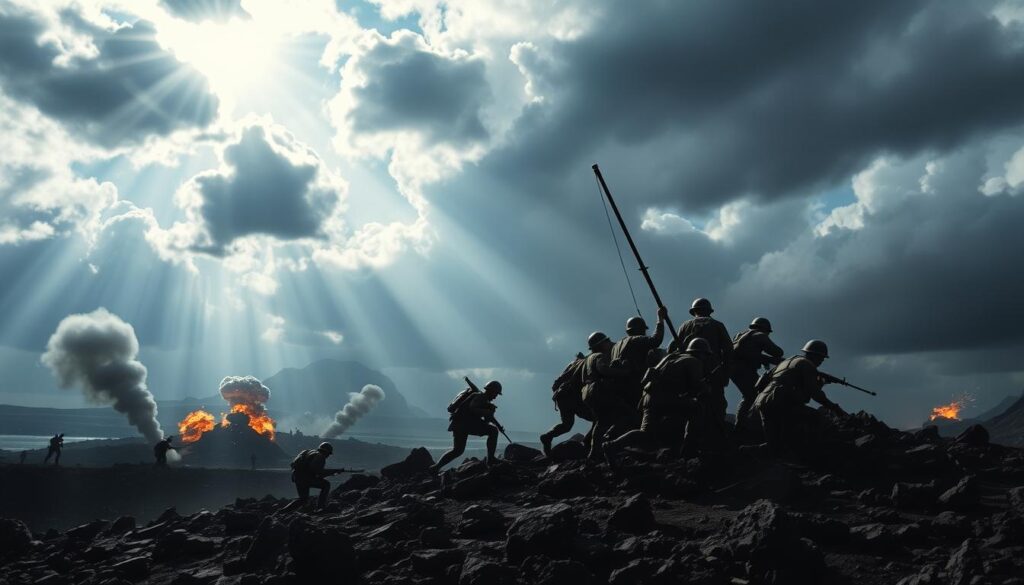
The Battle of Iwo Jima was a key event in World War II. It happened from February 19 to March 26, 1945, lasting over 5 weeks1. It was part of the Pacific War. The United States Marine Corps and Navy fought to capture the island of Iwo Jima from the Imperial Japanese Army.
Iwo Jima is 660 miles south of Tokyo and is 2 miles wide by 4 miles long2. It was important for American forces because it could be used as an air base. This would help them fight against Japanese planes and attacks on the Mariana Islands1.
The American forces had 110,000 personnel and 500+ ships1. The Japanese had about 21,000 soldiers on the island at the start of the battle1.
The Battle of Iwo Jima was a significant event in World War II. The Americans lost 6,821 soldiers, 19,217 were wounded, and 2 were captured. This made a total of 28,698 casualties1. The Japanese lost between 17,845 to 18,375 soldiers, with 216 prisoners1.
About 70,000 U.S. Marines and 18,000 Japanese soldiers fought in the Battle of Iwo Jima2.
Key Takeaways
- The Battle of Iwo Jima was a major conflict in the Pacific War during World War II.
- The American forces included 110,000 personnel and 500+ ships, while the Japanese had approximately 21,000 soldiers on Iwo Jima1.
- The total American casualties during the main battle phase were reported as 6,821 dead, 19,217 wounded, with 2 captured, resulting in 28,698 total casualties1.
- Japanese casualties during the main battle phase were estimated between 17,845 to 18,375 killed or missing in action, with 216 prisoners1.
- Approximately 70,000 U.S. Marines and 18,000 Japanese soldiers were involved in the Battle of Iwo Jima2.
Overview of the Battle of Iwo Jima
The Battle of Iwo Jima was a key fight in World War II’s Pacific Theater. It was a major test for the United States Marine Corps. The battle showed the bravery of the Japanese soldiers defending the island.
Historical Context and Significance
The battle took place from February 19 to March 16, 1945. It was one of the bloodiest battles for the U.S. Marine Corps3. The island, 760 miles from Tokyo, was vital for U.S. airfields needed for B-29 bombers3.
The Japanese soldiers, led by Lieutenant General Kuribayashi Tadamichi, built strong defenses. They used tunnels and fortifications to fight hard.
Geographic Importance
Iwo Jima is about 8 to 10 square miles. It has volcanic terrain and Mount Suribachi, a key symbol of the battle34. Its location between Saipan and Tokyo made it important for air routes in the Pacific4.
Key Objectives of the Campaign
The main goals of the U.S. campaign were:
- To secure airfields for B-29 bombers targeting Japan.
- To take out the Japanese soldiers‘ strongholds.
- To set up a base for future Pacific operations.
The United States Marine Corps thought they’d win in four days. But it took 36 days34. The Japanese soldiers‘ strong defense led to many U.S. casualties. This showed the island’s strategic and symbolic value in the war.
Major Events During the Battle
The Battle of Iwo Jima was filled with intense moments that changed its course. From the start to the famous flag raising, each event showed the bravery of the veterans involved.
The Initial Amphibious Assault
On 19 February, the Fourth and Fifth Marine Divisions landed on Iwo Jima. They faced strong resistance from Japanese forces5. The Marines moved forward, facing tough terrain and heavy losses6.
The Iconic Flag Raising
On 23 February, the 28th Marines reached Mount Suribachi and raised the American flag6. This moment boosted morale and became a symbol of courage and determination.
Key Battles Within the Conflict
During the five-week battle, many key fights took place. Despite being outnumbered, the Marines kept moving forward. This led to over 25,000 casualties and nearly 7,000 deaths5. By 26 March, Iwo Jima was captured, marking a big win in the Pacific.
Strategies and Military Tactics
The United States Marine Corps came up with new ways to land on beaches during the Pacific War. They used flamethrower tanks and artillery to soften up enemy defenses7.
Japanese soldiers under Commander Kuribayashi built a complex network of tunnels and hidden guns. This made it hard for American troops to break through7.
Both sides showed great skill in battle. The Americans, with about 60,000 troops, faced off against around 21,000 Japanese. The fighting was intense, leading to a total of 25,520 American casualties78.
American Strategies and Innovations
- Advanced amphibious landing techniques
- Use of flamethrower tanks
- Coordinated artillery and air support
Japanese Defense Techniques
- Extensive tunnel networks
- Hidden artillery positions
- Strategic use of terrain for defense
Analysis of Combat Effectiveness
The American plans worked well, even with strong resistance. The Japanese tactics, though clever, led to many deaths. They couldn’t stop the United States Marine Corps from winning9.
| Aspect | American Forces | Japanese Forces |
|---|---|---|
| Number of Troops | 60,000 | 21,000 |
| Strategies | Amphibious landings, flamethrower tanks | Tunnel networks, hidden artillery |
| Casualties | High | High |
| Outcome | Established beachheads | Defeated by superior force |
Aftermath and Historical Legacy
The Battle of Iwo Jima had a deep impact on the world after the war. It shows the sacrifices made and the lasting legacy it left.
Casualties and Losses
The battle was very bloody, with over 26,000 American casualties, including 6,800 dead10. The Japanese lost more than 18,844 soldiers, with only 216 captured10. These numbers show the huge human cost of the war.
Long-Term Impact on U.S.-Japan Relations
After the war, the U.S. and Japan became close allies. This change helped bring peace and economic growth to the region. It greatly changed East Asia’s politics.
Commemoration and Memorials Today
Today, we remember the veterans of Iwo Jima with memorials and ceremonies. The famous flag-raising statue on Mount Suribachi is a symbol of courage. These memorials keep the memory of those who served alive for future generations.
FAQ
Why was Iwo Jima strategically important during World War II?
Iwo Jima was key in the Pacific War. It offered a vital base for airfields. These airfields were needed for the U.S. Marine Corps to use B-29 bombers and support moves towards Japan.
What role did Mount Suribachi play in the Battle of Iwo Jima?
Mount Suribachi was a major spot on Iwo Jima. It was important for both Japanese and American forces. The famous flag raising on Mount Suribachi showed American determination and strength.
How did the geography of Iwo Jima influence the outcome of the battle?
Iwo Jima’s volcanic terrain was tough for the U.S. Marine Corps. The island’s narrow beaches and strong defenses made the attack hard. This led to long and intense fighting, but the Americans won.
What were the key objectives of the American campaign in the Battle of Iwo Jima?
The U.S. Marine Corps aimed to capture the island’s airfields. These airfields were essential for launching B-29 bombers and air support. Taking Iwo Jima also weakened Japan’s defenses.
How did the Battle of Iwo Jima affect the overall Pacific War?
The Battle of Iwo Jima was a big win for the U.S. It gave them a base for air operations, getting closer to Japan. This victory also lifted American morale and showed the bravery of the veterans.
What was the significance of the flag raising on Mount Suribachi?
The flag raising on Mount Suribachi was a symbol of American courage and unity. It boosted morale during the tough battle. It’s remembered in photos and memorials for the veterans.
How many casualties were suffered during the Battle of Iwo Jima?
The Battle of Iwo Jima was very costly. About 6,821 U.S. Marines were killed and 19,217 were wounded. The Japanese lost nearly all 21,000 soldiers on the island.
What military strategies did the Japanese soldiers employ to defend Iwo Jima?
The Japanese used creative defense tactics. They built underground bunkers, hidden artillery, and tunnels. These plans aimed to cause as many American casualties as possible.
How is the Battle of Iwo Jima commemorated today?
The Battle of Iwo Jima is remembered through memorials and ceremonies. The Iwo Jima Memorial in Arlington, Virginia, is a key place of remembrance. It honors those who lost their lives.
What is the legacy of the Battle of Iwo Jima in U.S.-Japan relations?
The Battle of Iwo Jima helped shape U.S.-Japan relations after World War II. The shared sacrifices and commemorations have turned the two nations into close allies. This partnership has lasted for many years.
Source Links
- Battle of Iwo Jima – https://en.wikipedia.org/wiki/Battle_of_Iwo_Jima
- Iwo Jima Fact Sheet – https://www.nationalww2museum.org/sites/default/files/2020-02/iwo-jima-fact-sheet.pdf
- Battle of Iwo Jima | Facts, Significance, Photos, & Map | Britannica – https://www.britannica.com/topic/Battle-of-Iwo-Jima
- Battle of Iwo Jima – https://www.usmcmuseum.com/battle-of-iwo-jima.html
- Battle of Iwo Jima ‑ Facts, Significance & Dates – https://www.history.com/topics/world-war-ii/battle-of-iwo-jima
- Chronology of the Battle of Iwo Jima – https://www.nps.gov/parkhistory/online_books/npswapa/PacTheaterCAmp/Iwo/chronology.htm
- PDF – https://www.usmcu.edu/Portals/218/Iwo Jima.pdf
- Battle of Iwo Jima – https://www.history.navy.mil/browse-by-topic/wars-conflicts-and-operations/world-war-ii/1945/battle-of-iwo-jima.html
- Analysis of the Battle of Iwo Jima – https://apps.dtic.mil/sti/tr/pdf/ADA143991.pdf
- The Battle of Iwo Jima – https://marineparents.com/marinecorps/iwo-jima.asp