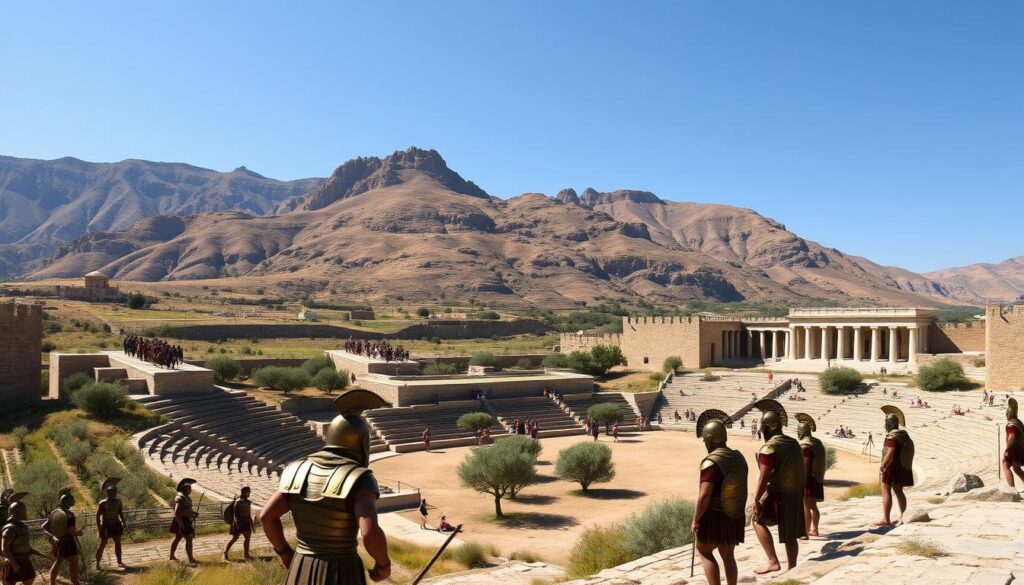
Sparta was a key city-state in ancient Greece, known for its unique social and political setup. This setup made it stand out from other Greek city-states and helped it become a military powerhouse1. It was located in Laconia, in the Peloponnese region, along the Eurotas River. It was also called Lacedaemon2. As you learn about Sparta’s history, you’ll see how it became a major military force in ancient Greece around 650 BC3.
Understanding Sparta’s location is key to knowing its importance in ancient Greece. It was known as Lacedaemon, covering the whole area, while Sparta was the main settlement by the Eurotas River1. Its strategic spot helped it control the area, making it a strong force in ancient Greece.
Exploring Sparta, you’ll find out about its unique social structure. It included Spartiates, mothakes, perioikoi, and helots1. This structure was key to its military strength. You’ll also see how Sparta’s military tactics, like the phalanx formation, made it a strong opponent in battles2.
Key Takeaways
- Sparta was a prominent ancient Greek city-state in Laconia.
- The city-state was known for its unique social and political structure.
- Sparta emerged as a dominant military power in ancient Greece around 650 BCE3.
- The city-state was situated in the Peloponnese region, strategically located along the Eurotas River.
- Sparta’s military innovations, such as the phalanx formation, made it a formidable opponent on the battlefield2.
- The history of Sparta is a fascinating topic, and understanding its geographical location is essential to grasping its significance in ancient Greece1.
Historical Significance of Sparta
Sparta was a military powerhouse in ancient Greece. It greatly influenced regional politics and warfare. Its success came from a society dedicated to martial excellence.
Origins and Founding
The history of Sparta began around 1000 BC, after the Mycenaean civilization fell4. Figures like King Lelex and the Heracleidae played key roles in its founding. They made Sparta a strong city-state.
Key Historical Events
Sparta became the top Greek military force during the Greco-Persian Wars5. It fought against Athens’ naval power. The Peloponnesian War (431–404 BC) made Sparta even stronger, winning at the Battle of Aegospotami4.
Military Innovations
Spartan warriors were known for their discipline and smart military tactics. They used the phalanx formation to defend and attack effectively5. The Agoge training made all male Spartans ready for military duty4.
Spartan Society and Culture
Sparta in ancient Greece was known for its Spartan culture. This culture valued military strength and social order. It played a big role in Sparta’s importance back then.
Social Structure and Classes
The Spartan society was divided into clear classes to keep things running smoothly. The main groups were:
- Spartiates: Full citizens who had to serve in the military6
- Mothakes: Non-Spartans raised like Spartans6
- Perioikoi: Free, non-citizen people6
- Helots: Enslaved people who outnumbered Spartiates, causing tension6
Helots could get married, own land, and even buy their freedom. But their large numbers sometimes led to uprisings6.
Education and Upbringing
The Spartan education started at seven. Boys went through tough training to become great warriors. This training taught them discipline and toughness6.
This education system made Spartans strong in battle. It also taught them important values. This way, each new generation kept Sparta’s ideals alive.
Religious Practices
Religion in Sparta was closely tied to its warrior culture. The gods were seen as symbols of war and strength. This focus on combat and bravery was central to Spartan life.
Rituals and ceremonies were a big part of daily life. They helped unite the Spartans and gave them a sense of purpose.
Sparta’s Military Prowess
At the heart of Sparta was its unmatched military focus, shaping every facet of Spartan life.
The Spartan Army Structure
The Spartan military hierarchy was meticulously organized. Citizens were divided into distinct classes. Spartiates enjoyed full rights, mothakes were free non-Spartiate descendants, perioikoi were free non-Spartiates, and helots were state-owned enslaved locals. This structure ensured a disciplined and efficient fighting force.
Training Regimens and Agoge
From a young age, Spartan boys entered the agoge, a rigorous training program starting at seven years old. They faced harsh physical conditions, went barefoot, rarely bathed, and wore a single cloak throughout the year. Regular fitness inspections and brutal contests, such as driving opponents off islands, honed their resilience and combat skills7.
Notable Battles and Strategies
Spartans in battle were renowned for their superior organization and tactical maneuvers. The Battle of Thermopylae stands out, where their disciplined phalanx held off vast Persian forces through strategic positioning and unwavering courage8. Their ability to maintain formation under pressure made Spartan military tactics a formidable force in ancient warfare.
The Legacy of Sparta
Sparta’s legacy continues to impact modern society. It’s not just about its military strength. It has shaped today’s institutions and stories.
Influence on Modern Institutions
Many military schools look up to Sparta for training. They focus on discipline and toughness. Schools also teach Spartan values to build strength and leadership in students.
The history of Sparta guides programs that value teamwork and duty. These values made Sparta famous.
Sparta in Literature and Popular Culture
Sparta shows up in books and movies, symbolizing courage and strategy. Classics like Plutarch’s “Lives” and modern films celebrate Sparta. Yet, these stories sometimes get Sparta wrong, showing its complex side.
Preservation of Spartan Heritage
Archaeologists and historians work hard to keep Sparta’s legacy alive. They dig up ancient sites and study history. This helps us understand Sparta’s society and daily life.
Studying Sparta teaches us about civic duty and the balance between personal and public interests. Its lasting impact shows how important Sparta was and remains in shaping our world9.
FAQ
What was the geographical significance of Sparta in ancient Greece?
Sparta was in the Peloponnese region, near the Eurotas River. This location gave natural defenses and helped with trade and communication. It helped Sparta become a top military power in ancient Greece.
How did Sparta’s social structure contribute to its military prowess?
Sparta had a strict social order. It had Spartiates, mothakes, perioikoi, and helots. This setup focused on military training. It made Spartan warriors disciplined and strong, unlike other city-states.
What was the agoge system, and how did it shape Spartan warriors?
The agoge was Sparta’s tough training for young boys. It aimed to make skilled warriors. It taught endurance, combat skills, and loyalty, making Spartan warriors very effective in battle.
What role did Sparta play in the Peloponnesian War?
Sparta led in the Peloponnesian War against Athens. It used its strong military tactics and disciplined army to win. This victory greatly changed ancient Greece’s politics and military.
How did Spartan military tactics differ from those of other Greek city-states?
Spartans used tactics like the phalanx formation and hoplite warfare. These were disciplined and focused on teamwork. Their training made them very effective and feared in battle.
In what ways has Sparta influenced modern military institutions?
Spartan values of discipline and training have inspired modern militaries. Their emphasis on physical fitness and unit tactics is seen in today’s military academies and training.
How is Sparta portrayed in literature and popular culture?
Sparta is seen as a symbol of military strength and discipline in media. Movies like “300” show Spartan bravery and strategy. But, these portrayals might not always be accurate.
What efforts are being made to preserve Spartan heritage today?
Archaeologists and historians are working to keep Sparta’s legacy alive. Museums, schools, and cultural groups help. They ensure future generations can learn about this important ancient city-state.
Source Links
- Sparta – https://en.wikipedia.org/wiki/Sparta
- Sparta | History, Location, Population, Map, & Facts | Britannica – https://www.britannica.com/place/Sparta
- Sparta | Boundless World History – https://courses.lumenlearning.com/tc3-boundless-worldhistory/chapter/sparta/
- History of Sparta – https://en.wikipedia.org/wiki/History_of_Sparta
- Sparta: Definition, Greece & Peloponnesian War | HISTORY – https://www.history.com/topics/ancient-greece/sparta
- Culture in Classical Sparta | Western Civilization – https://courses.lumenlearning.com/atd-herkimer-westerncivilization/chapter/culture-in-classical-sparta/
- How Ancient Sparta’s Harsh Military System Trained Boys Into Fierce Warriors | HISTORY – https://www.history.com/news/sparta-warriors-training
- Spartan army – https://en.wikipedia.org/wiki/Spartan_army
- Sparta Was Much More Than an Army of Super Warriors – https://www.smithsonianmag.com/history/sparta-much-more-army-warriors-180978583/