The Syrian Civil War started in March 2011 as part of the Arab Spring. It began with protests against President Bashar al-Assad’s regime. By 2012, it had turned into a full-scale civil war.
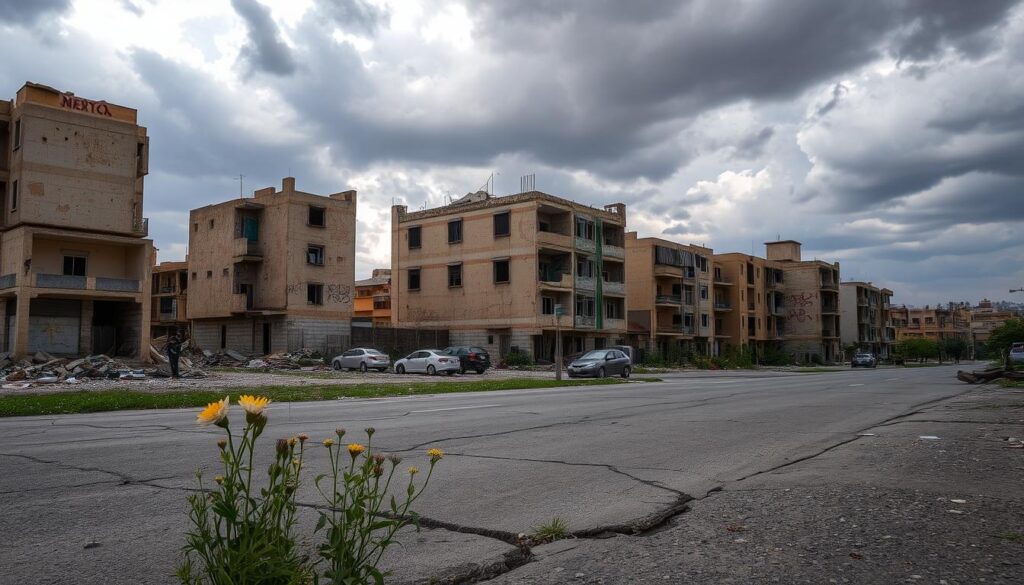
This war has caused a huge humanitarian crisis. Nearly fourteen million people, over half of Syria’s population before the war, have been displaced. This is a staggering number.
The conflict in Syria has seen ongoing violence and instability. Key players include the Free Syrian Army and Islamic State in Iraq and the Levant. The war has resulted in a huge loss of life, with estimates ranging from 580,000 to 617,910+.
The war has deeply affected Syria and its people. As of March 2021, 6.7 million people are internally displaced, and 6.6 million are external refugees. The war has also drawn in international actors like Iran, Russia, and Hezbollah, who support the Syrian government.
Key Takeaways
- The Syrian Civil War began in March 2011 as part of the Arab Spring protests.
- The conflict has resulted in significant humanitarian impact and displacement, with nearly fourteen million people displaced1.
- The war in Syria has been marked by ongoing violence and instability, with key participants including the Free Syrian Army and Islamic State in Iraq and the Levant2.
- Total deaths in the Syrian civil war have been estimated at 580,000 to 617,910+3.
- The conflict has been influenced by various international actors, including Iran, Russia, and Hezbollah, which are the main international supporters of the Syrian government2.
- The Syrian Civil War has resulted in significant loss of life and displacement, with 6.7 million internally displaced people and 6.6 million external refugees as of March 20213.
Overview of the Syrian Civil War
The Syrian Civil War has been a major issue in the Middle East. It has greatly affected the stability of the region and international relations.
Background and Causes
The conflict started due to long-term political oppression and economic inequality under the Assad regime. The regime’s authoritarianism and corruption made people unhappy. Economic changes mainly helped those close to the regime.
A severe drought from 2006 to 2010 made things even worse. It led to a lot of social unrest4.
Key Players and Factions
Many groups are important in the Syrian crisis. The Syrian government, led by Bashar al-Assad, gets support from Iran and Russia. Rebel groups, like the Turkish-backed Free Syrian Army and Hayat Tahrir al-Sham, fight against the regime.
Kurdish forces, such as the Syrian Democratic Forces (SDF), want their own freedom. The US and Turkey also play big roles in the conflict546.
Timeline of Key Events
- Early 2011: Protests turned into armed conflict, starting the Syrian crisis4.
- 2012: Rebel forces took over big cities like Aleppo, Hama, and Homs56.
- 2020: Russia and Turkey made a ceasefire in Idlib, trying to calm things down6.
Humanitarian Impact of the Conflict
The ongoing conflict in Syria has triggered a profound humanitarian crisis. It affects millions of lives within the country and beyond its borders.
Displacement and Refugee Crisis
Over 14 million people have been displaced by the war. This has created one of the largest refugee populations in the world. Turkey alone hosts nearly 3 million Syrian refugees, putting a huge strain on local resources7.
Internally, 7.2 million Syrians are displaced. They struggle to rebuild their lives amidst continuous instability7.
Health and Education Challenges
The humanitarian crisis in Syria has severely damaged the nation’s healthcare and education systems. Many hospitals and schools are in ruins or non-functional. This leaves millions without essential services.
Approximately 2 million children have been unable to attend school. 1.6 million are at risk of dropping out, which hinders their future prospects7.
International Aid Response
Global efforts to address the humanitarian crisis in Syria have been substantial. Yet, they are often hindered by ongoing conflict and political barriers. Organizations like World Vision have reached over 2.3 million people, providing critical support7.
Despite these efforts, access remains a significant challenge. Aid is frequently blocked or diverted. This exacerbates the suffering of Syrian refugees8.
Current State and Future Outlook
The situation in Syria is changing with new political and military developments. The recent change in leadership is a key moment in the ongoing fight.
Ongoing Military and Political Dynamics
After Assad’s fall in December 2024, an Islamist-led government took over. This change has caused divisions, with groups like ISIS in Syria controlling different areas9. The balance of power is fragile, making it hard to have one leader in charge10.
Role of International Community
Global powers are key in shaping Syria’s future. Russia and Iran keep their influence with military and economic aid. The United States has stepped back from direct involvement11. Yet, international groups try to help, but different interests make it hard to work together9.
Prospects for Peace and Reconciliation
Finding peace is a big challenge. The fight against ISIS in Syria is ongoing, but the group’s strength is a big obstacle10. Talks under UN Resolution 2254 aim for everyone to be heard, but agreeing is hard11. For lasting peace, the world needs to work together and tackle the conflict’s root causes.
FAQ
What triggered the start of the Syrian Civil War?
The Syrian Civil War started in 2011, during the Arab Spring protests. People first called for democracy and the freedom of political prisoners. But, the Assad regime used violence, turning the protests into a big conflict.
Who are the main parties involved in the Syrian conflict?
The Syrian conflict has many players. There’s the Assad regime, rebel groups, and extremist groups like ISIS. Countries like Russia, the US, Turkey, and Iran also play big roles, either by fighting or supporting certain groups.
What has been the impact of the war on Syrian refugees?
The war has led to a huge refugee crisis. Millions of Syrians have left their homes. They seek safety in Syria and neighboring countries. This crisis has had a big impact on the world.
How has the international community responded to the Syrian crisis?
The world has helped in many ways. The UN and NGOs have given aid. Countries have offered asylum and support. But, different interests have made it hard to agree on a single plan.
What role has ISIS played in the Syrian war?
ISIS became a big problem in the war. They used the chaos to take over areas. This led to more fighting by international groups to stop them.
What is the current state of the conflict in Syria?
The conflict is ongoing. The Assad regime controls much of Syria, but rebels and extremists hold some areas. There are talks about a new government, but peace is hard to find.
Are there prospects for peace and reconciliation in Syria?
Finding peace in Syria is hard. There are talks for ceasefires and political solutions. But, the deep divisions and outside interference make it tough. Real peace needs solving both political and humanitarian problems.
How have environmental factors contributed to the Syrian crisis?
Environmental issues, like a big drought from 2006-2010, made things worse. The drought caused food shortages, economic problems, and people moved to cities. This increased tensions and helped start the war.
Source Links
- Syria’s War and the Descent Into Horror – https://www.cfr.org/article/syrias-civil-war
- Syrian Civil War | Syrian history | Britannica – https://www.britannica.com/event/Syrian-Civil-War
- Syrian civil war – https://en.wikipedia.org/wiki/Syrian_civil_war
- Tracing the evolution of the Syrian civil war (2011-2020) – https://www.clingendael.org/pub/2021/eu-relevance-in-the-syrian-and-iraqi-civil-wars/2-tracing-the-evolution-of-the-syrian-civil-war-2011-2020/
- The Fall of Assad in Syria: How It Happened and What Comes Next – https://www.nytimes.com/article/syria-civil-war-rebels.html
- What’s happening in Syria? A simple guide | CNN – https://www.cnn.com/2024/11/30/middleeast/syrian-civil-war-reignited-explainer-intl/index.html
- Syrian refugee crisis: Facts, FAQs, and how to help – https://www.worldvision.org/refugees-news-stories/syrian-refugee-crisis-facts
- Human rights in Syria – https://www.amnesty.org/en/location/middle-east-and-north-africa/middle-east/syria/report-syria/
- What Future for Syria? – https://www.gmfus.org/news/what-future-syria
- Syria’s Civil War Gives Way to the Post-Assad Era – https://www.worldpoliticsreview.com/the-syria-civil-war-might-be-ending-but-the-crisis-will-live-on/
- The Assad regime falls. What happens now? – https://www.brookings.edu/articles/the-assad-regime-falls-what-happens-now/