
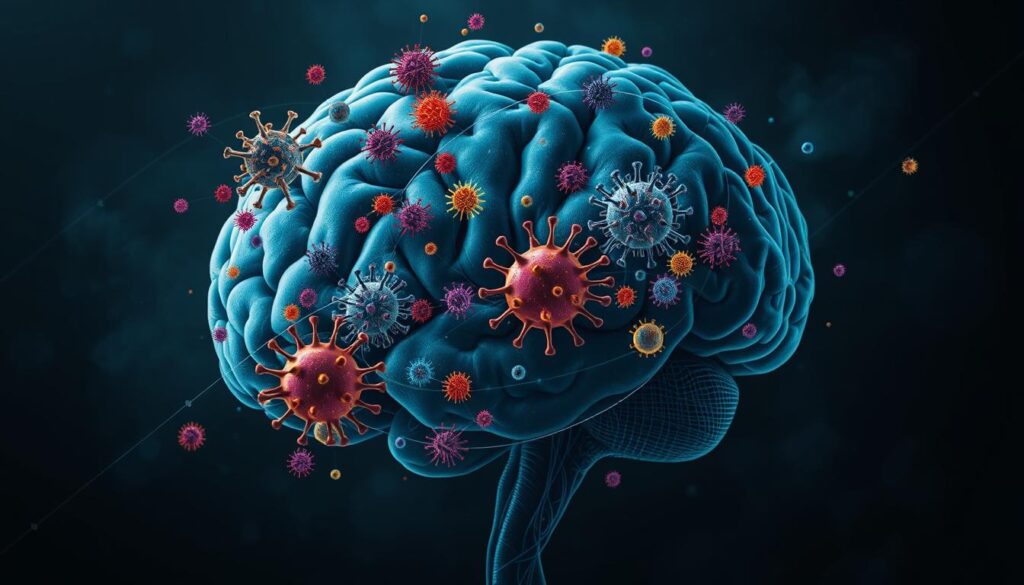
New research reveals striking links between viral infections and neurodegenerative diseases. Scientists have found that viruses may significantly affect neurological health risks. These findings suggest potential pathogenesis mechanisms in neurodegenerative conditions1.
Large-scale studies offer crucial insights into viral impacts on neurological conditions. The FinnGen project found 45 unique virus-neurodegenerative disease associations. The UK Biobank confirmed 22 additional associations1.
Viral encephalitis emerged as a major risk factor. It increased Alzheimer’s disease risk 30 times in FinnGen data. In the UK Biobank, the risk was 22 times higher1.
Viral infections can trigger neuroinflammation, key to understanding neurodegenerative disease progression. Some infections increase neurological disease risks for up to 15 years1.
Key Takeaways
- Viruses may significantly impact neurological health
- Viral encephalitis shows strong associations with Alzheimer’s disease
- Long-term neurological risks can persist years after viral infections
- Large-scale studies reveal complex virus-neurodegenerative disease connections
- Preventive measures like vaccines might help reduce potential risks
Understanding Neurodegenerative Diseases
Neurodegenerative diseases are complex disorders that affect the nervous system. They impact millions worldwide, harming brain function, memory, and mobility. Viral infections and RNA viruses may contribute to these neurological conditions2.
What Are Neurodegenerative Diseases?
These diseases cause gradual neuron deterioration in specific brain regions. Your nervous system becomes vulnerable to damage, disrupting normal cellular functions. Alzheimer’s and Parkinson’s are key examples of these progressive neurological challenges3.
Common Types of Neurodegenerative Diseases
- Alzheimer’s Disease: Impacts approximately 50 million people globally3
- Parkinson’s Disease: Involves complex protein aggregation3
- Multiple Sclerosis: Affects myelin sheaths of neurons3
- Amyotrophic Lateral Sclerosis (ALS): Causes motor neuron degeneration3
Symptoms and Progression
Monitoring and early detection are vital for understanding disease progression. Regular medical check-ups help track symptom changes and adjust treatment plans4.
Caregivers play a crucial role in supporting individuals with these challenging conditions4.
Early detection can significantly impact the management of neurological disorders4.
Genetic factors and environmental influences affect the risk of developing these diseases. Protein mutations and cellular process changes can speed up neurodegeneration3.
Understanding these mechanisms helps researchers develop targeted therapies for Alzheimer’s and Parkinson’s disease.
| Disease | Key Characteristics | Global Impact |
|---|---|---|
| Alzheimer’s | Memory loss, cognitive decline | 70% of dementia cases2 |
| Parkinson’s | Movement disorders | Affects motor function |
| Multiple Sclerosis | Neurological communication disruption | Impacts nerve signaling |
The Link Between Viruses and Neurodegeneration
Viruses can deeply affect the nervous system, possibly triggering neurodegenerative conditions. These complex interactions involve intricate molecular mechanisms. Researchers study these to understand the link between viral infections and neurological disorders.
How Viruses Infect the Nervous System
Your nervous system can be invaded by viruses through various pathways. Microbes can enter neural networks, causing major disruptions in brain function5.
These infections may set off a chain of effects. This can lead to long-term damage to the nervous system.
- Direct neural invasion
- Inflammatory response activation
- Protein misfolding mechanisms
- Immune system dysregulation
Potential Mechanisms of Damage
Viral infections can greatly increase the risk of neurodegenerative diseases. Studies show a link between early and mid-life infections and higher risks.
These risks include developing conditions like Alzheimer’s, Parkinson’s, and amyotrophic lateral sclerosis5. Hospital-treated infections seem to play a role in this.
| Virus Type | Potential Neurological Impact |
|---|---|
| Herpes Simplex Virus | Increased Alzheimer’s risk6 |
| HIV-1 | Neurocognitive disorders6 |
| Hepatitis Viruses | Potential Parkinson’s Disease association6 |
Understanding prion diseases and their epidemiological connections to viral infections remains a critical research frontier.
Viral interactions can change neural protein structures at a basic level. This may trigger processes that lead to brain degeneration.
Antiviral treatments might offer promising interventions in reducing clinical risks5. More research is needed to fully understand these complex relationships.
Notable Viruses Associated with Neurodegenerative Conditions
Viruses and neurodegenerative diseases have a complex relationship. Scientists are studying how viruses interact with the nervous system. This research offers insights into neuroinflammation and disease mechanisms.
Scientists found links between viral infections and neurodegenerative conditions. They identified 45 viral exposures that increase risks of neurological disorders7. This research shows interesting patterns about viruses’ role in neurodegeneration.
Herpes Simplex Virus (HSV)
HSV is a key virus in neurodegenerative research. Studies suggest HSV infections might trigger neuroinflammation. This could speed up neurological damage.
Human Immunodeficiency Virus (HIV)
HIV poses unique challenges to neurological health. It can directly affect the nervous system. This may lead to cognitive issues and increase neurodegenerative risks.
West Nile Virus
West Nile Virus is another important research area. Scientists have noticed possible long-term neurological effects from this infection.
- Viral encephalitis increases Alzheimer’s disease risk by 30-fold8
- Some viral exposures can increase neurodegeneration risk up to 15 years after infection7
- Vaccination might help reduce neurodegenerative disease risks9
“Understanding viral impacts on neurological health could revolutionize prevention and treatment strategies for neurodegenerative diseases.”
The virus-neurodegeneration link remains a key research focus. Ongoing studies aim to reveal how viral infections affect long-term brain health879.
The Role of the Immune System
Your body’s immune system guards against viral infections and neurological issues. It interacts with neuroinflammation, offering insights into neurodegenerative diseases10.
Immune Response to Viral Infections
Viral infections spark complex immune responses that impact neurological health. The immune system’s reaction to pathogens may contribute to long-term neurological risks.
Studies reveal that viral infections can increase neurodegenerative risk for up to 15 years after exposure11.
- Innate immune activation occurs during neurodegenerative processes
- Microglia transition from normal to reactive states
- Immune responses can potentially damage neural tissues
Consequences of Chronic Inflammation
Chronic neuroinflammation is a key pathway in neurodegenerative disorders. Persistent inflammation can severely damage neural networks10.
Key observations include:
- Inflammation is associated with diseases like Alzheimer’s and Parkinson’s
- Immune system regulation is crucial for maintaining neurological balance
- Therapeutic approaches aim to control inflammatory responses
The immune system’s ability to regulate inflammatory responses is paramount in preventing neurological damage.
Targeting immune responses could slow down neurodegeneration and offer new treatment strategies10. These complex interactions open promising avenues for future medical interventions.
Case Studies: Viruses and Alzheimer’s Disease
Viral infections may play a key role in Alzheimer’s disease development. Scientists have found intriguing links between these two health issues. This research offers new perspectives on neurological health.
Understanding Viral Exposure and Alzheimer’s Risk
NIH researchers have uncovered surprising connections between past viral infections and Alzheimer’s. Their findings reveal some alarming trends in neurodegenerative disorders12.
- Viral encephalitis shows the strongest association with Alzheimer’s risk12
- Individuals with viral encephalitis are at least 20 times more likely to receive an Alzheimer’s diagnosis13
- Generalized dementia demonstrates the most viral exposure associations13
Key Research Findings
Scientists analyzed medical records to study viral infections and their neurological effects. They found 45 significant associations between neurodegenerative diseases and viral infections13. This discovery came from examining 300,000 medical records.
The connection between viral infections and neurological health is complex and demands further investigation.
Severe flu cases were linked to various neurodegenerative disorders. About 80% of observed viruses can invade the nervous system12. These viruses can trigger inflammatory immune responses.
Potential Implications
These findings are groundbreaking, but researchers urge caution. No direct causal link has been confirmed yet13. Medical decisions shouldn’t rely solely on these associations.
Our knowledge of Alzheimer’s disease continues to grow. New research hints at viral infections’ potential long-term neurological impacts. This could change how we view these seemingly temporary health issues.
Exploring Multiple Sclerosis and Viruses
Multiple sclerosis (MS) is a complex neurological condition with viral connections. RNA viruses play a role in MS epidemiology. Researchers are studying these links to understand MS better14.
The Epstein-Barr Virus Connection
The Epstein-Barr virus (EBV) is crucial in MS research. Scientists have found strong evidence linking EBV to MS development15.
- Over 99% of MS patients have EBV antibodies in their blood
- 20-25% of patients show unique antibody patterns
- EBV appears to be a potential trigger for MS onset
Insights from Recent Studies
New research has revealed important insights into viral interactions with MS. A study of military personnel found surprising results about EBV’s role15.
Out of 801 MS cases, EBV infection was present in virtually every instance at disease onset.
| Viral Aspect | MS Correlation |
|---|---|
| EBV Antibodies | Present in 99% of MS patients |
| EBNA1 Protein Reactivity | 20-25% of patients show elevated levels |
| Global MS Prevalence | Over 2 million individuals worldwide14 |
Scientists are now exploring new vaccine strategies for MS. They’re also looking into ways to change the immune system. These efforts aim to address the complex viral interactions in MS15.
Emerging Research on Viruses and Parkinson’s Disease
Scientists are finding links between viral infections and Parkinson’s disease. This sheds light on possible triggers for this brain disorder16. The connection offers hope for better understanding and prevention.
Parkinson’s disease affects dopamine-producing brain cells. It impacts a person’s movement and life quality16. Researchers are studying how viruses might cause this condition.
The Role of Environmental Factors
The Braak hypothesis suggests a new view on Parkinson’s origins. It proposes that germs may enter through the nose and move to the gut16.
Key factors being studied include:
- Viral infections affecting the nervous system
- Oxidative stress triggered by viral interactions16
- Neuroinflammatory responses
Recent Discoveries and Theories
New research has found interesting links between viruses and Parkinson’s disease:
- RNA viruses can increase alpha-synuclein, a protein linked to Parkinson’s16
- Viral infections may harm neurons through inflammation
- Some viruses might affect the brain’s dopamine system16
“Understanding the viral mechanisms in Parkinson’s disease could unlock new prevention and treatment strategies.”
Studying viral infections in Parkinson’s remains crucial. Scientists hope to create better treatments by exploring how viruses affect the nervous system17.
Preventive Measures Against Viral Infections
Protecting yourself from viral infections can lower the risk of neurodegenerative diseases. Understanding this link requires proactive health strategies. These strategies can help reduce epidemiology risks.
Vaccination: Your First Line of Defense
Vaccines offer strong protection against viral threats. Research shows they can prevent neurological complications.
- Seasonal flu vaccination is associated with up to a 29% reduced risk of developing dementia18.
- Herpes zoster vaccination can decrease dementia risk by up to 30%18.
“Prevention is always better than cure, especially when it comes to neurological health.”
Healthy Lifestyle Choices
Your daily habits greatly impact your neurological health. Here are strategies to protect against viral infections:
- Maintain a balanced diet rich in antioxidants
- Exercise regularly to boost immune function
- Get adequate sleep
- Practice good hygiene
Certain viral infections pose substantial risks. People over 65 have a nearly 70% increased risk of Alzheimer’s diagnosis within a year of COVID-19 infection18.
This highlights the need for thorough preventive approaches. Managing viral exposure is key to protecting your neurological health.
Learn about the link between viruses and brain health. It can help you make smart choices for your long-term well-being.
Treatment Options for Virus-Related Conditions
Virus-related neurological conditions require innovative approaches. These address the complex mechanisms of RNA viruses and neuroinflammation. Researchers are developing strategies to combat long-term neurological impacts of viral infections.
Gene therapy shows promise for neurodegenerative challenges. Clinical trials have demonstrated its potential in treating various neurological conditions19. Researchers are exploring advanced approaches targeting the root causes of these disorders.
Antiviral Medication Strategies
Medical professionals use several key treatment approaches for virus-related neurological conditions:
- Targeted antiviral medications to reduce viral load
- Immunomodulatory treatments to manage neuroinflammation
- Gene therapy interventions for specific neurological disorders20
Neurological Interventions
Advanced neurological interventions are becoming more sophisticated. Gene therapy using AAV vectors shows promising results for various conditions19. Patients with specific genetic disorders have seen improved motor skills and potential lifespan extensions.
“The future of neurological treatment lies in personalized, targeted interventions that address the root causes of viral-induced neurological challenges.”
Key considerations for treatment include:
- Early detection of viral impacts on the nervous system
- Personalized treatment approaches
- Comprehensive management of neuroinflammation
Ongoing research continues to advance our understanding of virus-related neurological conditions20. Your treatment should be guided by cutting-edge medical insights and personalized care strategies.
Future Directions in Research
Neuroscientific research is evolving rapidly. It’s expanding our understanding of prion diseases and neurodegeneration. Researchers are using advanced data science tools to explore genetic and viral interactions.
Potential Therapies Targeting Viruses
Scientists are exploring new strategies to address neurodegenerative conditions. They’re focusing on viral interactions to develop innovative treatments.
- Developing personalized treatment protocols
- Creating targeted antiviral interventions
- Investigating precision medicine approaches
Recent studies reveal crucial insights into viral impacts on neurological health. The FinnGen database showed a strong link between viral encephalitis and Alzheimer’s disease21.
This finding highlights the importance of understanding viral pathogenesis21. It could lead to new approaches in preventing and treating neurodegenerative diseases.
The Role of Genetic Factors
Genetic research is uncovering fascinating connections between viral infections and neurodegenerative risks. Cognitive impairment prevalence ranges between 5.1% and 41.0% globally22.
These figures underscore the need for comprehensive genetic studies. They could help identify risk factors and develop targeted interventions.
| Research Focus | Key Objectives |
|---|---|
| Viral Interactions | Map molecular mechanisms of neurodegeneration |
| Genetic Screening | Identify high-risk genetic markers |
| Preventive Strategies | Develop targeted intervention protocols |
The future of neurodegenerative research is exciting and promising. It focuses on understanding complex relationships between viruses, genes, and molecular mechanisms.
This ongoing exploration could unlock new therapeutic strategies. These breakthroughs may transform patient outcomes and improve lives worldwide.
Conclusion: Understanding the Interplay Between Viruses and Neurodegeneration
Viral infections can greatly affect neurological health. Studies show strong links between viral exposure and neurodegenerative conditions23. About 90% of these diseases occur randomly, pointing to environmental factors like viral infections23.
Viruses can trigger neurodegenerative processes through various molecular mechanisms. They can change protein grouping and cause stress in neural systems24. Herpes simplex and HIV may harm mitochondria, leading to brain damage25.
Scientists are working to uncover more about these complex interactions. This research could lead to new ways to prevent and treat these diseases. Your support of this work is vital for progress.
FAQ
What is the connection between viral infections and neurodegenerative diseases?
Viral illnesses can increase the risk of neurodegenerative diseases like Alzheimer’s and Parkinson’s. Large biobank studies show this link can appear up to 15 years after infection. These findings highlight the long-term impact of viral infections on brain health.
Which viral infection shows the strongest link to Alzheimer’s disease?
Viral encephalitis has the most striking connection to Alzheimer’s. People who’ve had viral brain inflammation are 30 times more likely to develop Alzheimer’s. This stark increase underscores the severe impact of brain infections.
How do viral infections potentially contribute to neurodegenerative diseases?
Viral infections may trigger neuroinflammation and immune responses. These reactions can cause long-term changes in the nervous system. Such changes might increase the risk of Alzheimer’s, Parkinson’s, and multiple sclerosis.
Are there any viruses specifically linked to multiple sclerosis?
The Epstein-Barr virus is consistently associated with multiple sclerosis. This link was confirmed in the FinnGen database. However, differences in diagnostic coding affected its visibility in the UK Biobank.
Can vaccinations help prevent neurodegenerative disease risks?
Vaccines for influenza, varicella-zoster, and certain pneumonia viruses might reduce neurodegenerative risks. Vaccination could potentially lessen long-term neurological effects of viral infections. This approach offers a promising preventive strategy.
How long after a viral infection might neurodegenerative disease risks increase?
Studies show viral infection links to neurodegenerative diseases can last up to 15 years. This suggests the immune system’s response plays a crucial role in disease development. The long-term effects highlight the importance of viral infection prevention.
Which neurodegenerative diseases were studied in this research?
The study examined six conditions using data from Finnish and UK biobanks. These included Alzheimer’s, amyotrophic lateral sclerosis, generalized dementia, vascular dementia, Parkinson’s, and multiple sclerosis.
What makes viral encephalitis particularly concerning?
Viral encephalitis shows a strong link to Alzheimer’s disease. In the FinnGen database, it increased Alzheimer’s risk by 30 times. This highlights the severe long-term impact of viral brain infections on neurological health.
Source Links
- Links found between viruses and neurodegenerative diseases – https://www.nih.gov/news-events/nih-research-matters/links-found-between-viruses-neurodegenerative-diseases
- Unraveling Molecular and Genetic Insights into Neurodegenerative Diseases: Advances in Understanding Alzheimer’s, Parkinson’s, and Huntington’s Diseases and Amyotrophic Lateral Sclerosis – https://www.mdpi.com/1422-0067/24/13/10809
- Overview of Neurodegenerative Diseases | Cell Signaling Technology – https://www.cellsignal.com/science-resources/overview-of-neurodegeneration?srsltid=AfmBOorG-5MYO0N3SzzPxZxJqp2IAelgKfaVtlBHKNrgSG81ZU2CsCuP
- Neurodegenerative diseases – https://my.clevelandclinic.org/health/diseases/24976-neurodegenerative-diseases
- Viral pathogens increase risk of neurodegenerative disease – Nature Reviews Neurology – https://www.nature.com/articles/s41582-023-00790-6
- Viruses in neurodegenerative diseases: More than just suspects in crimes – https://journals.plos.org/plospathogens/article?id=10.1371/journal.ppat.1010670
- Virus exposure and neurodegenerative disease risk across national biobanks – https://www.ean.org/research/resources/neurology-updates/detail/virus-exposure-and-neurodegenerative-disease-risk-across-national-biobanks
- Nothing to Sneeze At: Viruses Raise Risk of Neurodegenerative Disease – https://www.alzforum.org/news/research-news/nothing-sneeze-viruses-raise-risk-neurodegenerative-disease
- Viruses Tied to Subsequent Dementia, Other Neurodegenerative Diseases – https://www.medpagetoday.com/neurology/generalneurology/102872
- The role of the immune system in neurodegenerative diseases – https://gaintherapeutics.com/perspectives/the-role-of-the-immune-system-in-neurodegenerative-diseases/
- How the Immune System Shapes Neurodegenerative Diseases – https://pmc.ncbi.nlm.nih.gov/articles/PMC9746609/
- Could a viral illness increase chances of developing Alzheimer’s or other neurodegenerative disease? – https://www.alzheimers.gov/news/could-viral-illness-increase-chances-developing-alzheimers-or-other-neurodegenerative-disease
- Dementia: Study links multiple viral infections to a higher risk – https://www.medicalnewstoday.com/articles/new-study-links-multiple-viral-infections-to-a-higher-risk-of-dementia
- Exploring the “Multiple-Hit Hypothesis” of Neurodegenerative Disease: Bacterial Infection Comes Up to Bat – https://pmc.ncbi.nlm.nih.gov/articles/PMC6546885/
- Study identifies how Epstein-Barr virus triggers multiple sclerosis – https://med.stanford.edu/news/all-news/2022/01/epstein-barr-virus-multiple-sclerosis.html
- The Intersection of Parkinson’s Disease, Viral Infections, and COVID-19 – Molecular Neurobiology – https://link.springer.com/article/10.1007/s12035-021-02408-8
- The effect of viruses on neurodegenerative diseases – https://www.biomedcentral.com/collections/EVND
- Vaccination to prevent dementia? New research suggests one way viral infections can accelerate neurodegeneration – https://theconversation.com/vaccination-to-prevent-dementia-new-research-suggests-one-way-viral-infections-can-accelerate-neurodegeneration-197009
- Battling Neurodegenerative Diseases with Adeno-Associated Virus-Based Approaches – https://pmc.ncbi.nlm.nih.gov/articles/PMC7232215/
- Viral vectors for therapy of neurologic diseases – https://pmc.ncbi.nlm.nih.gov/articles/PMC5929167/
- Links found between viruses and neurodegenerative diseases – https://www.nia.nih.gov/news/links-found-between-viruses-and-neurodegenerative-diseases
- New insights on the link between Epstein‑Barr virus infection and cognitive decline in neurodegenerative diseases (Review) – https://www.spandidos-publications.com/10.3892/etm.2024.12702
- Viruses in neurodegenerative diseases: More than just suspects in crimes – https://pmc.ncbi.nlm.nih.gov/articles/PMC9352104/
- Molecular Mechanisms Associated with Neurodegeneration of Neurotropic Viral Infection – Molecular Neurobiology – https://link.springer.com/article/10.1007/s12035-023-03761-6
- Viruses and Mitochondrial Dysfunction in Neurodegeneration and Cognition: An Evolutionary Perspective – Cellular and Molecular Neurobiology – https://link.springer.com/article/10.1007/s10571-024-01503-3

