
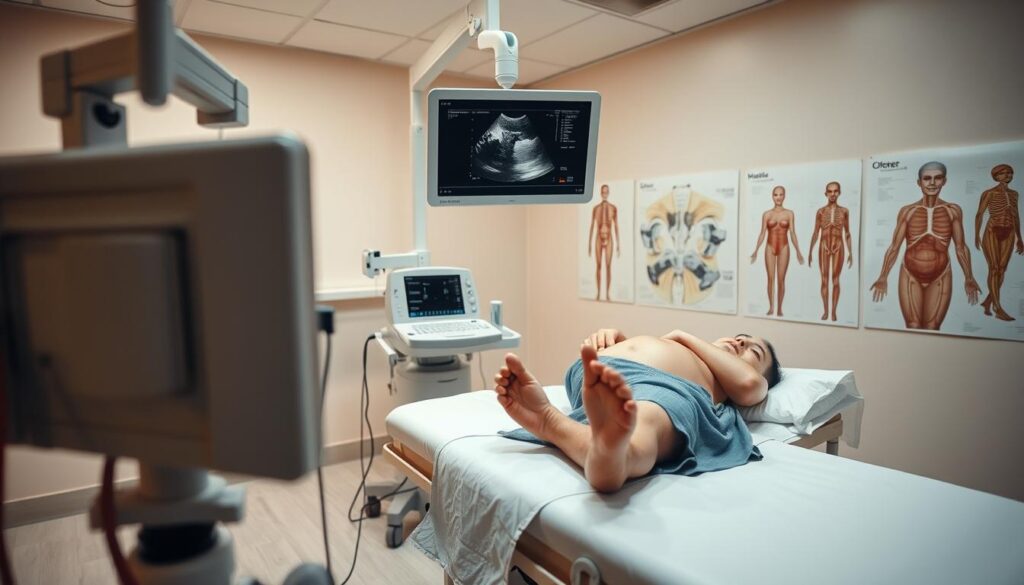
Endoscopic Ultrasound (EUS) is a cutting-edge medical procedure for detailed gastrointestinal health insights. This minimally invasive technique combines advanced imaging technologies to examine internal organs with precision1. EUS offers a sophisticated approach to medical diagnostics for digestive concerns and cancer screening2.
Specialists use a thin, flexible endoscope with an ultrasound probe during the procedure. This tool captures high-resolution images of your digestive tract and surrounding organs. The examination typically takes about an hour for thorough investigation31.
Your medical team will guide you through every step of the Interventional Endoscopy process. They ensure your comfort and understanding throughout the procedure. EUS helps diagnose various conditions, from inflammatory diseases to different types of cancer1.
This invaluable tool in modern Gastrointestinal Imaging offers more precise results than traditional methods. It provides doctors with detailed information to make accurate diagnoses and treatment plans.
Key Takeaways
- EUS is a minimally invasive diagnostic procedure
- The examination provides detailed internal imaging
- Procedure typically lasts about an hour
- Can diagnose multiple digestive tract conditions
- Offers more precise imaging compared to traditional methods
What is Endoscopic Ultrasound and How Does It Work
Endoscopic ultrasound (EUS) is a cutting-edge medical imaging technique. It combines endoscopy and ultrasound to examine the gastrointestinal tract. This method offers unparalleled insights into your internal organs45.
Components of EUS Technology
The core of endosonography uses a specialized medical device. It integrates two powerful diagnostic tools. Here are the key components:
- High-resolution camera for visual examination
- Ultrasound device for detailed internal imaging
- Flexible probe for minimally invasive exploration
The Role of Echoendoscope
An echoendoscope is a remarkable medical instrument. It captures intricate images of your digestive system. It emits high-frequency sound waves to create detailed organ representations6.
Advantages Over Traditional Imaging Methods
EUS offers significant benefits compared to traditional diagnostic techniques:
| Traditional Method | EUS Advantage |
|---|---|
| CT Scan | More precise imaging of small tumors |
| MRI | Enables real-time Fine Needle Aspiration |
| Standard Ultrasound | Deeper organ visualization |
“EUS provides physicians with an unprecedented window into the body’s intricate internal landscape.”
EUS can diagnose conditions in various organs, including the pancreas, liver, and gallbladder4. It allows doctors to collect tissue samples during the examination. This is done through fine-needle aspiration5.
Key Applications and Medical Uses of Endoscopic Ultrasound
Endoscopic ultrasound (EUS) is a powerful diagnostic tool in modern medical imaging. It offers precise insights into various medical conditions. EUS is particularly useful for pancreatic cancer screening and bile duct evaluation7.
The primary applications of EUS include:
- Pancreatic Cancer Screening: EUS detects malignant pancreatic tumors with over 90% sensitivity8.
- Bile Duct Evaluation: EUS identifies common bile duct stones and assesses biliary tree abnormalities9.
- Submucosal Lesion Assessment: It provides detailed imaging of small lesions in the gastrointestinal tract7.
Medical professionals use EUS for many diagnostic purposes. It can stage various cancers, including esophageal, stomach, rectal, and pancreatic malignancies9.
EUS uses a high-frequency ultrasound probe for precise tumor staging. Its pre-operative accuracy ranges from 80% to 90%7.
| EUS Application | Diagnostic Capability | Sensitivity |
|---|---|---|
| Pancreatic Tumor Detection | Malignant Tumor Identification | 90-99% |
| Bile Duct Examination | Stone and Abnormality Detection | 85-90% |
| Submucosal Lesion Evaluation | Detailed Tissue Imaging | 80-85% |
EUS has evolved from a purely diagnostic tool to a minimally invasive therapeutic intervention. It offers unique medical insights8. Your doctor can determine if EUS is right for your specific medical needs.
“EUS provides a differentiated view of tissue morphology, making it one of the most accurate diagnostic tools available.” – Medical Imaging Research Institute
Preparing for Your EUS Procedure
Preparing for an Endoscopic Ultrasound (EUS) is crucial for accurate Gastrointestinal Imaging results. Understanding the steps can boost your confidence about the upcoming Therapeutic EUS procedure10.
Pre-Procedure Instructions
Your healthcare team will provide specific EUS Preparation guidelines for your needs. These include important steps to follow before the procedure.
- Fasting for at least 6 hours before the procedure11
- Reviewing all current medications with your doctor
- Arranging transportation home after the procedure10
Medication and Dietary Considerations
Some medications need special attention before your EUS. Blood thinners and diabetic medications often require temporary discontinuation10.
Specific blood thinners like Eliquis, Plavix, and Xarelto may need to be stopped 5 days before your procedure10.
“Proper preparation is key to a successful Endoscopic Ultrasound procedure.”
What to Bring on Procedure Day
For your EUS, remember to bring these essential items:
- A valid photo ID
- Insurance information
- List of current medications
- A responsible driver aged 18 or older12
Your procedure typically lasts 60 to 90 minutes, with 30-45 minutes for recovery11. After the Endoscopic Ultrasound, you’ll need someone to drive you home10.
Conclusion
Endoscopic ultrasound (EUS) has transformed gastrointestinal diagnostics. It offers deep insights into complex medical conditions. Your grasp of this tech can greatly affect your healthcare journey13.
EUS allows precise imaging and tissue sampling across many organs. It’s a key tool in modern medicine. The technique boasts high staging accuracy for various cancers14.
EUS surpasses traditional imaging methods. Doctors can now perform minimally invasive procedures with great precision. They can detect small pancreatic tumors and diagnose tricky gastrointestinal lesions13.
Some EUS procedures have success rates nearing 95%15. This method keeps pushing the limits of medical diagnostics and treatment. EUS remains a leader in innovative healthcare solutions.
You can learn more about this tech in comprehensive EUS studies. New techniques like EUS-guided drainage and needle sampling are still evolving. These promise even better diagnostic and treatment options1415.
FAQ
What is an Endoscopic Ultrasound (EUS)?
An Endoscopic Ultrasound is a low-risk medical exam of your digestive tract and nearby organs. It uses a special tool with a camera and ultrasound device. This tool creates detailed images of your internal organs with high accuracy.
How is an EUS procedure performed?
Doctors insert a thin, flexible tube through your mouth or anus. You’ll likely get sedation for comfort. The tube has an ultrasound device that makes detailed images of your insides.
What conditions can EUS help diagnose?
EUS can spot various health issues in your digestive system. It’s great for finding pancreatic cancer, colon cancer, and chronic pancreatitis. EUS also helps with inflammatory bowel disease, bile duct stones, and unusual growths.
It’s especially good at finding and staging digestive tract cancers. EUS can also check if tumors have spread.
How should I prepare for an Endoscopic Ultrasound?
Your prep depends on the type of EUS you’re having. Usually, you’ll need to fast for at least six hours before. For lower GI EUS, you might need a liquid diet and laxatives.
Tell your doctors about any medications you take. Also, arrange for someone to drive you home after.
What are the advantages of EUS compared to other imaging methods?
EUS gives clearer images of small tumors and cysts than MRI and CT scans. It can also take tissue samples during the exam. EUS even allows for targeted medication delivery to specific areas.
Is the EUS procedure safe?
EUS is generally safe, but like all medical procedures, it has some risks. Most patients feel little discomfort, and the exam usually takes less than an hour. Your doctor will explain the risks and benefits before you proceed.
Can EUS be used for treatment, or is it only diagnostic?
EUS is both a diagnostic and treatment tool. It can drain pancreatic pseudocysts and deliver targeted medications. EUS can also take tissue samples for further testing.
How long does recovery take after an EUS?
Recovery is typically quick. Most patients go home the same day and feel normal within 24 hours. You might have a sore throat or feel bloated, but this usually goes away fast.
Source Links
- Endoscopic Ultrasound (EUS) | Endoscopy Procedure NJ – https://www.valleyhealth.com/services/endoscopic-ultrasound
- Endoscopic Ultrasound – https://www.providence.org/services/endoscopic-ultrasound
- Endoscopic Ultrasound | University of Michigan Health – https://www.uofmhealth.org/conditions-treatments/digestive-and-liver-health/endoscopic-ultrasound
- Endoscopic Ultrasound – https://www.hopkinsmedicine.org/health/treatment-tests-and-therapies/endoscopic-ultrasound
- Endoscopic Ultrasound | Medical Examination – https://www.cincinnatichildrens.org/health/e/endoscopic-ultrasound
- Endoscopic ultrasound (EUS) – https://www.cancerresearchuk.org/about-cancer/tests-and-scans/endoscopic-ultrasound-eus
- mp-712 – Medical Policies – Credence – Liferay – https://policies.credenceblue.com/portal/web/credence-policies/home/-/asset_publisher/gvKEs0SDu27L/content/mp-712/78515
- Diagnostic and Therapeutic Indications for Endoscopic Ultrasound (EUS) in Patients with Pancreatic and Biliary Disease—Novel Interventional Procedures – https://pmc.ncbi.nlm.nih.gov/articles/PMC9497766/
- Endoscopic Ultrasound | Northwest Healthcare – https://www.healthiertucson.com/endoscopic-ultrasound
- PDF – https://www.guthrie.org/sites/default/files/2020EUSrevisedfinal.pdf
- Upper EUS: Procedure & Preparation – https://www.northshore.org/gastroenterology/procedures/endoscopic-procedures/eus-upper/
- EUS (Endoscopic Ultrasound) of the Upper GI Tract: Preparation Instructions – https://www.med.umich.edu/1libr/MPU/EUS_upper_prep.pdf
- Endoscopic ultrasound: what is it and when should it be used? – https://pmc.ncbi.nlm.nih.gov/articles/PMC4952290/
- Endoscopic ultrasound in gastroenterology: From diagnosis to therapeutic implications – https://pmc.ncbi.nlm.nih.gov/articles/PMC4069309/
- Therapeutic endoscopic ultrasound – https://fg.bmj.com/content/8/2/119

