
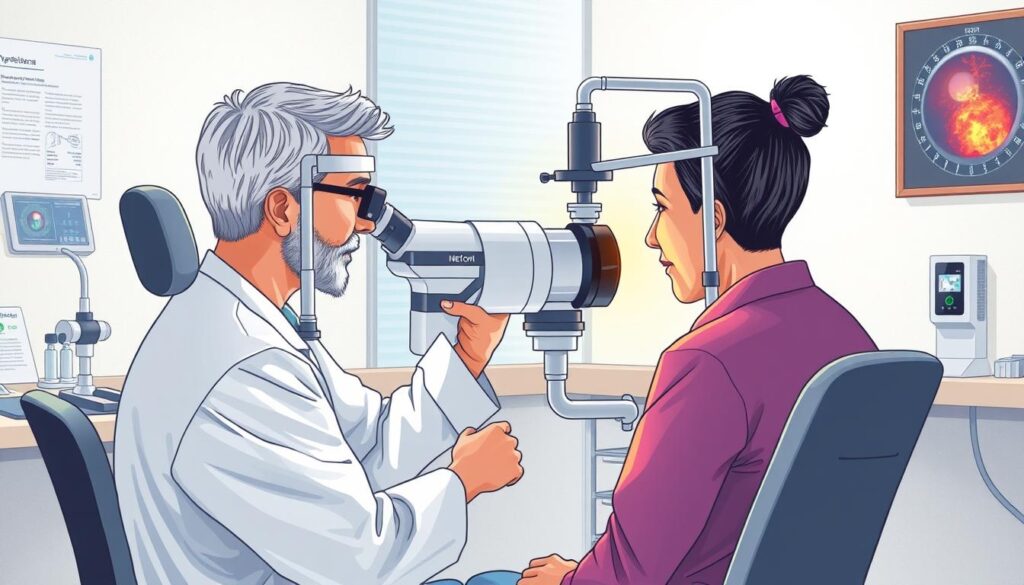
Eye melanoma is a serious ocular cancer that affects vision and overall health. It develops in the uvea, the middle layer of your eye. Most eye melanomas grow in areas not easily visible, making early detection challenging1.
Each year, about 368 people are diagnosed with this complex eye condition2. The average age of diagnosis is 61 years old2. Knowing the symptoms and risk factors can help you protect your eye health.
Uveal melanoma can affect the iris, ciliary body, and choroid. Recognizing potential warning signs is crucial for timely intervention1. Early detection is key to preserving your vision and starting effective treatment.
Key Takeaways
- Eye melanoma primarily develops in the uvea
- Most cases are difficult to detect without professional examination
- Vision changes can be early warning signs
- Risk increases with age
- Early detection is critical for effective treatment
What is Eye Melanoma and Its Early Warning Signs
Eye melanoma is a rare cancer that grows in eye pigment cells. It’s serious, but knowing its signs helps catch it early3. Uveal melanoma, the most common type, can affect the iris, ciliary body, and choroid3.
Eye tumors can be scary, but knowledge is key. Many people with Choroidal or Iris Melanoma may not notice symptoms right away4.
Common Symptoms to Watch For
Look out for these possible eye tumor signs:
- Blurry or sudden vision loss4
- Floaters or unexpected light flashes4
- Dark spots on the iris4
- Changes in pupil size or shape4
- Unusual eye movement4
Note: Pain is typically uncommon unless the Ciliary Body Melanoma has significantly grown outside the eye4.
Risk Factors and Causes
| Risk Factor | Impact |
|---|---|
| Age | Most common between 60-80 years5 |
| UV Exposure | Increased risk with significant sun exposure3 |
| Skin Color | Higher risk for fair-skinned individuals |
“Early detection and immediate action are crucial for a favorable outcome in eye melanoma cases”3.
Guard your eyes with regular check-ups. Wear sunglasses that block 99-100% of UV rays3. Your vision matters, so stay alert.
Diagnosis and Treatment Options for Ocular Cancer
Eye cancer diagnosis requires a thorough evaluation to find the best treatment plan. Understanding your options is vital in ophthalmic oncology. Your doctor will use various tests to determine the most effective strategy6.
- Comprehensive eye examinations with dilated pupils6
- Eye ultrasound using high-frequency sound waves7
- Fluorescein angiography
- Ocular coherence tomography6
Your treatment options depend on tumor size, location, and your overall health. These factors help doctors choose the best approach for you6.
| Treatment Method | Typical Application |
|---|---|
| Radiation Therapy | Small to medium-sized tumors7 |
| Photodynamic Therapy | Smaller tumors only7 |
| Laser Treatment | Specific situations7 |
| Surgery | Large tumors requiring partial or complete eye removal7 |
Blood tests can check liver function and scans can detect cancer spread. These tests provide crucial information for treatment planning7.
Genetic analysis of tumor tissue offers valuable insights for tailoring your treatment. This helps doctors create a more personalized approach6.
Early detection and personalized treatment are key in managing eye cancer effectively.
Ongoing monitoring is essential, even after successful treatment. Intraocular melanoma can potentially return, so regular check-ups are important6.
Conclusion
Eye cancer treatment requires a proactive approach to managing vision impairment. Recent medical advances offer new hope for patients exploring treatment options. Uveal melanoma affects about 2,500 people yearly in the U.S., with promising developments in targeted therapies8.
Your journey with vision impairment doesn’t end at diagnosis. Treatment strategies have improved, offering more precise interventions. The FDA approved Kimmtrak in January 2022, boosting one-year survival rates to 73%8.
Research reveals genetic insights into ocular melanomas. Scientists found key mutations like GNAQ and GNA11 in uveal melanoma samples9. These findings lead to more targeted and effective eye cancer treatments.
Stay informed and work closely with your healthcare team. Regular screenings and understanding risk factors can make a big difference. Your proactive approach is crucial in managing eye melanoma.
FAQ
What is eye melanoma?
Eye melanoma is the most common eye cancer. It develops in the uvea, the eye’s middle layer. This rare condition typically affects adults, with an average diagnosis age of 61.
It can impact the iris, ciliary body, or choroid. These areas contain melanin-producing cells where the cancer grows.
What are the primary symptoms of eye melanoma?
Common symptoms include blurred vision and dark spots on the iris. Vision loss, floaters, and changes in pupil shape may also occur. Early-stage eye melanoma often shows no noticeable symptoms.
Regular eye exams are crucial for early detection. They can spot problems before symptoms appear.
What are the main risk factors for eye melanoma?
Key risk factors include light eye color and fair skin. Advanced age and certain genetic conditions also increase risk. The exact causes aren’t fully understood.
UV exposure may play a role in its development. However, more research is needed to confirm this link.
How is eye melanoma diagnosed?
Diagnosis involves comprehensive eye exams. These include ophthalmoscopy, ultrasound, and angiography. A biopsy may be necessary to confirm the diagnosis.
These tests help determine the cancer’s characteristics. This information guides treatment decisions.
What treatment options are available for eye melanoma?
Treatment depends on tumor size and location. Options include radiation therapy, laser treatment, and photodynamic therapy. Cryotherapy and surgery are also possible treatments.
For advanced cases, immunotherapy shows promising results. Your doctor will recommend the best approach for your situation.
Can eye melanoma be cured?
Early detection is crucial for the best outcomes. Not all cases can be completely cured. However, treatment advancements have improved vision preservation and disease management.
Regular follow-ups are essential. They help monitor for potential recurrence or spread of the cancer.
How can I reduce my risk of developing eye melanoma?
You can’t completely prevent eye melanoma. However, you can reduce risks with regular eye exams. Protect your eyes from UV radiation with sunglasses.
Be aware of your personal and family medical history. This information can help guide your prevention strategies.
Is eye melanoma hereditary?
Some genetic conditions can increase eye melanoma risk. If you have a family history, discuss it with an ophthalmologist. They may recommend more frequent screenings.
Understanding your genetic risk can help with early detection and prevention strategies.
Source Links
- Eye melanoma – Symptoms and causes – https://www.mayoclinic.org/diseases-conditions/eye-melanoma/symptoms-causes/syc-20372371
- Ocular (eye) melanoma cancer – https://www.cancer.org.au/cancer-information/types-of-cancer/rare-cancers/eye-ocular-melanoma
- Understanding Eyelid and Eye Melanoma: Early Detection and Treatment – Illinois Eye Center – https://www.illinoiseyecenter.com/understanding-eyelid-and-eye-melanoma-early-detection-and-treatment/
- Signs and Symptoms of Eye Cancer – https://www.cancer.org/cancer/types/eye-cancer/detection-diagnosis-staging/signs-symptoms.html
- What are the Symptoms of Early Stage Eye Melanoma? – https://www.healthline.com/health/early-stage-eye-melanoma-symptoms
- Intraocular (Uveal) Melanoma Treatment – https://www.cancer.gov/types/eye/patient/intraocular-melanoma-treatment-pdq
- Eye melanoma – Diagnosis and treatment – https://www.mayoclinic.org/diseases-conditions/eye-melanoma/diagnosis-treatment/drc-20372376
- Ocular Melanoma – AIM at Melanoma Foundation – https://www.aimatmelanoma.org/melanoma-101/types-of-melanoma/ocular-melanoma/
- Uveal Melanoma – PMC – https://pmc.ncbi.nlm.nih.gov/articles/PMC3135138/

