
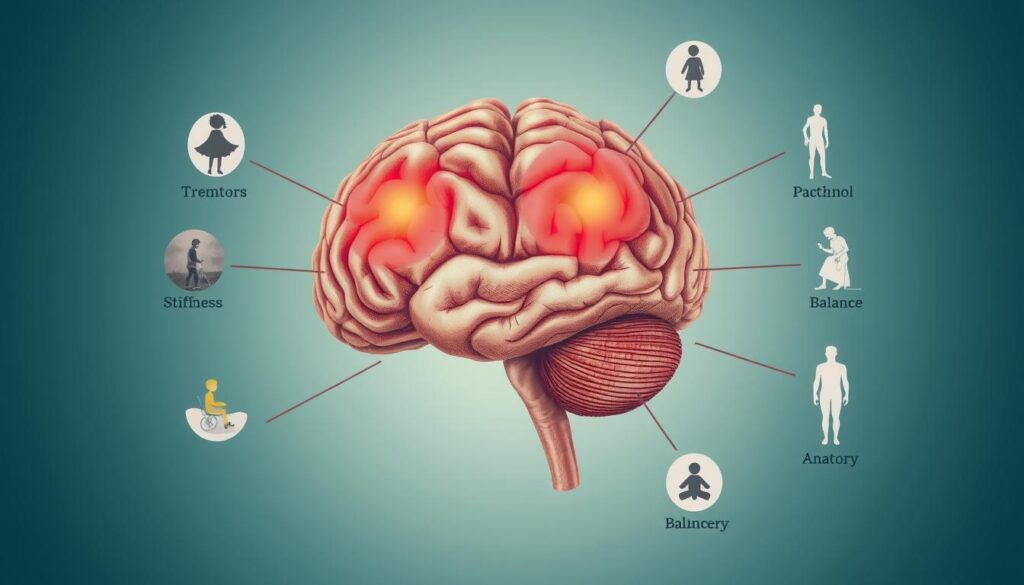
Parkinson’s disease is a complex brain disorder that affects movement and daily life. It causes symptoms like tremors due to low dopamine levels1. Most people develop Parkinson’s later in life, usually around age 702.
Some experience symptoms before 50, which may have genetic links1. Men are more likely to get this condition12. There’s no cure yet, but research is improving treatment options3.
Parkinson’s affects each person differently. Brain cells in patients often have protein clumps called Lewy bodies1. These contribute to the disease’s progression.
The condition can cause cognitive changes and movement problems. Each person’s experience with Parkinson’s is unique.
Key Takeaways
- Parkinson’s disease primarily affects movement and brain function
- Symptoms typically emerge after age 50, with rare early-onset cases
- Men have a higher likelihood of developing the condition
- No definitive diagnostic test currently exists
- Ongoing research continues to improve understanding and treatment
What is Parkinson’s Disease?
Parkinson’s disease is a complex brain disorder affecting millions worldwide. It hinders movement control, causing daily life challenges4.
Parkinson’s occurs when brain cells producing dopamine deteriorate. By the time symptoms appear, most people have lost 60-80% of these cells5.
Disease Characteristics
The disease is characterized by several key features:
- Presence of Lewy bodies in brain cells
- Accumulation of alpha-synuclein protein
- Progressive neurological damage
Who is Most Affected?
Parkinson’s typically starts around age 60. Men are more likely to develop the condition6.
| Risk Factor | Impact |
|---|---|
| Age | Most common in people over 50 |
| Gender | More prevalent in men |
| Genetics | Increased risk with family history |
Potential Causes
The exact cause remains unclear, but researchers have identified several contributing factors:
- Genetic mutations
- Environmental exposures
- Oxidative stress in brain cells
Understanding Parkinson’s is the first step toward effective management and improved quality of life.
Parkinson’s can cause rigidity and balance problems. It leads to progressive neurological changes. Your doctor can help create a tailored treatment plan4.
Common Symptoms You May Experience
Parkinson’s disease affects people differently. Knowing the symptoms helps spot early signs. Seek medical help if you notice these signs.
Doctors diagnose Parkinson’s by looking at two or more main motor symptoms. These include tremors, rigidity, bradykinesia, and postural instability7. Not all symptoms need to be present for a diagnosis7.
Motor Symptoms
Motor symptoms can greatly affect your daily activities. Here are the key motor symptoms:
- Tremors: Usually start in one hand, foot, or leg7
- Bradykinesia: Slow movement with reduced facial expressions7
- Rigidity: Muscle stiffness often confused with arthritis7
- Postural Instability: Balance problems, more common in later stages7
Non-Motor Symptoms
Parkinson’s affects more than just movement. Non-motor symptoms can include:
- Cognitive changes
- Depression
- Sense of smell disturbances
- Fatigue
- Gastrointestinal problems
- Vision issues
Recognizing Early Signs
Early signs of Parkinson’s can be hard to spot. Look out for these changes:
- Mild tremors in one hand
- Difficulty rising from a chair
- Softer speech
- Smaller handwriting
“The key is early recognition and understanding of your symptoms.” – Parkinson’s Research Foundation
Treatment Options for Parkinson’s Disease
Parkinson’s disease management requires a tailored approach for your unique symptoms. Your treatment may include medical interventions, surgery, and lifestyle changes. These options aim to boost your quality of life8.
Medication Strategies for Symptom Management
Levodopa is the most effective medication for Parkinson’s symptoms. It helps control walking problems and tremors successfully9.
Your treatment plan might include:
- Carbidopa-levodopa (Sinemet)
- Inhaled levodopa for breakthrough symptoms
- Dopamine agonists to mimic dopamine effects
- MAO B inhibitors to prolong medication effectiveness
Advanced Surgical Interventions
Deep brain stimulation (DBS) is a good option for patients who don’t respond to medications. It involves implanting electrodes in key brain areas to disrupt abnormal patterns8.
DBS can greatly reduce motor symptoms and improve daily functioning9. This surgical procedure offers hope for many Parkinson’s patients.
| Treatment Type | Primary Benefits | Considerations |
|---|---|---|
| Levodopa Therapy | Symptom Control | Individual Response Varies |
| Deep Brain Stimulation | Reduce Motor Symptoms | Surgical Intervention Required |
Lifestyle and Supportive Therapies
Neuroprotective therapies work alongside medical treatments. Physical therapy, exercise, and a balanced diet can help manage symptoms. These approaches may even slow disease progression.
Your healthcare team will create a personalized plan for you. The goal is to boost your independence and life quality8.
“Treatment is a journey of adaptation and hope” – Parkinson’s Research Foundation
Living with Parkinson’s Disease
Parkinson’s disease presents unique challenges for each person. Resilience and planning are key to managing this condition. Regular exercise, from team sports to gentle stretching, is vital for symptom control10.
A strong support network is crucial for your well-being. Support groups offer emotional resources and practical advice. Professional counseling or online forums can help with emotional challenges10.
Work closely with healthcare pros specializing in Parkinson’s treatment. A movement disorder specialist can provide comprehensive care throughout your journey11. Exciting research explores new therapies, offering hope for better management12.
Don’t forget about financial and practical matters. Look into support options like Employment and Support Allowance. Personal Independence Payment can help maintain your quality of life10.
Stay informed and keep a positive outlook. Remember, you’re not alone in this journey. Many people with Parkinson’s enjoy years of productive living12.
FAQ
What is Parkinson’s Disease?
Parkinson’s Disease (PD) is a progressive brain disorder affecting movement and non-movement functions. It happens when brain cells producing dopamine stop working or die. Nearly 1 million people in the U.S. and over 6 million worldwide have this condition.
What are the main symptoms of Parkinson’s Disease?
PD has both motor and non-motor symptoms. Motor symptoms include tremors, slow movement, rigidity, and poor balance. Non-motor symptoms can be depression, sleep issues, cognitive changes, and loss of smell.
Symptoms often start on one side of the body. They gradually get worse over time.
What causes Parkinson’s Disease?
The exact cause is unknown. It’s thought to be a mix of genetic and environmental factors. The disease shows unusual protein clumps in brain cells.
Key risk factors are age, gender, and genes. Most cases occur after 60 and are more common in men.
How is Parkinson’s Disease treated?
Treatment aims to manage symptoms and improve life quality. Options include medications like levodopa with carbidopa, dopamine agonists, and enzyme inhibitors. Deep brain stimulation is a surgical choice for some patients.
Lifestyle changes also play a big role. These include physical therapy, occupational therapy, exercise, and a healthy diet.
Can Parkinson’s Disease be prevented?
There’s no sure way to prevent Parkinson’s Disease. But you can lower your risk with a healthy lifestyle. Regular exercise, a good diet, and staying mentally active may help.
Early detection and care can greatly improve your life quality. It can also slow down the disease.
How can I support a loved one with Parkinson’s Disease?
Support involves staying informed and being emotionally supportive. Help with daily tasks and encourage joining support groups. Assist with medical visits and help maintain their independence.
The Michael J. Fox Foundation offers great resources. They also provide local support networks.
What is the life expectancy for someone with Parkinson’s Disease?
Life expectancy varies based on personal factors, age of onset, and overall health. With proper care, many people with Parkinson’s can live long, fulfilling lives.
Ongoing research keeps developing new treatments. These efforts aim to improve patient outcomes.
Are there any promising new treatments on the horizon?
Research is exploring new therapies and innovative treatment approaches. Scientists are looking for ways to slow or stop disease progression. They aim to address the root causes of Parkinson’s, not just manage symptoms.
Source Links
- Parkinson’s Disease: Causes, Symptoms, and Treatments – https://www.nia.nih.gov/health/parkinsons-disease/parkinsons-disease-causes-symptoms-and-treatments
- Parkinson’s disease – Symptoms and causes – https://www.mayoclinic.org/diseases-conditions/parkinsons-disease/symptoms-causes/syc-20376055
- What is Parkinson’s? – https://www.parkinson.org/understanding-parkinsons/what-is-parkinsons
- Parkinson disease – https://www.who.int/news-room/fact-sheets/detail/parkinson-disease
- Parkinson’s Disease – https://www.ninds.nih.gov/health-information/disorders/parkinsons-disease
- Parkinson’s Disease and Dementia – https://www.hopkinsmedicine.org/health/conditions-and-diseases/parkinsons-disease/parkinsons-disease-and-dementia
- Symptoms of Parkinson’s | APDA – https://www.apdaparkinson.org/what-is-parkinsons/symptoms/
- Parkinson’s Treatment Options – https://www.hopkinsmedicine.org/health/conditions-and-diseases/parkinsons-disease/parkinsons-treatment-options
- Parkinson’s disease – Diagnosis and treatment – https://www.mayoclinic.org/diseases-conditions/parkinsons-disease/diagnosis-treatment/drc-20376062
- Parkinson’s disease – Living with – https://www.nhs.uk/conditions/parkinsons-disease/living-with/
- 5 Steps to Living Well – https://www.parkinson.org/living-with-parkinsons/new-to-parkinsons/5-steps
- Living With Parkinson’s Disease – https://www.ucsfhealth.org/education/living-with-parkinsons-disease

