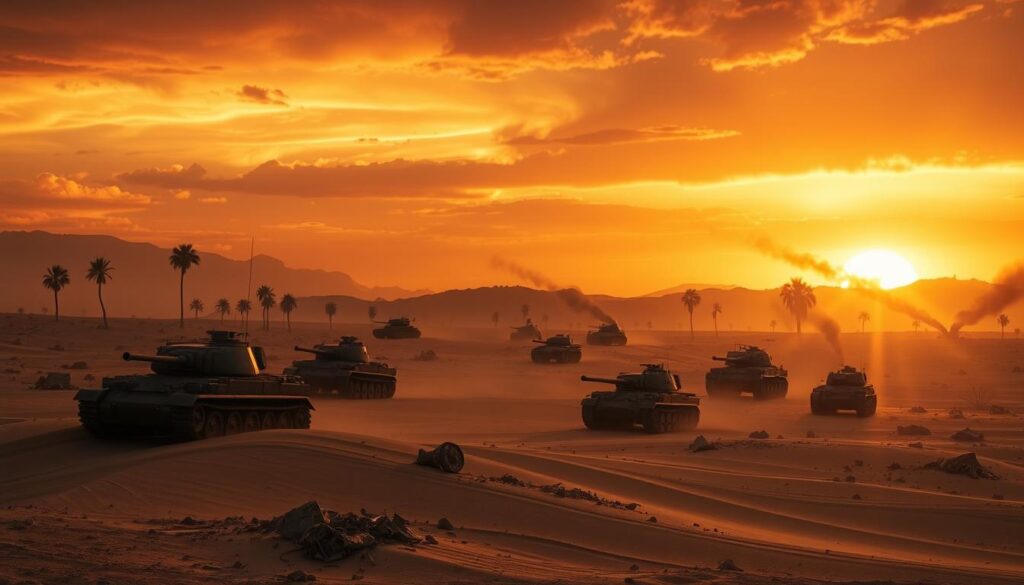
The Battle of El Alamein was a key moment in WWII history. It was a turning point in the North African campaign1. The battle took place from July 1–27 and October 23—November 11, 1942. It was fought in coastal central Egypt.
German and Italian forces faced off against British, Australian, New Zealander, South African, and Indian troops. The Axis had 116,000 soldiers, 547 tanks, and 192 armoured cars2. The Allies had 195,000 soldiers, 1,029 tanks, and 435 armoured cars2. This made El Alamein a significant battle in WWII history.
The battle’s impact went beyond its immediate outcome. It marked a shift in power in the North African campaign, with the Allies winning3. The Axis forces had 770-900 aircraft and 552 artillery pieces. But the Allies’ superior numbers and strategy won the day2.
Key Takeaways
- The Battle of El Alamein was a turning point in the North African campaign, favoring the Allies1.
- The battle took place from July 1–27 and October 23—November 11, 1942, in coastal central Egypt1.
- The Axis forces, made up of German and Italian soldiers, were outnumbered by the Allies2.
- The Allies won, with the Axis forces losing 2,000-9,000 soldiers and 4,800-15,000 wounded2.
- The battle was a big win for the British Army, boosting morale and reputation of leaders like General Montgomery3.
- The Battle of El Alamein was a key moment in WWII history, with the Allies winning and taking control of North Africa1.
- The Allies’ victory was due to their strong numbers of tanks, artillery, and anti-tank guns2.
Overview of the Battle of El Alamein
The Battle of El Alamein was a key moment in the North Africa campaign. It marked the start of the decline for Axis forces in the area. This battle showed the strategic skills of Allied commanders and highlighted El Alamein’s importance in World War II.
Historical Context of World War II
In the summer of 1942, the British 8th Army faced a tough time after losing at the Battle of Gazala to Erwin Rommel’s Panzer Army Africa4. The North Africa campaign was vital because control over this area could greatly affect the war’s outcome. The battle at El Alamein limited the Axis forces’ movement, narrowing their front to 40 miles and limiting their ability to move4.
Key Military Leaders Involved
The rivalry between Rommel vs Montgomery was key to the battle. Field Marshal Erwin Rommel, known as the “Desert Fox,” led the Axis forces with great skill. General Bernard Montgomery, on the other hand, led the British Eighth Army with a careful and determined approach5. Montgomery’s leadership and the help from various Commonwealth nations boosted the Allied forces4.
Significance of the Location
El Alamein’s location, about 100 kilometers west of Alexandria, was chosen for its strong defenses. The Qattara Depression to the south made it impossible for tanks to pass5. This advantage allowed the Allies to build a strong defensive line. It helped them stop the Axis forces and paved the way for a major victory.
Major Phases of the Battle
The El Alamein battle had two main phases. Each phase showed different strategies and key moments. These moments helped the Allies win the North African campaign.
First Battle of El Alamein: Key Events and Outcomes
The First Battle of El Alamein happened from July 1st to July 22nd, 1942. It stopped the Axis from moving further into Egypt6. The Allies used defensive tactics to fight off Rommel’s attack.
This battle was key to keeping the Suez Canal out of Axis hands. It’s a vital strategic point.
Both sides dug in, leading to a standoff. The Allies’ ability to hold their ground showed their strength and readiness.
Second Battle of El Alamein: Tactics and Strategies
The Second Battle of El Alamein took place from October 23rd to November 11th, 1942. It was a turning point in the El Alamein battle. General Bernard Montgomery led the Allied attack with careful planning.
He used over 300 Sherman tanks for their firepower5. The success of Operation Supercharge forced Rommel’s forces to retreat into Tunisia5. This victory lifted the Allies’ spirits and disrupted Axis supply lines.
| Force | Personnel | Infantry Battalions | Medium Tanks | Anti-Tank Guns | Artillery Guns | Aircraft |
|---|---|---|---|---|---|---|
| Allied Eighth Army | 195,000 | 85 | 1,029 | 1,451 | 908 | 530 |
| Axis Army | 104,000 | 71 | 496 | 800 | 500 | 500 |
Impact on the War Effort
The victory at El Alamein changed the course of WWII history. It was a key moment in the North Africa campaign. The Allies started to gain the upper hand.
Turning Point in the North African Campaign
At El Alamein, the Allies got a big advantage. They stopped the Axis troops from moving forward in North Africa78. This was around the same time as Operation Torch, when the Allies landed on November 8. This move trapped the Axis forces.
Influence on Allied Strategy and Morale
The win lifted British spirits after many losses, boosting morale among soldiers and civilians7. It also shaped future Allied plans. This led to the invasion of Sicily and Italy, moving the war forward8.
| Aspect | Allied Forces | Axis Forces |
|---|---|---|
| Personnel | 195,000 men | 150,000 men |
| Tanks | 1,000 tanks | 600 tanks |
| Aircraft | 530 operational | 430 operational |
| Casualties | ~5,5007 | Significant losses leading to withdrawal7 |
Aftermath and Legacy
The Battle of El Alamein was a key moment in WWII history. The losses were huge, with Axis forces losing thousands. About 9,000 Axis soldiers died, 15,000 were hurt, and 30,000 were taken prisoner out of 110,000 troops9. The Allies lost 4,800 soldiers and 9,000 were wounded from 195,000 troops9.
These numbers show how intense and costly the battle was.
Casualties and Human Cost
The loss of life and injuries on both sides deeply affected soldiers and their families. The high number of casualties showed the harshness of war. Many veterans came back with physical and emotional scars, changing post-war societies and memories.
Commemoration and Historical Significance
El Alamein is remembered through many memorials and museums. These places honor the bravery and strength of the soldiers. They also teach future generations about the battle.
The victory at El Alamein boosted Allied spirits and helped win more battles in North Africa and beyond10. Historians keep studying the battle’s tactics and outcomes. They see its vital role in defeating Axis forces. The battle’s lessons have shaped modern military strategies and interest scholars and fans worldwide.
FAQ
What was the Battle of El Alamein?
The Battle of El Alamein was a key fight in World War II. It happened in 1942 and stopped the Axis forces’ push. Led by Field Marshal Erwin Rommel, they were trying to take over North Africa.
Thanks to this battle, the Allies won a big victory in North Africa.
Why was El Alamein a strategic location in WWII?
El Alamein is in Egypt, near the Suez Canal. This area controls important supply routes and oil. It was a key spot in the war.
Who were the key military leaders in the Battle of El Alamein?
The battle was between Field Marshal Erwin Rommel and Field Marshal Bernard Montgomery. Rommel led the German-Italian Panzer Army. Montgomery was in charge of the British Eighth Army.
Their decisions and leadership were very important.
What were the major phases of the Battle of El Alamein?
The battle had two main parts. First, the Allies stopped Rommel’s advance. Then, Montgomery’s team planned and won a big victory.
How did the Battle of El Alamein impact the overall war effort in WWII?
Winning at El Alamein changed the North African campaign. It made the Allies more confident. It also hurt the Axis supply lines.
This victory helped the Allies plan for more attacks, like the invasion of Sicily and Italy.
What were the consequences of the Battle of El Alamein?
The battle was very costly for both sides. It marked the end of Axis forces in North Africa. It also boosted Allied morale.
It showed the importance of good planning in war. Today, it’s studied in military schools.
How is the Battle of El Alamein commemorated today?
The battle’s legacy is remembered through memorials and museums. In Egypt and the UK, there are annual ceremonies. These events keep the battle’s lessons alive.
What role did deception tactics play in the Second Battle of El Alamein?
Montgomery used clever tricks to fool Rommel’s forces. He spread false information and made fake plans. These tactics helped the Allies win.
Source Links
- Battles of El-Alamein | Significance, Map, Casualties, Montgomery, & Rommel | Britannica – https://www.britannica.com/event/battles-of-El-Alamein
- Second Battle of El Alamein – https://en.wikipedia.org/wiki/Second_Battle_of_El_Alamein
- Second Battle of El Alamein – https://www.nam.ac.uk/explore/battle-alamein
- How the Second Battle of El Alamein was won – https://www.iwm.org.uk/history/how-the-second-battle-of-el-alamein-was-won
- BBC – History – World Wars: Second Battle of El Alamein – https://www.bbc.co.uk/history/worldwars/wwtwo/ff5_second_alamein.shtml
- Battle of El Alamein – WW2 Timeline (July to November 1942) – https://www.secondworldwarhistory.com/battle-of-el-alamein.php
- El Alamein battles | Australian War Memorial – https://www.awm.gov.au/articles/encyclopedia/el_alamein/reading
- The Second Battle of El Alamein – https://www.ultius.com/ultius-blog/entry/the-second-battle-of-el-alamein.html
- El Alamein: turning point in the desert | The Past – https://the-past.com/feature/el-alamein-turning-point-in-the-desert/
- El Alamein 1942: Its place in history – The History Press – https://thehistorypress.co.uk/article/el-alamein-1942-its-place-in-history/