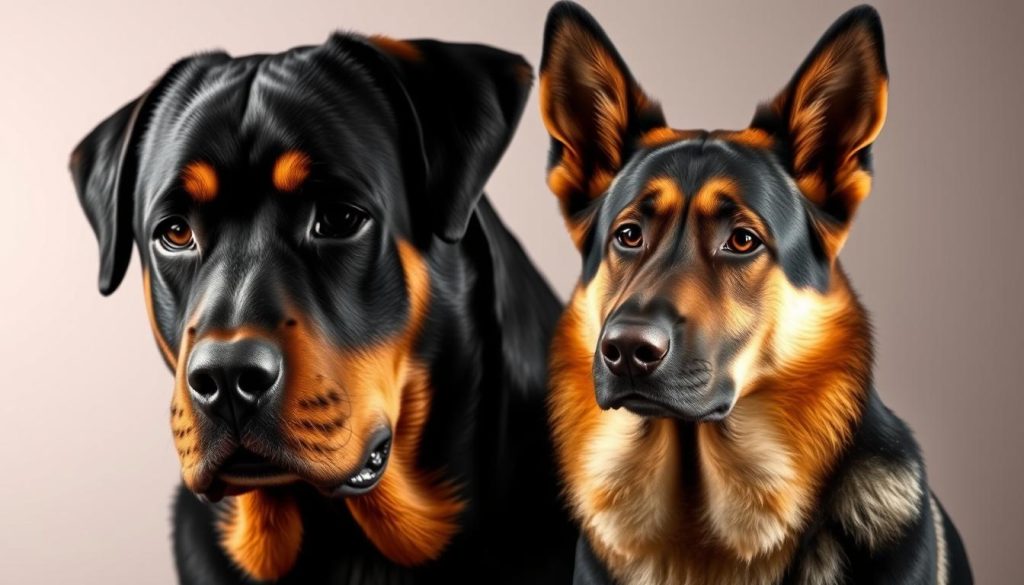
Rottweilers come from a mix of ancient Roman drover dogs and local German canines. These powerful dogs trace their origins to the Roman Empire’s military campaigns1. Roman legions brought strong dogs across Europe for herding and protecting cattle during long marches1.
In Rottweil, Germany, Roman military dogs mixed with native breeds, creating a unique lineage. This blend resulted in a breed perfect for herding and guarding2. The crossing produced a strong and smart working dog.
The Rottweiler’s ancestry combines Roman Molossian-type dogs and German herding breeds. Their skill in managing livestock and protecting people made them valuable throughout European history1.
Key Takeaways
- Rottweilers descend from Roman military drover dogs
- Breed developed through natural crossing in Rottweil, Germany
- Combines traits of Roman and German herding breeds
- Originated as working dogs for herding and protection
- Represents one of the oldest surviving dog breed lineages
Rottweiler Breed Origins
Rottweilers trace their roots to ancient Roman Empire drover dogs. These German breeds were developed for cattle herding and protection3. The name comes from Rottweil, a town founded by Romans in 73 AD3.
Known as the Butcher’s dog, Rottweilers were crucial in livestock management. These Molossoid breeds were bred for strength, intelligence, and working abilities4. Butchers used them to drive cattle, guard property, and provide agricultural support.
- Descended from Roman drover dogs
- Originated in Rottweil, Germany
- Developed as working cattle herding dogs
The first breed standard was created in 19014. Rottweilers almost went extinct in the mid-1800s due to industrialization5. During World War I, they served as messenger, draught, guard, and rescue dogs3.
Official breed clubs helped preserve and standardize Rottweilers. The Deutscher Rottweiler-Klub (DRK) was founded in 19143. The Süddeutscher Rottweiler-Klub (SDRK) followed in 19153.
In 1921, these organizations merged to form the Allgemeiner Deutscher Rottweiler Klub (ADRK). This remains the breed’s official home club today.
Modern Rottweiler Characteristics and Development
Rottweilers are powerful dogs with impressive stature. Males stand 24-27 inches tall, while females reach 22-25 inches at the withers6. Their muscular build reflects their working dog ancestry Rottweiler history.
Physical Characteristics
These dogs have a short, hard outer coat and possible undercoat6. Their mahogany or rust-colored markings cover less than 10% of their body6.
Male Rottweilers weigh 110-132 pounds, while females range from 77-106 pounds6. This breed embodies strength and athletic prowess.
Working Heritage
Rottweilers have a rich history as working dogs. They served various roles during World Wars I and II.
Their temperament makes them ideal for police work and search missions. They also excel as service dogs Rottweiler breed details.
Temperament Standards
Rottweilers are loyal, confident, and protective. They show affection to family but remain cautious with strangers7.
Early socialization and training are key to developing their full potential7. In 2017, Rottweilers ranked eighth among registered purebred dogs in the U.S6.
FAQ
What are the ancient origins of the Rottweiler breed?
Rottweilers come from Molossian dogs used by Roman legions. These dogs protected people and livestock while traveling with troops. They bred with local German dogs in Rottweil, creating the modern Rottweiler.
Why were Rottweilers called “Butcher’s dogs”?
In Rottweil, Germany, these dogs herded cattle and protected butchers’ property. They used their strength and smarts to manage livestock. Rottweilers also guarded their owners’ assets, making them valuable working dogs.
What makes Rottweilers unique among working dog breeds?
Rottweilers are Molossoid breeds with a strong working background. They blend physical strength, intelligence, and loyalty. This mix makes them great for police work, search and rescue, and service roles.
What are the key physical characteristics of a Rottweiler?
Rottweilers have a powerful build and a black and tan coat. Their muscular body and athletic frame show their working dog roots. They’re known for their robust appearance and strong physique.
How do modern Rottweilers differ from their ancestors?
Modern Rottweilers keep their loyalty and working skills. Careful breeding has refined them for various roles. They now serve as family pets, police dogs, and service animals.
Are Rottweilers good family dogs?
With proper training, Rottweilers can be great family companions. They’re loyal, protective, and smart. However, they need consistent training and early socialization. Experienced owners who understand their working dog nature are best suited.
What is the Rottweiler’s temperament like?
Rottweilers are confident, brave, and self-assured dogs. Their smarts and protective instincts make them excellent guardians. They can be wary of strangers but are loving to their family when trained well.
Source Links
- History of the Rottweiler – Rottie Squad Kennel – https://www.rottiesquad.com/history/
- Rottweiler Dog Breed Information | Purina – https://www.purina.co.nz/find-a-pet/dog-breeds/rottweiler
- Early History of Rottweilers – https://www.kingrottweilers.com/early-history-rottweilers/
- History of the Rottweiler: Origins, Facts & More – Dogster – https://www.dogster.com/lifestyle/rottweiler-history
- Rottweiler Breed Guide: History, Temperament & Health – https://www.trupanion.com/pet-blog/article/rottweiler
- Rottweiler – https://en.wikipedia.org/wiki/Rottweiler
- Rottweiler Dog Breed Information & Characteristics – https://dogtime.com/dog-breeds/rottweiler