
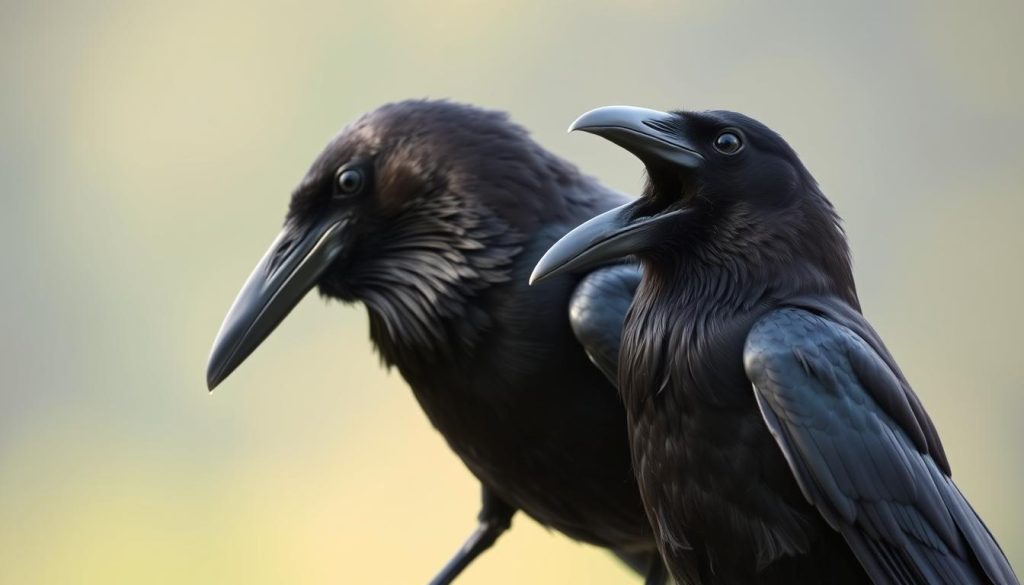
Crows and ravens often puzzle even expert birdwatchers. These smart black birds from the Corvidae family look very similar. Their remarkable resemblance makes it hard to tell them apart1.
Both crows and ravens are incredibly smart birds. They thrive in cities and wild areas alike. Ravens usually fly in pairs, while crows gather in large groups called murders1.
These birds fascinate nature lovers with their complex behaviors. Ravens can reach 67 cm long with wingspans of 130 cm. Crows are smaller, measuring about 46 cm in length2.
Scientists and bird enthusiasts are intrigued by how these birds communicate. Their unique social habits continue to spark interest in research circles.
Key Takeaways
- Crows and ravens belong to the same Corvidae family
- Ravens are larger and travel in smaller groups
- Both species demonstrate remarkable intelligence
- Bird identification requires careful observation
- Their social behaviors differ significantly
Physical Characteristics and Visual Identification Guide
Telling crows and ravens apart can be tricky for bird lovers. These black birds look similar, but small differences help birdwatchers spot them3.
North America has four main types of these cool birds. They are the American Crow, Fish Crow, Common Raven, and Chihuahuan Raven4.
These birds have amazing physical features that make them special.
Size and Body Structure
Ravens are much bigger than crows. They look more powerful and weigh a lot more.
- Common Raven: 689–1,625 g (24–57 oz)4
- American Crow: 316–620 g (11–22 oz)4
- Fish Crow: 195–330 g (7–12 oz)4
Ravens have thicker beaks than crows. They also have a shaggy throat that makes them look tough3.
Flight and Tail Patterns
The biggest difference is how they fly. Ravens have a wedge-shaped tail, while crows have a square tail3.
Their wings are also different sizes:
“In flight, ravens soar more elegantly, while crows engage in more frequent wing flapping.” – Ornithology Expert
Ravens have four main “finger” feathers when flying. Crows have five3.
These small changes show how each bird is special in its own way.
Crows vs Ravens: Behavior and Habitat Distinctions
Crows and ravens showcase fascinating differences in their behavior. These intelligent corvids captivate researchers and bird enthusiasts alike. Their bird intelligence shines through unique social structures and adaptations6.
Social dynamics set these birds apart in remarkable ways. Ravens typically live in smaller family units. They’re often seen alone or in pairs6.
Crows show complex social behavior by forming large groups called murders. These groups can gather in massive communal roosting sites. Hundreds of crows may roost together7.
- Ravens prefer solitary or small group interactions
- Crows thrive in large social networks
- Communal roosting is a distinctive crow behavior
Habitat choices highlight their behavioral differences. Ravens prefer wilder, less populated spaces. Crows show remarkable adaptability in urban environments8.
Communication skills also set these birds apart. Ravens have a complex vocal repertoire. They can make seven distinct calls and imitate other bird sounds7.
Crows show their smarts by remembering human faces. They’re especially good at recalling people they see as threats7.
Nature has equipped these birds with remarkable cognitive abilities that continue to surprise researchers.
Corvid behavior proves these birds are more than simple creatures. They’re intelligent, adaptive, and endlessly fascinating8.
Conclusion
Crows and ravens showcase remarkable intelligence and adaptability. These corvids display skills beyond their physical appearances9. Their complex behaviors fascinate both casual observers and serious bird enthusiasts worldwide.
Vocalizations offer the most reliable way to tell these birds apart. Crows make a sharp “caw-caw” sound. Ravens produce a deeper “gronk-gronk” call9. Crows often dominate urban environments, while ravens prefer wilder landscapes10.
Recognizing these birds goes beyond simple identification. It’s a chance to appreciate their intricate intelligence and adaptability. The world of crows and ravens offers endless fascination and discovery.
Nature lovers are encouraged to keep exploring these incredible corvids. Observing their behaviors can deepen our understanding of these extraordinary avian species.
FAQ
How can I tell the difference between a crow and a raven?
Ravens are larger than crows and have thicker, more curved beaks. Their tails are wedge-shaped, while crows have fan-shaped tails. Ravens make deep, croaking sounds, and crows have sharp “caws”.
Ravens prefer wild habitats and are more solitary. Crows adapt well to urban areas and are more social birds.
Are ravens smarter than crows?
Both corvids are highly intelligent, but ravens show more advanced problem-solving skills. They excel at planning ahead and using tools creatively. However, crows also display remarkable intelligence in their own right.
Where do crows and ravens typically live?
Crows thrive in urban, suburban, and rural areas across North America. They often live in large groups. Ravens prefer remote wilderness like forests, mountains, and coastal regions.
You’re more likely to see ravens alone or in pairs.
What family do crows and ravens belong to?
Crows and ravens are part of the Corvidae family. This group includes smart birds like magpies, jays, and jackdaws. Corvids are known for their brainpower and complex social behaviors.
How big are ravens compared to crows?
Ravens are much larger than crows, similar in size to Red-tailed Hawks. A typical crow is 16-20 inches long. Ravens can reach 24-27 inches with a larger body and wingspan.
Do crows and ravens sound different?
Yes, their calls are very distinct. Crows make a sharp, high-pitched “caw” sound. Ravens produce a deeper, guttural croaking noise. These vocal differences help identify the species in the wild.
Are crows and ravens dangerous to humans?
Neither species is typically dangerous to humans. They’re smart birds that usually avoid direct human contact. During nesting season, they may become protective if they feel threatened.
Ravens tend to be more cautious around people. Crows can be bolder in urban settings.
Can crows and ravens interbreed?
No, crows and ravens cannot interbreed. They are separate species with different genetic makeup. Despite some similarities, they are too distinct for reproduction between the two to occur.
Source Links
- How to Tell a Raven From a Crow – https://www.audubon.org/magazine/how-tell-raven-crow
- Tell Crows and Ravens Apart — Corvid Clarity – https://urbannature.blog/2023/10/28/telling-crows-and-ravens-apart/
- The definitive guide for distinguishing American crows & common ravens – https://corvidresearch.blog/2020/04/16/the-definitive-guide-for-distinguishing-american-crows-common-ravens/
- How to Tell Crows and Ravens Apart by Sight and Sound – https://www.allaboutbirds.org/news/similar-species-crows-and-ravens/
- No title found – https://www.woodlandtrust.org.uk/blog/2020/01/rook-crow-or-raven/
- Raven vs Crow: The Key Differences in These Clever Birds – https://betterwithbirds.com/bird-id/raven-crow/
- What’s the Difference Between Ravens and Crows? – https://www.treehugger.com/difference-between-ravens-and-crows-6502012
- Crow versus Raven: Easy Ways to Tell the Difference – https://www.junehunter.com/blogs/nature/crow-vs-raven?srsltid=AfmBOoqGaxHJkIA00IVNQIHjKsDwzjY2pGp75qh6uUpH6uiqIVO-n_pE
- Are Crows And Ravens The Same? – https://www.scienceabc.com/nature/animals/are-crows-and-ravens-the-same.html
- Crows Beat Ravens by Being More Aggressive – https://www.nationalgeographic.com/animals/article/crows-jerks-ravens-aggressive-gang-animals

