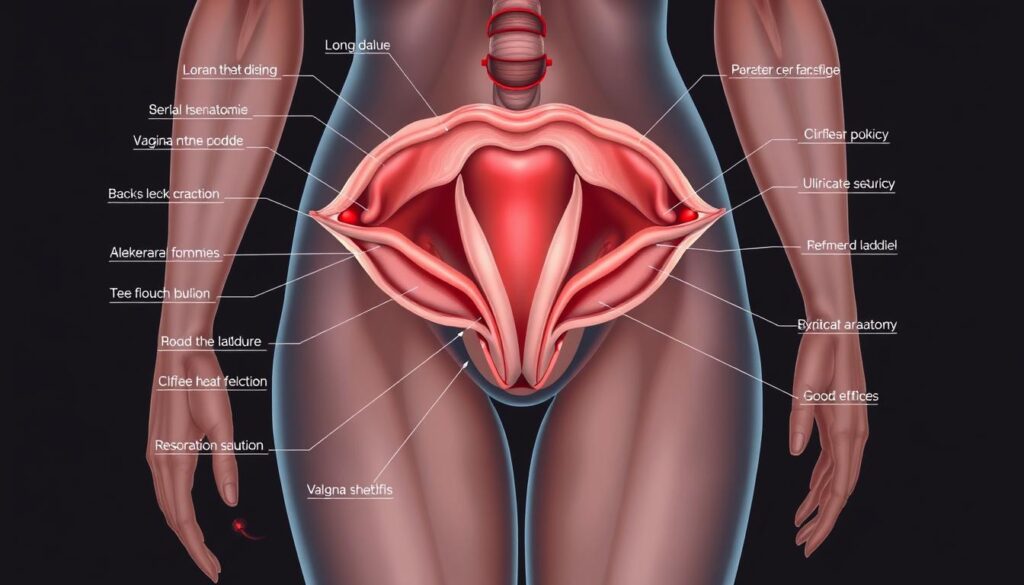
Human sexual anatomy is a captivating subject filled with intrigue. The G-spot’s existence and role are still debated by scientists1. Knowing your body’s erogenous zones is key to sexual awareness and enjoyment2.
Your sexual anatomy is unique, with personal variations in sensitive areas. The female reproductive system has many pleasure points, including the G-spot3. This sensitive region lies 5-8 cm inside the vagina on the front wall3.
Scientific studies continue to explore this fascinating aspect of sexual anatomy. The clitoris, both external and internal, is crucial for arousal and pleasure1. Most women achieve orgasms through clitoral stimulation1.
Key Takeaways
- The G-spot is located 5-8 cm inside the vagina
- Sexual anatomy varies between individuals
- Scientific research on the G-spot remains ongoing
- Clitoral stimulation is most common for orgasm
- Personal exploration is key to understanding sexual pleasure
Common Myths About the G-spot
Female genitalia often spark confusion in health talks. Let’s debunk some G-spot myths that puzzle many people.
Myth: The G-spot Doesn’t Exist
Studies show intriguing facts about the G-spot debate. 62.9% of women reported having a G-spot in self-awareness studies4. Many researchers discuss its nature.
84.3% believed in a sensitive area in the vagina4. Science has evolved on this topic.
A 2017 study suggested the G-spot is a complex network of tissues and nerves5. It’s part of the clitoral network, not a single structure.
Myth: It’s Only for Certain Women
Sensitivity varies among women. Here are some interesting findings:
- 65.9% of participants reported a more sensitive area in the vagina4
- 55.1% identified sensitivity in the anterior vaginal wall4
- Factors like education and sexual function index influence G-spot awareness4
Myth: Stimulating It Is Painful
The G-spot is part of the Clitourethrovaginal (CUV) Complex. This includes nerves, tissues, the clitoris, urethra, and anterior vaginal wall5.
Experts suggest gentle, targeted stimulation. The urethral sponge is the main erogenous zone. It responds best to steady pressure, not light touch5.
“The G-spot is less about a specific location and more about understanding your body’s unique responses.” – Sexual Health Expert
Understanding the G-spot
Human sexual anatomy offers fascinating insights into reproductive health and pleasure. The G-spot is a complex aspect of sexual experience. It varies greatly between individuals6.
What Exactly is the G-spot?
The G-spot is an erogenous zone on the vagina’s front wall. It’s usually 2-3 inches inside, near the belly button6. Its size, location, and sensitivity can differ for each person6.
Anatomical Insights
In sexual anatomy, the G-spot connects with other sensitive areas. The clitoris, with over 10,000 nerve endings, is crucial for sexual response6.
Understanding this network helps people explore their unique sexual anatomy.
Locating the G-spot
Finding the G-spot takes patience and exploration. Here are some tips:
- Use gentle pressure on the anterior vaginal wall
- Explore different angles and techniques
- Communicate with your partner about comfort and pleasure
“Sexual pleasure is a personal journey of discovery and understanding.”
Many find clitoral stimulation the most reliable way to orgasm6. External G-spot massage can work by pressing gently on the lower abdomen6.
Sexual experiences are deeply personal. What works for one might not work for another7. Research continues to explore female sexual anatomy’s complexities6.
Real Experiences and Evidence
Sexual anatomy offers fascinating insights into reproductive health. Female genital anatomy is more complex than commonly thought. Most vagina owners can’t reach orgasm through penetration alone, showing the intricate nature of sexual pleasure8.
The clitoris is a remarkable organ with 8,000 nerve endings. That’s twice the number found in the penis8. About 90% of the clitoris is hidden beneath the surface9.
It has two bulbs and two arms of erectile tissue. This makes it a complex structure worthy of study9.
Medical knowledge of female sexual health is still limited. Female sexual topics are often ignored in medical education. There’s only one specialized field for female sexual health, compared to 27 for men9.
This knowledge gap leads to misunderstandings about genital anatomy and sexual experiences10. Learning about sexual anatomy can be empowering. It helps challenge outdated ideas about human sexuality.
Accurate information and open talks about reproductive health are key. They promote a better understanding of sexual experiences10.
FAQ
What exactly is the G-spot?
The G-spot is an erogenous zone inside the vagina. It’s part of the internal clitoral network. This area can provide intense pleasure when stimulated during sexual activity.
Sensitivity varies from person to person. Many report heightened sensations when this spot is touched.
How deep is the vagina when not aroused?
An unaroused vagina is about 3.5 inches deep. Depth can vary based on age, weight, and menopause status.
During arousal, the vagina becomes more elastic. The cervix tilts upward, lengthening the vaginal canal.
What components make up the vulva?
The vulva is a complex external genital area. It includes the mons pubis, labia majora, labia minora, and clitoris.
Other parts are vestibular bulbs, vulva vestibule, and various glands. The clitoris has about 8,000 nerve endings and can become erect.
How does sexual anatomy vary among individuals?
Sexual anatomy is unique to each person. Most have either a penis and scrotum or a vulva.
Some people are intersex, with anatomy that doesn’t fit typical definitions. Gender identity may not always match assigned sex at birth.
What role do Bartholin’s and Skene’s glands play?
Bartholin’s glands secrete lubricating mucus for comfortable sex. Skene’s glands may have antimicrobial properties.
These glands contribute to female sexual anatomy’s complexity. Skene’s glands might be involved in female ejaculation.
Why is the brain considered the most important sex organ?
The brain controls sexual response, arousal, and pleasure. It processes sensory information and manages hormonal responses.
It interprets emotional and physical stimuli. The brain integrates and experiences sexual pleasure from various erogenous zones.
How do hormones affect vaginal health?
Estrogen is crucial for vaginal health. It influences tissues and cells that secrete fluids.
This hormone keeps vaginal walls moist, elastic, and healthy. Hormone levels impact lubrication and function throughout life stages.
Source Links
- Debunking the Myth: Exploring the Controversy Surrounding the G-Spot, A-Spot, and C-Spot | Sexual Health and Healing – https://sexualhealthandhealing.org/debunking-the-myth-exploring-the-controversy-surrounding-the-g-spot-a-spot-and-c-spot/
- The Female G-Spot: Facts, Myths, and More! – https://www.foriawellness.com/blogs/learn/female-g-spot
- G-spot – https://en.wikipedia.org/wiki/G-spot
- G-spot: Fact or Fiction?: A Systematic Review – https://pmc.ncbi.nlm.nih.gov/articles/PMC8498956/
- 6 G-Spot Myths Women Wish Men Would Stop Believing – https://medium.com/sexography/6-g-spot-myths-women-wish-men-would-stop-believing-c636ca20a211
- Locating and Stimulating the G-Spot – https://www.verywellhealth.com/where-is-the-g-spot-7564654
- The G-Spot: How to Find It (Diagram) & How To Stimulate It – https://www.naturalcycles.com/cyclematters/g-spot
- 23 Vagina Facts You’ll Want to Tell All Your Friends – https://www.healthline.com/health/womens-health/vagina-vulva-facts
- The Evolution of Female Anatomy – https://www.psychologytoday.com/intl/blog/the-human-beast/202211/the-evolution-female-anatomy
- Conceptual anatomy of the female genitalia using text mining and implications for patient care – https://mh.bmj.com/cgi/rapidpdf/medhum-2023-012747?ijkey=Gq0k50gRe6cGeyR&keytype=ref