
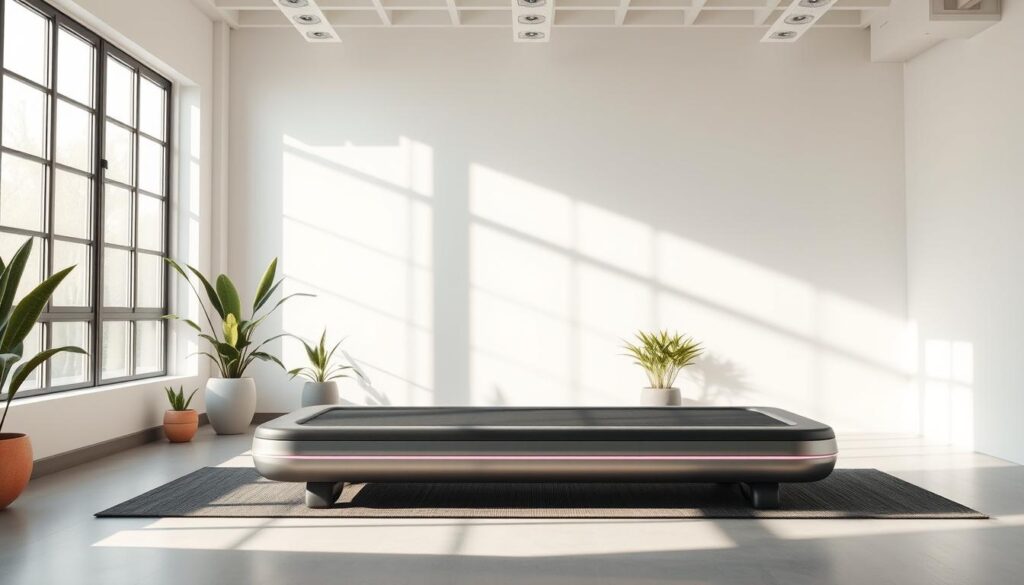
Vibration therapy is revolutionizing fitness and wellness. Whole-Body Vibration (WBV) boosts physical health in just 15 minutes daily. This innovative method could transform your fitness routine1.
WBV uses specialized platforms for rapid muscle contractions through oscillatory training. This technology may help with weight loss, flexibility, and muscle soreness reduction1.
Research suggests WBV could be a promising fitness tool. It may boost muscle strength when paired with a balanced diet1.
Vibration therapy stimulates muscles through controlled vibrations. It potentially offers benefits similar to traditional exercise.
Always consult a healthcare professional before starting a new fitness regimen. While beneficial, WBV isn’t suitable for everyone1.
Pregnant individuals and those with specific health conditions should be cautious.
Key Takeaways
- Whole-Body Vibration requires just 15 minutes, three times weekly
- Potential benefits include improved muscle strength and flexibility
- Combines innovative technology with fitness goals
- Requires medical consultation before starting
- Complementary to traditional exercise and diet
Understanding Whole-Body Vibration Technology
Whole-body vibration technology (WBVT) is a new fitness and rehab approach. It uses special equipment to send vibrations through your body2. This method taps into the power of biomechanical stimulation.
WBVT works by creating rhythmic neuromuscular stimulation. This triggers unique responses in your body. You can lay, sit, or stand on a vibrating platform during the exercise2.
How Vibration Platforms Work
Vibration platforms create fast oscillations. These cause your muscles to contract and relax automatically. The platforms have specific parts that make this happen.
- Frequency range: 15-70 hertz
- Amplitude: 1-10 millimeters
- Typical session duration: 15-20 minutes
Types of Vibration Training Equipment
There are two main types of whole-body vibration. These are for physiotherapy and fitness training. The equipment falls into two categories:
- Lineal vibration platforms
- Pivotal vibration platforms
Frequency and Amplitude Explained
Two key factors make whole-body vibration work: frequency and amplitude. Frequency determines the number of vibrations per second. Amplitude measures how strong these vibrations are.
| Vibration Type | Frequency Range | Typical Application |
|---|---|---|
| Low-Frequency | 15-30 Hz | Rehabilitation |
| High-Frequency | 30-70 Hz | Strength Training |
“Whole-body vibration is not just exercise; it’s a technological approach to stimulating your body’s natural responses.”
Studies on modern WBVT machines began about 15 years ago. Researchers are still exploring its potential benefits for various health issues2.
Health and Fitness Benefits of Vibration Training
Vibration training is a powerful fitness technique that can transform your workout routine. It offers more muscle activation and calorie burning in less time. Power Plate technology creates unique muscle engagement opportunities3.
Research has shown vibration training’s potential for body transformation and health improvement. It can significantly reduce body fat and activate up to 138% more muscle fibers43.
Vibration training may increase calorie burn by up to 50%3. Your body responds differently to this type of fitness. Rapid muscle contractions force constant engagement and relaxation, creating a unique training stimulus4.
“Vibration training offers a revolutionary approach to fitness that goes beyond traditional workout methods.”
This approach can improve muscle strength, balance, and overall physical performance. Research suggests potential benefits for blood circulation, bone mineral density, and muscle recovery.
Vibration training might also enhance cognitive function4. It offers a comprehensive approach to health and fitness.
Disclaimer: No major medical organization has provided definitive recommendations due to ongoing research4. Consult a healthcare professional before starting any new fitness regimen.
Whole-Body Vibration for Medical Conditions
Vibration therapy shows promise for managing various medical conditions. This innovative approach to exercise could benefit your health. Studies have explored how oscillatory training might impact different health issues.
Addressing Chronic Back Pain
Vibration therapy may offer relief for chronic back pain sufferers. It activates muscle fibers and helps stabilize lower back muscles. This technique can potentially reduce pain and improve overall back function.
- Reduces muscle tension
- Improves muscle stability
- Potentially decreases pain levels
Osteoporosis Management Strategies
Whole-body vibration presents an intriguing option for managing osteoporosis. Early studies show mixed results, but potential benefits exist5.
- Potential reduction in fall risk
- Possible improvements in bone density
- Enhanced muscle strength
Blood Pressure and Circulation Benefits
Vibration therapy might offer surprising cardiovascular advantages. Research suggests whole-body vibration could reduce arterial stiffness and improve blood circulation6. Overweight individuals might particularly benefit from these potential improvements5.
Carefully designed vibration interventions could provide rehabilitation opportunities for various medical conditions.
Before starting any new therapy, consult with healthcare professionals. They’ll ensure it’s appropriate for your specific health needs5.
Conclusion
Whole-body vibration therapy is an exciting new area in fitness and health research. Scientists are exploring its potential across various fields. Studies suggest vibration fitness could offer innovative ways to improve physical wellness78.
Research on whole-body vibration shows promising results for multiple health aspects. A review of 309 studies found significant potential in managing chronic low back pain8. Evidence from 821 participants indicates vibration therapy might benefit different age groups and health conditions8.
While exciting, whole-body vibration should be seen as a complementary technique. Always consult healthcare professionals about your personal health journey. WBV can enhance your fitness routine, but shouldn’t replace regular exercise and a balanced lifestyle97.
Whole-body vibration therapy blends innovation and wellness as scientific understanding grows. Stay informed and approach this technology with an open, critical mind. You might unlock its benefits for your personal health and fitness goals.
FAQ
What is Whole-Body Vibration (WBV)?
Whole-Body Vibration is a passive exercise using a machine with a vibrating platform. You stand, sit, or lie on it. The vibrations make your muscles contract and relax rapidly. This may offer benefits like improved strength, flexibility, and blood flow.
How does a Whole-Body Vibration platform work?
Vibration platforms work at 15-70 hertz frequencies and 1-10 millimeter amplitudes. Your body adapts to these quick oscillations automatically. This creates a light neuromuscular training effect, stimulating muscle activation.
What are the potential health benefits of Whole-Body Vibration?
WBV may improve muscle performance, bone density, strength, and balance. It could aid fat loss when combined with calorie restriction. The exercise might reduce muscle soreness and enhance flexibility.
WBV may also improve blood circulation. These benefits can vary based on individual factors.
How long are typical Whole-Body Vibration sessions?
Most WBV sessions last 15-20 minutes and are done three times a week. Duration and frequency can vary based on fitness goals and health conditions.
Can Whole-Body Vibration help with medical conditions?
Research suggests WBV may benefit certain conditions. It could improve chronic back pain by activating muscle fibers. For postmenopausal women, it might reduce fall risks.
Some improvements in circulation and blood pressure have been observed. Always consult a doctor before using WBV for medical purposes.
Is Whole-Body Vibration a replacement for traditional exercise?
No, WBV shouldn’t replace regular physical activity. It shows promising benefits but works best as a complement. Use it alongside a comprehensive fitness routine and healthy diet.
Are there any precautions I should take before trying Whole-Body Vibration?
Consult a healthcare professional before starting WBV, especially if pregnant, older, or with existing conditions. While generally safe, individual health circumstances can vary. Professional guidance is recommended for best results.
How does Whole-Body Vibration compare to walking in terms of calorie burning?
Studies show vibration plates burn calories similar to moderate-intensity walking. Results can vary based on individual factors and specific vibration training approaches. Combine WBV with other exercises for optimal fitness results.
Source Links
- Is whole-body vibration an effective workout? – https://www.mayoclinic.org/healthy-lifestyle/fitness/expert-answers/whole-body-vibration/faq-20057958
- Whole Body Vibration Therapy – https://sciencebasedmedicine.org/whole-body-vibration-therapy/
- The Top 5 Health Benefits of Vibration Plates | Power Plate – https://powerplate.com/pages/how-50-vibrations-per-second-can-unlock-multiple-health-benefits?srsltid=AfmBOoqjlmzvaRnLHJsol8HIGYGuUv-fRaT-x0EHIULTLQ0_J8M70o6Q
- Vibration Plates: Benefits and Exercises – https://www.webmd.com/fitness-exercise/vibration-plates
- Whole-Body Vibration and Rehabilitation of Chronic Diseases: A Review of the Literature – https://pmc.ncbi.nlm.nih.gov/articles/PMC3737877/
- Can Whole Body Vibration Be Harmful? – https://www.medicinenet.com/can_whole_body_vibration_be_harmful/article.htm
- Frontiers | Effects of whole-body vibration training on cognitive function: A systematic review – https://www.frontiersin.org/journals/human-neuroscience/articles/10.3389/fnhum.2023.854515/full
- Effects of whole-body vibration therapy on pain, functionality, postural stability, and proprioception in patients with subacute and chronic non-specific low back pain: a systematic review – Wiener Medizinische Wochenschrift – https://link.springer.com/article/10.1007/s10354-023-01026-4
- The Effects of Whole Body Vibration on Mobility and Balance in Parkinson Disease: a Systematic Review – https://pmc.ncbi.nlm.nih.gov/articles/PMC4100042/

