World War I, also known as the First World War or the Great War, was a global conflict. It lasted from July 28, 1914, to November 11, 1918. Most of the world’s great powers were involved, divided into two alliances: the Allies and the Central Powers1.
The war was fought on many fronts, including Europe, the Middle East, Africa, and Asia-Pacific. It resulted in over 9,000,000 fatalities, including both military and civilian deaths1. The conflict started after the assassination of Archduke Franz Ferdinand by Gavrilo Princip on June 28, 1914, in Sarajevo, Bosnia2.
The war involved many powers, including Austria-Hungary, Germany, Russia, France, Great Britain, Serbia, and the Ottoman Empire2. It lasted for 4 years, 3 months, and 14 days, from July 28, 1914, to November 11, 19181. The total estimated casualties were over 9,000,000 fatalities, including both military and civilian deaths1.
Key Takeaways
- World War I was a global conflict that lasted from July 28, 1914, to November 11, 1918.
- The war involved most of the world’s great powers, assembled in two opposing alliances: the Allies and the Central Powers.
- The conflict was fought on multiple fronts, including Europe, the Middle East, Africa, and Asia-Pacific.
- The war resulted in over 9,000,000 fatalities, including military and civilian deaths.
- The assassination of Archduke Franz Ferdinand by Gavrilo Princip triggered the start of World War I.
- The war involved multiple powers, including Austria-Hungary, Germany, Russia, France, Great Britain, Serbia, and the Ottoman Empire.
Overview of World War I
The early 20th century was filled with political and military tension in Europe. This led to World War One. The assassination of Archduke Franz Ferdinand by Gavrilo Princip in Sarajevo on June 28, 1914, sparked the war3.
This event caused a big diplomatic crisis. Austria-Hungary then sent an ultimatum to Serbia. The complex alliances pulled many countries into the war.
Key Events Leading to the War
Several key events led to WW1:
- Assassination of Archduke Franz Ferdinand
- The July Crisis and Austria-Hungary’s ultimatum to Serbia
- The formation of the Triple Entente and Triple Alliance
Major Players Involved
The war divided into two main sides:
- Allied Powers: France, United Kingdom, Russia, Italy, United States3
- Central Powers: Germany, Austria-Hungary, Ottoman Empire, Bulgaria
The Outbreak of Hostilities
The assassination set off a chain of war declarations. Austria-Hungary declared war on Serbia. Russia mobilized for Serbia, and Germany declared war on Russia. Germany also declared war on France and Belgium, drawing the United Kingdom into the fight3.
Theater of War
World War I was fought on many fronts around the world. Each front had its own challenges and strategies. Knowing about these fronts helps us understand the war’s complexity and its lasting effects.
Western Front: Tactics and Battles
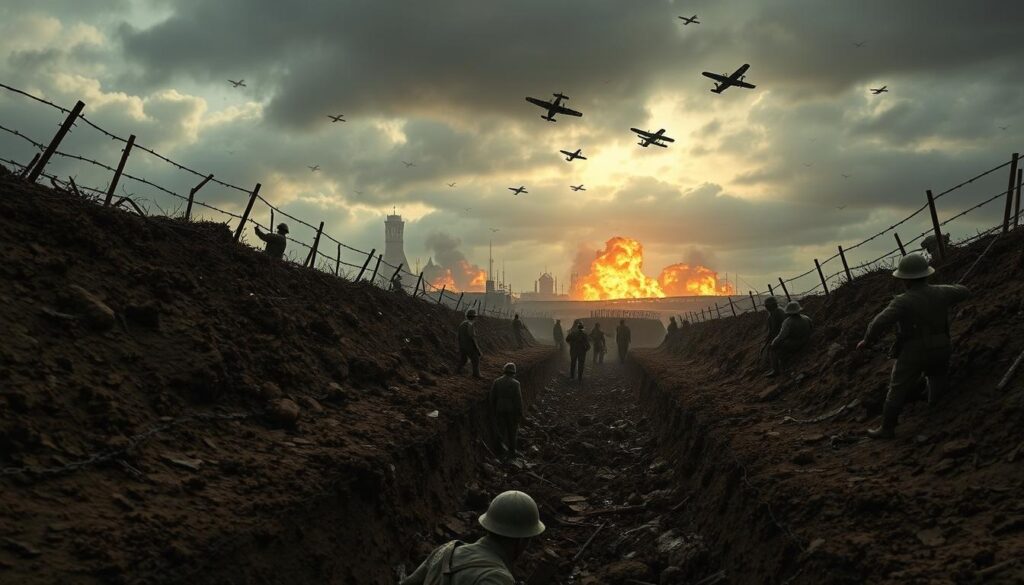
The Western Front is known for trench warfare. Soldiers faced harsh conditions and high casualties. Battles like Verdun, the Somme, and Passchendaele showed the war’s brutal nature4.
These battles were key to the war’s stalemate. They showed the war’s relentless nature.
Eastern Front: Challenges and Outcomes
The Eastern Front was more mobile than the Western Front. But it was just as brutal. Russia faced big challenges, like long distances and logistics, leading to its withdrawal in 19174.
Battles like Tannenberg and the Masurian Lakes showed the front’s chaotic nature.
Other Fronts: Africa and Asia
World War I also happened in Africa and Asia. These areas saw military actions that are often forgotten. The involvement of these regions made the war even bigger, affecting millions of lives.
Impact of World War I
World War I changed the world in big ways. It caused a lot of deaths and destruction. This led to big changes in society, economy, and politics.
Societal Changes Post-War
Women started working in big numbers after the war. This changed how people saw gender roles5. It also changed the class system in many countries.
- Increased workforce participation by women.
- Changes in family dynamics and societal expectations.
Economic Consequences and Recovery
The war cost a lot of money. Countries had to pay huge debts and work hard to recover5. Germany had to pay £6,600 million in damages, hurting its economy a lot6.
| Country | Economic Impact |
|---|---|
| Germany | £6,600 million in war damages6 |
| United Kingdom | Produced 2,600 tanks and saw 90% female workforce in munitions5 |
Political Repercussions: Treaty of Versailles
The Treaty of Versailles in 1919 had big effects. It made Germany pay a lot and changed Europe’s map56. These actions helped extremist groups rise, leading to World War II.
Legacy of World War I
World War I changed the face of modern warfare and left a lasting impact on the world. It changed how we remember history and view conflict today.
Influences on Modern Warfare
World War I brought new military technologies like tanks, airplanes, and chemical weapons. These changes shaped how wars are fought and how armies prepare for battle7.
Commemoration and Remembrance
Monuments and memorials, like the Thiepval Memorial in France, honor World War I’s fallen. It lists over 73,000 missing soldiers from the Battle of the Somme8. Events like Remembrance Day keep their memories alive for us today.
World War I in Popular Culture
World War I’s stories are seen in books, movies, and more. They show the deep human experiences and lasting effects of the war87.
FAQ
What are the different names used to refer to World War I?
World War I is also called the Great War, WWI, First World War, and World War 1. These names are used to talk about the global war from 1914 to 1918.
What triggered the outbreak of World War I?
The assassination of Archduke Franz Ferdinand of Austria-Hungary in June 1914 started World War I. This event led to a chain reaction of alliances being activated. It caused the major European powers to declare war.
Who were the major players in the First World War?
The war mainly involved the Allied Powers, like France, Britain, Russia, and the United States. They fought against the Central Powers, which included Germany, Austria-Hungary, the Ottoman Empire, and Bulgaria. These alliances shaped the war’s landscape.
What were the primary theaters of World War I?
The war was fought on several fronts, most famously the Western Front and the Eastern Front. There were also important fronts in Africa and Asia. These fronts involved colonial territories, affecting areas beyond Europe.
How did trench warfare shape the conflict?
Trench warfare was key on the Western Front, with long trenches across the landscape. This method led to long stalemates, high casualties, and great strain on soldiers. It changed military tactics and strategies.
What were some key battles of World War I?
The Battle of Verdun and the Battle of the Somme were major. They showed the brutal nature of trench warfare. They resulted in huge casualties, showing the war’s futility and devastation.
What were the economic consequences of the Great War?
The war had big economic impacts, like huge debts and trade disruptions. The war effort needed a lot of money, causing economic instability. This made recovery after the war hard.
How did the Treaty of Versailles affect post-WWI Europe?
The Treaty of Versailles put harsh penalties and reparations on Germany. This caused economic hardship and resentment. It helped rise nationalist movements and set the stage for World War II.
In what ways does World War I influence modern warfare?
World War I introduced new technologies and tactics, like tanks, airplanes, and chemical warfare. These innovations changed combat. They laid the groundwork for modern military strategy and tactics in future wars.
How is World War One commemorated today?
World War I is remembered through monuments, museums, and events like Remembrance Day or Veterans Day. These tributes honor those who served. They ensure the war’s lessons are remembered by future generations.
What is the legacy of the Great War in popular culture?
World War I’s legacy is seen in literature, film, and media. These works show the harsh experiences of soldiers and the war’s impact on society. They have shaped our understanding and memory of the war.
Can you provide a brief summary of the WWI timeline?
World War I started in 1914 with the assassination of Archduke Franz Ferdinand. It grew through alliances and battles across fronts. The war ended in 1918 with the Armistice. The Treaty of Versailles in 1919 officially ended the war between Germany and the Allied Powers.
Source Links
- World War I – https://en.wikipedia.org/wiki/World_War_I
- World War I: Summary, Causes & Facts | HISTORY – https://www.history.com/topics/world-war-i/world-war-i-history
- World War I | History, Summary, Causes, Combatants, Casualties, Map, & Facts | Britannica – https://www.britannica.com/event/World-War-I
- European theatre of World War I – https://en.wikipedia.org/wiki/European_theatre_of_World_War_I
- How did WW1 change the world? – https://www.bbc.co.uk/newsround/45966335
- The Impact of the First World War and Its Implications for Europe Today | Heinrich Böll Stiftung – https://www.boell.de/en/2014/07/08/impact-first-world-war-and-its-implications-europe-today
- First world war: 15 legacies still with us today – https://www.theguardian.com/world/2014/jan/15/firstworldwar
- The Long Legacy of World War I – https://origins.osu.edu/article/long-legacy-world-war-i