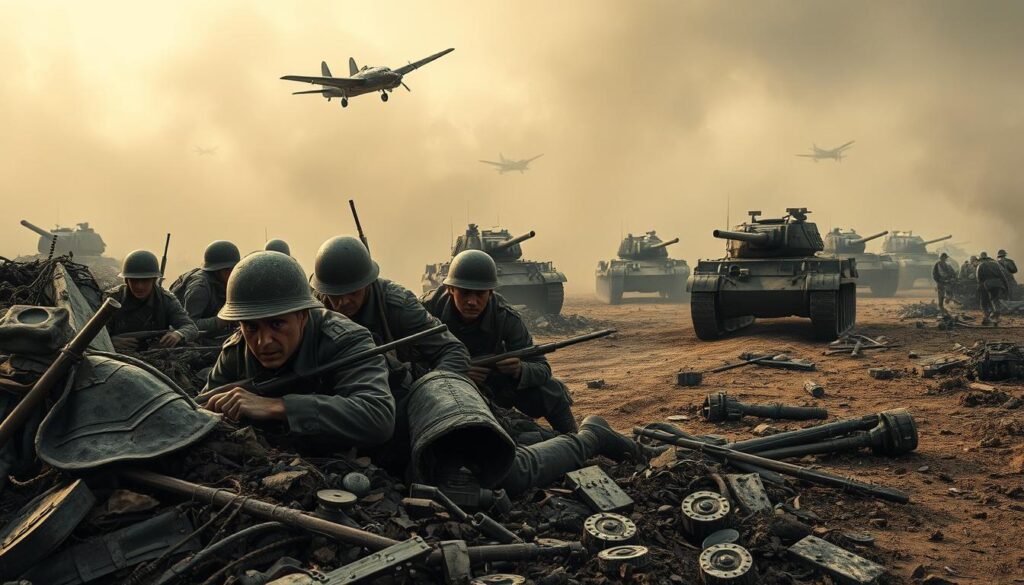
World War II, also known as the Second World War, lasted from 1939 to 1945. It was the deadliest war in history, with over 61,000,000 people killed1. Most of the world’s nations were involved, including Canada, China, France, Germany, India, Italy, Japan, Soviet Union, United Kingdom, and United States2.
The death toll was massive, ranging from 40,000,000 to 50,000,000. This makes it the bloodiest conflict in history2.
The war was between the Allies and the Axis powers. The Allies included France, Great Britain, the United States, the Soviet Union, and China. The Axis powers were Germany, Italy, and Japan2.
Germany’s invasion of Poland on September 1, 1939, started the war. Great Britain and France declared war on Germany on September 3, 19392. The Second World War had a huge impact on the world, shaping politics, economy, and society. It is a key part of modern history, with over 16,000,000 military dead1.
Exploring World War II, you might wonder how it started and its major consequences. Understanding these will help grasp the war’s significance and lasting impact. The total dead, including civilians and military, over 53,000,000, shows the war’s destructive power1.
Key Takeaways
- World War II was a global conflict that lasted from 1939 to 1945 and involved most of the world’s nations.
- The war resulted in a significant loss of life, with over 61,000,000 total dead1.
- The major participants involved in World War II included Canada, China, France, Germany, India, Italy, Japan, Soviet Union, United Kingdom, and United States2.
- The estimated death toll of World War II ranges from 40,000,000 to 50,000,000, making it the bloodiest conflict in history2.
- The war was fought between the Allies and the Axis powers, with the Allies emerging victorious2.
- The Second World War had a profound impact on the world, shaping global politics, economy, and society.
Background and Causes of World War II
The roots of World War 2 are deeply embedded in the unresolved tensions from the previous global conflict and the emergence of aggressive ideologies. Understanding these causes provides a clear view of how the world was pulled into another devastating war.
The Treaty of Versailles and Its Impact
The Treaty of Versailles, signed in 1919, imposed severe financial reparations and military limitations on Germany after World War I34. These conditions fostered a sense of humiliation and resentment among Germans. This laid the groundwork for future conflict.
The Rise of Totalitarian Regimes
In the 1930s, authoritarian regimes gained power as nations lost faith in liberal democracy3. Adolf Hitler and the Nazi Party seized totalitarian control in Germany in 1933. They advocated for the reversal of the Treaty of Versailles and promoted fascist ideologies4. Similar movements in Italy and Japan also pursued aggressive expansionist policies.
Economic Factors Leading to Conflict
The global economic crisis of the Great Depression created fertile ground for militarism and expansionism. Germany’s rearmament efforts strained its economy, leading to increased imports of raw materials4. Nazi Germany sought to occupy territories rich in resources to alleviate financial pressures. This further escalated tensions internationally.
| Key Event | Date | Impact |
|---|---|---|
| Treaty of Versailles Signed | June 28, 1919 | Imposed heavy reparations on Germany |
| Nazi Party Gains Power | 1933 | Adolf Hitler becomes Chancellor of Germany |
| Munich Agreement | 1938 | Allowed annexation of Sudetenland |
| Invasion of Poland | September 1, 1939 | Marked the beginning of WW2 |
Major Battles and Campaigns of World War II
World War II saw many key battles and campaigns that shaped its outcome. These fights showed how military tactics evolved and how nations persevered.
The Invasion of Poland and Blitzkrieg Tactics
Germany invaded Poland on September 1, 1939, and ended on September 7, 19395. They used Blitzkrieg, a fast and coordinated attack, to quickly defeat Polish defenses.
The Battle of Stalingrad: Turning Point in the East
The Battle of Stalingrad was a major fight on the Eastern Front, causing nearly 2 million casualties6. It was a turning point for Nazi Germany, as Soviet forces pushed them back.
D-Day: The Normandy Invasion
D-Day, the Allied invasion of Normandy, started on June 6, 19446. It was key in freeing Western Europe from Nazi control. The operation was a huge success, showing the strength of the Allies.
The Pacific Theater and Island Hopping Strategy
In the Pacific, the Allies used an island hopping strategy to move closer to Japan. The attack on Pearl Harbor on December 7, 1941, drew the United States into the war6. Over 2,400 Americans lost their lives in this attack.
The Aftermath and Legacy of World War II
World War II ended in 1945, marking a turning point for the world. It led to big changes that we see today.
The Formation of the United Nations
The war’s end brought a desire for peace and cooperation. So, the United Nations was formed. It aims to keep the world peaceful and united7.
The Cold War’s Emergence
After the war, the U.S. and the Soviet Union became the top powers. This led to the Cold War, a time of tension and competition7.
Impact on Global Politics and Economy
The Holocaust and the atomic bombings of Hiroshima and Nagasaki shocked the world. They showed the need for strong rules on human rights and nuclear weapons. These events greatly shaped our global politics and economy7.
FAQ
What were the main causes of World War II?
The main causes of World War II were many. The issues from World War I were not solved. The Treaty of Versailles was very harsh on Germany. This led to the rise of Nazi Germany and the Great Depression.
These factors made the world very unstable. This instability led to the start of the war.
How did the Treaty of Versailles contribute to the outbreak of World War II?
The Treaty of Versailles made Germany very unhappy. It forced them to pay a lot of money and lost a lot of land. This made many Germans very angry and poor.
Adolf Hitler and the Nazi Party used this anger to get power. Their aggressive actions started World War II.
What role did Nazi Germany play in the Second World War?
A: Nazi Germany, led by Adolf Hitler, was a key player in World War II. They invaded many countries and used Blitzkrieg tactics. They also carried out the Holocaust.
These actions greatly affected the war and caused a lot of harm.
How did the Great Depression influence the global conflict of WWII?
The Great Depression made the world very unstable. It led to more extreme politics and the rise of dictatorships. Countries in trouble turned to war to solve their problems.
This made the world even more tense and led to World War II.
What was the significance of the attack on Pearl Harbor?
The attack on Pearl Harbor by Imperial Japan was very important. It made the United States join the war. This changed the balance of power and helped the Allies win.
How did the Battle of Stalingrad impact the outcome of WWII?
The Battle of Stalingrad was a big turning point. The Soviet Union won, stopping Nazi Germany‘s advance. This victory started Germany’s decline and helped the Allies.
What was the strategic importance of D-Day during World War II?
A: D-Day was the Allied invasion of Normandy. It was very important for fighting Nazi Germany. It helped free Western Europe and was key to defeating the Axis powers.
What was the Holocaust and its impact on World War II?
The Holocaust was a genocide by Nazi Germany. It killed six million Jews and millions of others. It was one of the worst atrocities in history.
It changed how we think about human rights and remembering such tragedies.
How did the atomic bombings of Hiroshima and Nagasaki influence the end of WWII?
The atomic bombings of Hiroshima and Nagasaki ended the war. Japan surrendered without conditions. These bombings also started the nuclear age.
They changed international relations and military strategies in the Cold War.
What were the lasting impacts of World War II on global politics and economy?
A: World War II changed global politics a lot. It led to the United Nations and the rise of the United States and the Soviet Union. It also started the Cold War.
Economically, it ended European colonialism and made America strong. It also led to new technologies and industries that shape our world today.
Source Links
- World War II – https://en.wikipedia.org/wiki/World_War_II
- World War II | Facts, Summary, History, Dates, Combatants, & Causes | Britannica – https://www.britannica.com/event/World-War-II
- Causes of World War II – https://en.wikipedia.org/wiki/Causes_of_World_War_II
- The Causes of WWII – https://www.worldhistory.org/article/2409/the-causes-of-wwii/
- List of World War II battles – https://en.wikipedia.org/wiki/List_of_World_War_II_battles
- World War II Battles: Timeline | HISTORY – https://www.history.com/topics/world-war-ii/world-war-ii-battles-timeline
- Liberation and Legacy | The National WWII Museum | New Orleans – https://www.nationalww2museum.org/war/articles/liberation-and-legacy