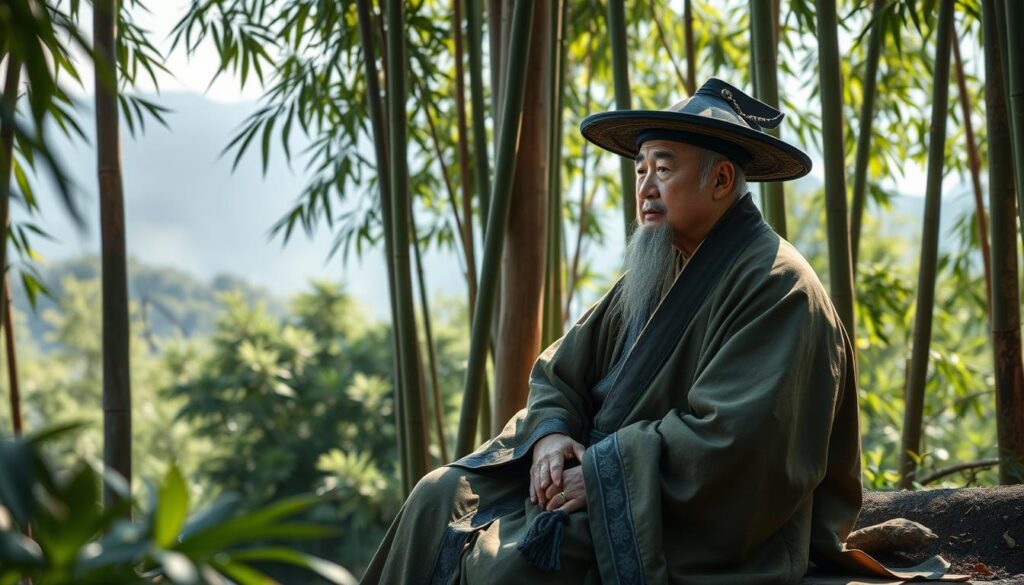
Confucius was a famous Chinese philosopher and teacher. He is seen as the top Chinese sage1. His teachings have greatly influenced Chinese philosophy and culture. They focus on personal and government morality, good social relationships, and a leader’s duty to lead with virtue1.
He started Confucianism, which has shaped East Asia’s intellectual and cultural life for ages. This makes him one of the most important figures in history.
Confucius lived from 551 to 479 B.C.E2. Back then, China had four main social classes: the noble/scholar elite, landowners/farmers, craftsmen, and merchants2. He was born around 551 BCE, when the Zhou polity’s power was fading3. His father came from Lu, a noble clan known for their modesty and ritual skills3.
Key Takeaways
- Confucius is a highly influential Chinese philosopher and teacher.
- His teachings emphasize personal and governmental morality, and a ruler’s responsibilities to lead by virtue1.
- Confucianism has had a profound impact on Chinese philosophy and culture2.
- Confucius lived during a time of social change and cultural evolution in China3.
- His ideas have shaped the intellectual and cultural life of East Asia for centuries.
- Confucius is considered a key figure in the development of Chinese thought and culture.
The Life and Times of Confucius
Confucius, a famous East Asian scholar, was born in 551 BCE in Lu, now Shandong province, China4. He lost his father soon after birth, starting his life in a humble shi (士) class position4. Despite these beginnings, he dedicated himself to education, setting the stage for his later contributions to the Confucian classics1.
Early Life and Education
Confucius came from the Kong family of Song, a once noble but now diminished lineage4. This background gave him a deep grasp of social order and the value of moral integrity1. His education was broad, covering many subjects that shaped his teachings in the Analects5.
Career and Political Involvement
In his early twenties, Confucius started his career in government, becoming Director of Public Works in 503 BCE and later Minister of Crime51. He managed law and order well but faced opposition from powerful families, leading to his resignation4. Seeking to apply his ideals, he spent 14 years in exile, traveling through various states4, promoting moral governance1.
Influence of Historical Context
Confucius lived when the Zhou dynasty was fading, a time of political turmoil and power fights4. This setting highlighted his belief in the power of moral influence over political might4. Inspired by figures like Zhougong, he stressed social harmony and the need for ethical leadership4. His teachings, compiled in the Analects, became key to Chinese education and state philosophy, forming the heart of the Confucian classics5.
Core Teachings of Confucius
Confucian teachings aim to create a harmonious society. They focus on personal virtue and the value of relationships. These teachings guide us in our daily lives and how we interact with others.
The Concept of Ren (Humaneness)
Ren, or humaneness, is at the heart of Confucian morality. It encourages us to be compassionate and empathetic towards others. This builds a community based on respect and kindness67.
By living with ren, we help the community. We follow the ethical standards Confucius taught.
Importance of Li (Ritual)
Li is about following proper conduct in life. Confucius thought that li could bring harmony and moral order to society68. Rituals show respect, keep traditions alive, and uphold ethical values in our community.
The Role of Filial Piety
Filial piety is key, showing respect and loyalty to parents and ancestors67. It strengthens family ties and passes on moral values to future generations. Confucius believed it was vital for personal growth and societal stability.
Legacy and Influence in Modern Society
Confucianism is a big part of East Asia’s social and cultural scenes today. Its teachings are a big part of daily life and how societies are set up.
Confucianism in East Asian Culture
Confucius’s teachings have shaped East Asian societies deeply. They influence family life and government policies. These teachings promote values like respect and harmony.
Confucius’s Impact on Education
Education in East Asia focuses on learning and self-improvement, following Confucian ideas. Schools focus on moral education and growing virtuous people. This creates a place where knowledge and ethics are valued9.
Contemporary Relevance of Confucian Ideals
In today’s world, Confucianism gives insights into business ethics and politics. Its ideas on kind leadership and social duty are important in modern governance and business9.
There’s also a growing interest in Confucian thought to tackle today’s moral and ethical issues. This philosophy keeps inspiring and guiding people and groups, showing it’s always relevant9.
FAQ
Who was Confucius and why is he significant in Chinese philosophy?
Confucius was a famous scholar and philosopher from ancient China. He lived during the Spring and Autumn Period. His teachings started Confucianism, which has shaped Chinese culture for over 2,000 years.
He is known as The Great Sage. Confucius focused on ethics and morality. He taught virtues like filial piety and humaneness.
What are the core teachings of Confucianism?
Confucianism centers on key concepts. Ren, or “humaneness,” is the highest virtue. Li, or ritual propriety, keeps society in harmony and order.
It also values filial piety, showing respect to parents and ancestors. These teachings are found in the Analects, a key source of Confucian philosophy.
What is the significance of the Analects in understanding Confucianism?
The Analects are sayings and ideas from Confucius and his followers. It was compiled after his death. This text is the heart of Confucian classics.
It gives insights into Confucius’s views on governance, morality, education, and personal conduct. The Analects are vital for understanding Confucianism’s lasting impact.
How did Confucius influence education in East Asia?
Confucius’s impact on education in East Asia is huge. He believed in accessible education and moral development. He taught that learning should lead to virtuous leadership.
His ideas have shaped education in China, Korea, and Japan. They emphasize continuous learning, self-improvement, and the ethical duties of educators and students.
What role does filial piety play in Confucian ethics?
Filial piety is key in Confucian ethics. It involves deep respect, loyalty, and care for parents and ancestors. This virtue helps maintain social harmony and stability.
It encourages individuals to fulfill their duties and obligations. Filial piety strengthens family bonds and respect between generations, essential for moral integrity and societal order.
In what ways is Confucianism relevant in today’s society?
Confucianism is relevant today by guiding ethics and promoting harmony. Its principles shape modern business ethics, political philosophy, and social norms in both East Asia and the West.
Confucian ideals like humaneness, ritual propriety, and filial piety offer insights for today’s challenges. They help foster respectful relationships and encourage responsible leadership.
Source Links
- https://en.wikipedia.org/wiki/Confucius – Confucius
- https://education.nationalgeographic.org/resource/confucianism/ – Confucianism
- https://plato.stanford.edu/entries/confucius/ – Confucius
- https://www.britannica.com/biography/Confucius – Confucius | Biography, Teachings, & Facts | Britannica
- https://www.worldhistory.org/Confucius/ – Confucius
- https://www.thechairmansbao.com/blog/introduction-to-confucius-and-teachings/ – An Introduction to Confucius and His Teachings | The Chairman’s Bao
- https://raider.pressbooks.pub/chineseculture/chapter/1-confucius-and-confucianism/ – 1. Confucius and Confucianism
- https://iep.utm.edu/confucius/ – Confucius | Internet Encyclopedia of Philosophy
- https://shaolin-kungfu.com/confucianism-in-china/ – Confucianism In China: A Deep Dive Into Its Legacy And Influence – Maling Shaolin Kung Fu Academy