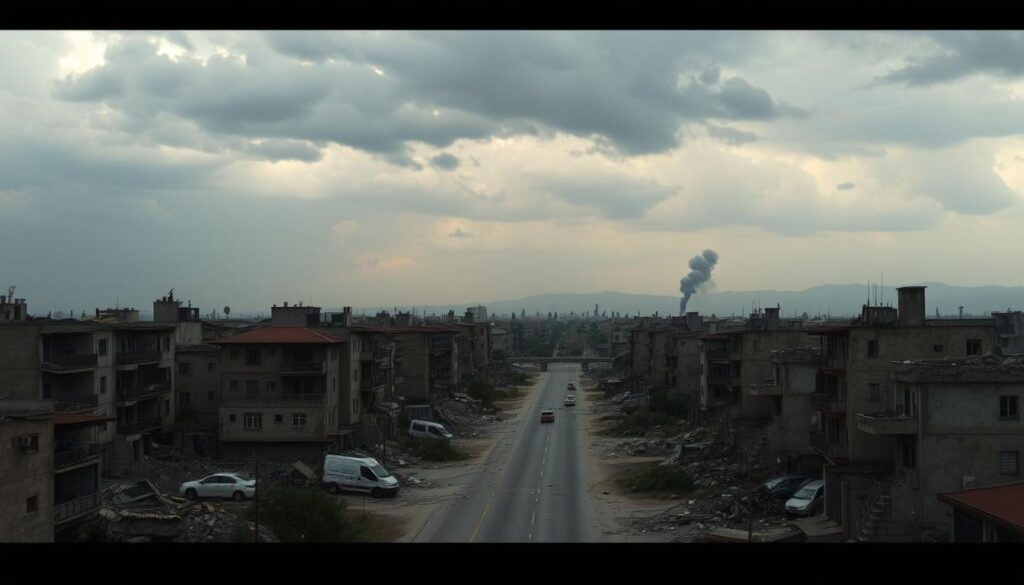
The War in Syria started in March 2011, part of the Arab Spring protests. It quickly turned into a full-scale civil war1. The fight began with protests against President Bashar al-Assad’s rule. It has deeply affected Syria and the world.
The war has caused a lot of suffering. It’s estimated that between 580,000 to 617,910+ people have died2. Also, 6.7 million people are displaced inside Syria, and 6.6 million have left the country2.
The War in Syria is a complex and ongoing issue. It affects Syria, the Middle East, and the world. It’s caused by political, economic, and environmental problems.
The conflict involves groups like the Free Syrian Army and the Islamic State1. It has also drawn support from Iran, Russia, and Hezbollah1.
Key Takeaways
- The War in Syria began in March 2011 as part of the Arab Spring protests.
- The conflict has resulted in significant human suffering, including estimated total deaths and displaced people.
- The Syrian civil war has involved key participants, including the Free Syrian Army and the Islamic State in Iraq and the Levant.
- International powers such as Iran, Russia, and Hezbollah have supported the Syrian government throughout the conflict.
- The conflict has had a profound impact on the country and the world, with far-reaching implications for the Middle East and global stability.
Overview and Background of the Conflict
The Syria crisis started with deep political and economic issues. A key event was in Daraa, where peaceful protests began after teenagers were arrested for writing on a school wall. The government’s tough response made things worse, leading to a big rebellion.
Origins of the Syrian Civil War
The trouble in Daraa was made worse by a long drought from 2006 to 2010. This drought hurt rural areas and pushed people to cities, making poverty worse3. The Assad regime’s strict rule, corruption, and favoritism also made many Syrians unhappy and want change.
Key Players Involved
The war has many groups, like the Assad government, the Free Syrian Army, and extremist groups like Jabhat al-Nusra and ISIS3. Countries like Iran, Russia, Turkey, and the United States also play big roles. They support different sides, making the Middle East conflict even harder4.
Timeline of Major Events
| Year | Event |
|---|---|
| 2011 | Protests begin in Daraa, escalating into civil war |
| 2013 | Use of chemical weapons prompts international response |
| 2015 | Peak of European migrant crisis with 1.3 million Syrians seeking asylum |
| 2018 | Over one million people remain in besieged areas |
| 2023 | Ongoing conflicts with no clear resolution in sight |
Knowing these details helps us understand the Syrian conflict’s complexity. It shows how hard it is to find peace.
Humanitarian Impact and Crisis
The ongoing conflict in Syria has caused a huge humanitarian crisis. It has affected millions of lives and destabilized the region. The scale of displacement and the severity of living conditions are big challenges for Syrians and neighboring countries.
Displacement and Refugee Crisis
Nearly 14 million people have been forced to leave their homes. This has created one of the largest refugee crises globally5. Turkey alone hosts nearly 3 million Syrian refugees, showing the war’s wide impact5. As of 2024, an estimated 16.7 million people in Syria need humanitarian aid, a 9% increase from last year5.
Human Rights Violations
The war has seen many human rights violations. This includes the use of chemical weapons against civilians and attacks on medical facilities6. Hospitals in Syria have been attacked, reducing patient consultations and damaging medical infrastructure6. Mental health support is critical as people face prolonged conflict and natural disasters6.
Access to Aid and Services
Getting to essential services is hard due to damaged infrastructure. Families often use expensive water delivery systems because clean water and sanitation are scarce6. Organizations like World Vision have helped over 2.3 million people in 2023, focusing on children and families5.
| Category | Statistics |
|---|---|
| Total Displaced | Over 14 million from 20115 |
| Internally Displaced | 7.2 million expected by 20257 |
| Refugees in Turkey | Nearly 3 million5 |
| Children Needing Aid | Approximately 7.5 million5 |
| Humanitarian Aid Needed | 16.7 million in 20245 |
| Hospital Attacks | Numerous incidents reducing medical services6 |
International Response and Involvement
The Middle East conflict in Syria has caught the world’s eye. Many countries are trying to help, each with their own plans and goals.
Role of the United Nations
The United Nations plays a key role in trying to bring peace and help those affected. They work on peace talks and help get aid to those in need.
Intervention by Foreign Powers
Foreign powers have made the Syrian conflict even more complicated. Russia and Iran support the Assad regime with military and financial help8. The United States, Turkey, and Gulf states back the opposition, trying to shape the conflict’s future8.
Sanctions and Diplomatic Efforts
Sanctions have been placed on the Assad regime for human rights abuses and using chemical weapons9. Diplomats are working hard to find a solution, but political differences slow them down.
| Aspect | Details |
|---|---|
| United Nations | Mediates peace talks and coordinates humanitarian aid |
| Russia and Iran | Support the Assad regime with military and financial aid8 |
| United States and Allies | Back opposition groups to counter the Assad regime’s influence8 |
| Sanctions | Imposed on Assad regime for human rights abuses and chemical weapons use9 |
Current Situation and Future Prospects
Syria is a complex mix of different groups controlling various areas. Even though the Assad regime was overthrown, peace is hard to find10. The SDF and Free Syrian Army control big parts of the country, making it hard to rebuild and govern.
Ongoing Conflicts and Tensions
The Middle East conflict is ongoing, with violence and disputes over land. Groups fight for power, making peace seem far away. Creating a single government is tough because of the many interests of both inside and outside players11.
Peace Talks and Resolution Efforts
Recent talks aim to unite different groups under a UN plan. These efforts are key to stopping more violence and helping Syria move towards peace and rebuilding1011.
Long-term Implications for the Region
The future of Syria will affect the whole Middle East. Factors like politics, economy, and social healing are important for stability. Help from the international community and smart diplomacy are needed to guide Syria towards peace12.
FAQ
What triggered the War in Syria?
The War in Syria started in 2011 with the Arab Spring protests. People began to protest against President Bashar al-Assad’s rule. The protests turned into a civil war due to political issues, economic problems, and a severe drought from 2006 to 2010.
Who are the key players involved in the Syrian conflict?
The Syrian conflict has many players. The Assad regime, opposition groups like the Free Syrian Army, and international powers are involved. Russia and Iran support Assad, while the U.S., Turkey, and Gulf states back the opposition. This makes Syria a battleground for global interests.
How has the Syrian refugee crisis impacted the region and the world?
The Syrian refugee crisis is huge, with millions displaced. It has put a lot of pressure on nearby countries and affected the world. The crisis shows the need for international help and better refugee policies.
What role has the United Nations played in the Syrian Civil War?
The United Nations has tried to bring peace and help Syrians. But, disagreements among countries have made it hard. The UN keeps working to help and find a solution to the conflict.
What are the major human rights violations reported during the War in Syria?
The War in Syria has seen many human rights abuses. These include using chemical weapons, attacking civilians, and hitting medical places. These actions have made the crisis worse and shown the human cost of the war.
How have international sanctions and diplomatic efforts influenced the Syrian conflict?
Sanctions and diplomacy have shaped the Syrian conflict. Sanctions on Assad and diplomatic efforts have had mixed results. The complex interests and alliances in the Middle East have made it hard to find a solution.
What is the current state of the War in Syria and what are the prospects for peace?
The latest news from Syria shows the conflict is ongoing. Despite some progress, peace talks face challenges. Achieving lasting peace is hard due to many interests and alliances. The future for Syria involves dealing with these issues and rebuilding the country.
How has the War in Syria affected global politics?
The War in Syria has changed global politics. It has become a key issue in international power struggles. The conflict has also shown the difficulty in solving big humanitarian crises through diplomacy.
What are the long-term implications of the Syrian Civil War for the Middle East?
The Syrian Civil War has big implications for the Middle East. It has led to ongoing instability and changes in power. For Syria to recover, it needs to address economic and social issues.
Source Links
- Syrian Civil War | Syrian history | Britannica – https://www.britannica.com/event/Syrian-Civil-War
- Syrian civil war – https://en.wikipedia.org/wiki/Syrian_civil_war
- Syria’s War and the Descent Into Horror – https://www.cfr.org/article/syrias-civil-war
- The Syrian Conflict Explained – ShelterBox – https://shelterbox.org/where-we-work/syria/conflict/
- Syrian refugee crisis: Facts, FAQs, and how to help – https://www.worldvision.org/refugees-news-stories/syrian-refugee-crisis-facts
- Syria Humanitarian Crisis – Center for Disaster Philanthropy – https://disasterphilanthropy.org/disasters/syria-humanitarian-crisis/
- Syria situation – https://reporting.unhcr.org/operational/situations/syria-situation
- Foreign involvement in the Syrian civil war – https://en.wikipedia.org/wiki/Foreign_involvement_in_the_Syrian_civil_war
- Conflict in Syria | Global Conflict Tracker – https://www.cfr.org/global-conflict-tracker/conflict/conflict-syria
- What Future for Syria? – https://www.gmfus.org/news/what-future-syria
- Where Syria goes next after the fall of Assad – https://www.atlanticcouncil.org/blogs/menasource/syria-next-assad-hts/
- Syria’s Civil War Gives Way to the Post-Assad Era – https://www.worldpoliticsreview.com/the-syria-civil-war-might-be-ending-but-the-crisis-will-live-on/