
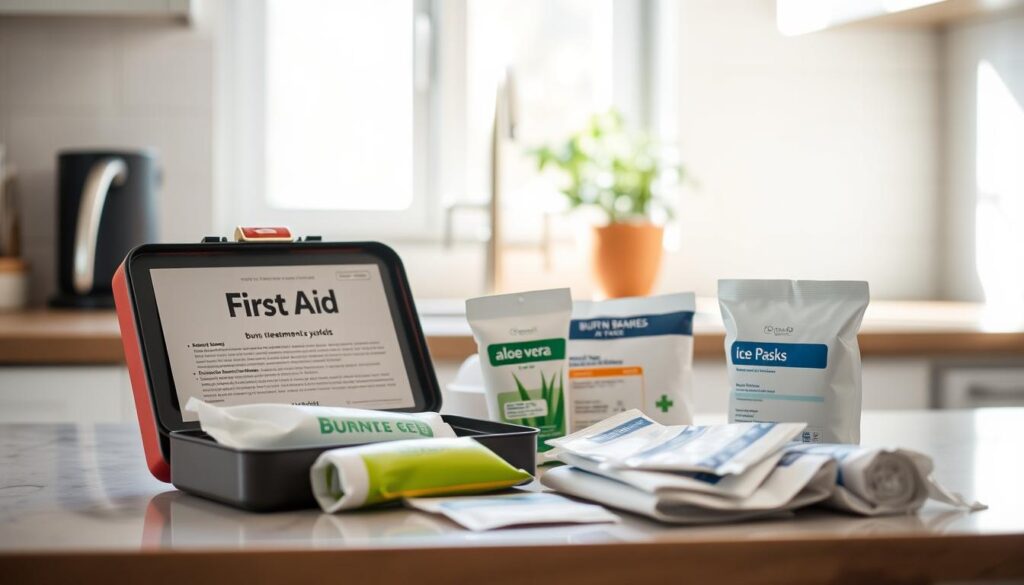
Burns are common thermal injuries that can occur unexpectedly in various settings. Children are especially at risk from hot drinks and microwaved foods1. Quick action can prevent further damage and speed up healing.
Every household should know burn prevention and fire safety skills. Proper first aid steps can greatly impact recovery for minor kitchen scaldings or small thermal injuries2.
Minor burns can often be treated at home with care. However, severe burns require immediate medical attention1. Your swift response can help reduce pain and potential complications.
Key Takeaways
- Learn to distinguish between minor and serious burn injuries
- Understand immediate first aid techniques for burns
- Know when to seek professional medical help
- Practice fire safety and burn prevention strategies
- Recognize the importance of proper wound care
Understanding Different Types of Burns
Burns vary in severity and impact. Knowing burn types helps recognize risks and determine proper treatment. Understanding these injuries is crucial for effective care.
https://www.youtube.com/watch?v=Dsvtzwp4nG8
First-Degree Burns: Surface-Level Damage
First-degree burns affect only the top skin layer. These superficial injuries cause mild redness, minor swelling, and slight pain.
Basic home care usually manages these burns. They typically heal within days without significant scarring3.
Second-Degree Burns: Deeper Skin Damage
Second-degree burns go deeper into skin layers. They present more challenges for burn rehabilitation4.
- Intense redness
- Painful blisters
- Significant swelling
When Burns Require Emergency Care
Some burns need immediate medical attention. Seek emergency care for burns that are:
- Larger than your palm
- Caused by chemicals or electricity
- Showing signs of shock
- Located on sensitive areas like hands, feet, face, or joints4
“Understanding burn severity can be life-saving and critical for proper treatment and recovery.”
Burns can lead to serious complications. These may include skin grafts and long-term scars. Children under 4 and adults over 60 face higher risks due to their more delicate skin4.
Burn treatment is complex. Professional medical evaluation prevents long-term damage. It also ensures proper rehabilitation3.
Immediate First Aid Steps for Burns
Quick and proper burn treatment can make a big difference in healing. Your fast response can help reduce pain and prevent complications5.
For minor burns, follow these key first aid steps:
- Cool the burn immediately under cold running water for 20 minutes5
- Remove any tight jewelry or clothing near the burned area before swelling occurs
- Apply a gentle moisturizing lotion with aloe vera to prevent skin drying
- Use sterile gauze to loosely cover the burn6
Pain control is crucial in burn care. You can take over-the-counter pain relievers like acetaminophen or ibuprofen6.
Check the burn’s severity before treating it. This will help you decide the best course of action.
| Burn Type | Characteristics | First Aid Approach |
|---|---|---|
| Minor Burns | Less than 3 inches, surface redness | Cool water, gentle coverage |
| Major Burns | Over 3 inches, deep tissue damage | Immediate medical attention |
Avoid these common mistakes during burn treatment:
- Never break blisters
- Do not apply ice directly
- Avoid using butter or creams
- Do not remove clothing stuck to the burn5
For expert advice on burn care, check out the Red Cross first aid resources. They offer detailed burn care instructions7.
“Quick action can prevent further injury and promote faster healing.”
Conclusion
Quick, informed responses to burns can greatly impact healing and prevent complications8. Proper burn management involves immediate treatment and ongoing care9. Understanding burn care is crucial for protecting yourself and your loved ones.
Fire safety starts with awareness and preparation. Children under five and adults over 55 are more prone to severe burns. Their thinner skin makes them more vulnerable10.
Install smoke detectors and keep flammable items away from heat sources. Create emergency evacuation plans for your home. These steps can help prevent dangerous situations.
Carefully assess burn severity if an injury occurs. Seek medical help for burns not healing within two weeks. After healing, protect the area with daily moisturizer.
Shield healed burns from sun exposure for 6-12 months. Your proactive approach can significantly reduce risks and promote better healing. Stay informed and prepared to handle burn emergencies effectively.
FAQ
What are the different types of burns?
Burns come in three main types. First-degree burns affect only the top skin layer. They cause redness and pain. Second-degree burns go deeper and cause blisters and intense pain.
Third-degree burns are the most serious. They need immediate medical care. First-degree burns heal within a week. Second-degree burns may take longer to heal.
How long should I cool a minor burn?
Cool a minor burn under cool running water for 10 minutes. This reduces pain and swelling. It also prevents further tissue damage. If water isn’t available, use a cool, wet cloth.
Don’t use ice. It can harm sensitive skin.
When should I seek medical help for a burn?
Seek immediate medical help if the burn is:
– Larger than 3 inches in diameter
– Deep or affects multiple skin layers
– On sensitive areas like face, hands, feet, or joints
– Caused by electrical or chemical sources
– Showing signs of infection
– Affecting children or older adults
How do I dress a minor burn?
To dress a minor burn:
– Use sterile non-stick gauze
– Apply aloe vera or moisturizing lotion
– Loosely bandage the burn
– Change the dressing every 3-5 days
– Avoid breaking blisters
– Keep the burn area clean
What should I avoid when treating a burn?
When treating a burn, avoid:
– Using ice directly on the burn
– Breaking blisters
– Applying butter, oil, or home remedies
– Removing clothing stuck to the burn
– Using cotton balls or fluffy materials
– Applying adhesive bandages directly to the burn
How long does a minor burn take to heal?
First-degree burns typically heal within 3-7 days. Second-degree burns may take 2-3 weeks to heal completely. Protect the area from sun exposure during healing.
Keep the burn moisturized. If it hasn’t healed within two weeks, see a doctor.
What pain relief can I use for burns?
For minor burns, use over-the-counter pain relievers like acetaminophen or ibuprofen. Apply a cool compress and aloe vera to reduce pain and swelling.
If pain is severe or lasts long, ask your doctor about other options.
Source Links
- First aid for burns – https://www.mayoclinic.org/first-aid/first-aid-burns/basics/art-20056649
- Burns and scalds – Treatment – https://www.nhs.uk/conditions/burns-and-scalds/treatment/
- Burns and Wounds – https://www.hopkinsmedicine.org/health/conditions-and-diseases/burns
- Burns: MedlinePlus Medical Encyclopedia – https://medlineplus.gov/ency/article/000030.htm
- Burns and scalds – https://www.nhsinform.scot/illnesses-and-conditions/injuries/skin-injuries/burns-and-scalds/
- First Aid with Burns: Proper Response and Treatment – https://www.healthline.com/health/first-aid-with-burns
- Burns: Types, Symptoms, and How To Help | Red Cross – https://www.redcross.org/take-a-class/resources/learn-first-aid/burns?srsltid=AfmBOor2Un40jafMXMYwbWGklN705r1r54DHFPJepeCM59aeBLAJbVGA
- Burn Basic First Aid: When to Seek Medical Help – https://www.aksharhospitals.com/blog/the-importance-of-burn-first-aid-when-to-seek-medical-help
- Burn Resuscitation and Management – StatPearls – https://www.ncbi.nlm.nih.gov/books/NBK430795/
- Assessment and classification of burn injury – https://www.uptodate.com/contents/assessment-and-classification-of-burn-injury/print

